334 posters, 125 sessions, 831 authors, 236 institutions
ePostersLive by SciGen Technologies S.A. All rights reserved.
78th Annual PostGraduate Assembly in Anesthesiology (PGA78) 2024
December 6 - 9, 2024 | New York City

4084
A Survey-Based Investigation into Patient Experience with Dexamethasone as an Adjunct to Peripheral Nerve Block
Part of Topic
A Survey-Based Investigation into Patient Experience with Dexamethasone as an Adjunct to Peripheral Nerve Block
Venod Narine, M.D., Jacob Abulencia MS3, Mia Renna
Background
- Arthroscopic shoulder surgeries utilize interscalene brachial plexus blocks as anesthetics for post-operative pain control (Image 1).
- A drawback of interscalene brachial plexus blocks is their short duration of analgesia (Holland et al.).
- The anti-inflammatory effects of the corticosteroid dexamethasone makes it a frequently utilized adjuvant to peripheral nerve blocks to extend their analgesic effects (Sakae et al.).
- Multiple studies have investigated the efficacy of dexamethasone as either a perineural or intravenous adjuvant to peripheral nerve blocks.
- Holland et al.: randomized controlled trial, no conclusive results
- Sakae et al.: randomized controlled trial, perineural administration more effective
- Albrecht et al.: systematic review with meta-analysis, intravenous administration more effective
- Tan, Tan, and Liu.: systematic review with meta-analysis, perineural administration more effective
- The purpose of this study was to evaluate the effectiveness of perineural and intravenous dexamethasone adjuvants in prolonging post-operative analgesia of brachial plexus blockades in adult patients undergoing shoulder arthroscopy with a combined peripheral nerve block and monitored anesthesia care technique.
Methods
- Inclusion Criteria
- Patients undergoing shoulder arthroscopy with combined peripheral nerve block and anesthesia care technique at an outpatient surgery center
- Exclusion Criteria
- Patients with a history of diabetes mellitus
- Patients weighing less than 60 kg or greater than 100 kg
- Peripheral Nerve Block
- 15 cc 0.5% ropivacaine, 5 cc 0.5% bupivacaine, 5 cc 2% lidocaine, 50 mcg epinephrine
- Variable and Control Groups
- Group A: variable, 5 mg perineural dexamethasone
- Group B: variable, 5 mg intravenous dexamethasone
- Group C: control, received only peripheral nerve block
- Gender and age distributions were recorded for each group [Figure 1]
- Data Collection
- Questionnaire given at discharge and filled out with each patient over the phone 24-72 hours after their procedures
- Recorded Data Points
- Duration of block (minutes)
- Level of pain first felt
- Thoughts on block duration
- Level of satisfaction with the block
- Opinion toward having another nerve block with the next procedure (Yes/No)
- Data Analysis
- Block durations for all three groups were analyzed via one-way ordinary ANOVA
- Block durations between pairs were each analyzed via Unpaired Parametric T-Test, other recorded data points were analyzed via Fisher’s Exact test
Results
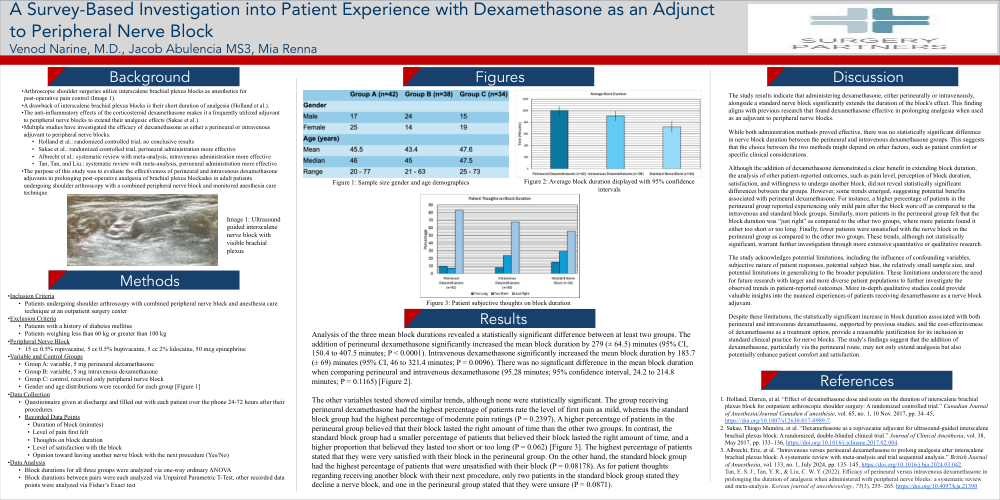
Analysis of the three mean block durations revealed a statistically significant difference between at least two groups. The addition of perineural dexamethasone significantly increased the mean block duration by 279 (± 64.5) minutes (95% CI, 150.4 to 407.5 minutes; P < 0.0001). Intravenous dexamethasone significantly increased the mean block duration by 183.7 (± 69) minutes (95% CI, 46 to 321.4 minutes; P = 0.0096). There was no significant difference in the mean block duration when comparing perineural and intravenous dexamethasone (95.28 minutes; 95% confidence interval, 24.2 to 214.8 minutes; P = 0.1165) [Figure 1, Figure 2].
The other variables tested showed similar trends, although none were statistically significant. The group receiving perineural dexamethasone had the highest percentage of patients rate the level of first pain as mild, whereas the standard block group had the highest percentage of moderate pain ratings (P = 0.2397). A higher percentage of patients in the perineural group believed that their block lasted the right amount of time than the other two groups. In contrast, the standard block group had a smaller percentage of patients that believed their block lasted the right amount of time, and a higher proportion that believed they lasted too short or too long (P = 0.062). The highest percentage of patients stated that they were very satisfied with their block in the perineural group. On the other hand, the standard block group had the highest percentage of patients that were unsatisfied with their block (P = 0.08178). As for patient thoughts regarding receiving another block with their next procedure, only two patients in the standard block group stated they decline a nerve block, and one in the perineural group stated that they were unsure (P = 0.0871) [Figure 1].
Discussion
The study results indicate that administering dexamethasone, either perineurally or intravenously, alongside a standard nerve block significantly extends the duration of the block's effect. This finding aligns with previous research that found dexamethasone effective in prolonging analgesia when used as an adjuvant to peripheral nerve blocks.
While both administration methods proved effective, there was no statistically significant difference in nerve block duration between the perineural and intravenous dexamethasone groups. This suggests that the choice between the two methods might depend on other factors, such as patient comfort or specific clinical considerations.
Although the addition of dexamethasone demonstrated a clear benefit in extending block duration, the analysis of other patient-reported outcomes, such as pain level, perception of block duration, satisfaction, and willingness to undergo another block, did not reveal statistically significant differences between the groups. However, some trends emerged, suggesting potential benefits associated with perineural dexamethasone. For instance, a higher percentage of patients in the perineural group reported experiencing only mild pain after the block wore off as compared to the intravenous and standard block groups. Similarly, more patients in the perineural group felt that the block duration was “just right” as compared to the other two groups, where more patients found it either too short or too long. Finally, fewer patients were unsatisfied with the nerve block in the perineural group as compared to the other two groups. These trends, although not statistically significant, warrant further investigation through more extensive quantitative or qualitative research.
The study acknowledges potential limitations, including the influence of confounding variables, subjective nature of patient responses, potential subject bias, the relatively small sample size, and potential limitations in generalizing to the broader population. These limitations underscore the need for future research with larger and more diverse patient populations to further investigate the observed trends in patient-reported outcomes. More in-depth qualitative studies could provide valuable insights into the nuanced experiences of patients receiving dexamethasone as a nerve block adjuvant.
Despite these limitations, the statistically significant increase in block duration associated with both perineural and intravenous dexamethasone, supported by previous studies, and the cost-effectiveness of dexamethasone as a treatment option, provide a reasonable justification for its inclusion in standard clinical practice for nerve blocks. The study's findings suggest that the addition of dexamethasone, particularly via the perineural route, may not only extend analgesia but also potentially enhance patient comfort and satisfaction.