334 posters, 125 sessions, 831 authors, 236 institutions
ePostersLive by SciGen Technologies S.A. All rights reserved.
78th Annual PostGraduate Assembly in Anesthesiology (PGA78) 2024
December 6 - 9, 2024 | New York City

4078
The Impact of Tricuspid Valve Regurgitation on Mortality and Heart Failure Progression Post-Cardiac Defibrillator Implantation
Poster Presenter
Part of Topic
Title: The Impact of Tricuspid Valve Regurgitation on Mortality and Heart Failure Progression Post-Cardiac Defibrillator Implantation
Authors: Emily MacDonald, MS-4, Adam Abbas, MS-4, Boris Borovcanin, MD, Nader Nader, MD, PhD, FACC, FCCP
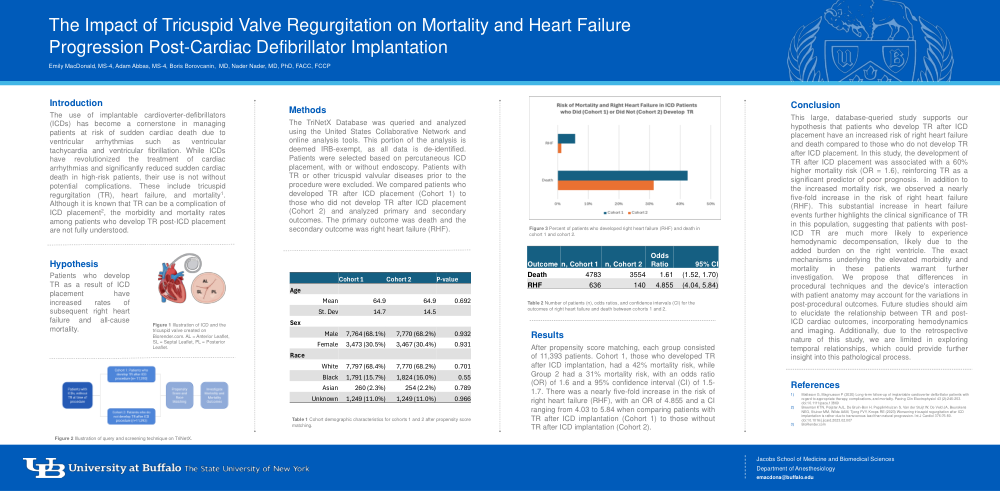
Introduction: The use of implantable cardioverter-defibrillators (ICDs) has become a cornerstone in managing patients at risk of sudden cardiac death due to ventricular arrhythmias such as ventricular tachycardia and ventricular fibrillation. While ICDs have revolutionized the treatment of cardiac arrhythmias and significantly reduced sudden cardiac death in high-risk patients, their use is not without potential complications. These include tricuspid regurgitation (TR), heart failure, and mortality1. Although it is known that TR can be a complication of ICD placement2, the morbidity and mortality rates among patients who develop TR post-ICD placement are not fully understood.
Hypothesis: Patients who develop TR as a result of ICD placement have increased rates of subsequent right heart failure and all-cause mortality.
Methods: The TriNetX Database was queried and analyzed using the United States Collaborative Network and online analysis tools. This portion of the analysis is deemed IRB-exempt, as all data is de-identified. Patients were selected based on percutaneous ICD placement, with or without endoscopy. Patients with TR or other tricuspid valvular diseases prior to the procedure were excluded. We compared patients who developed TR after ICD placement (Cohort 1) to those who did not develop TR after ICD placement (Cohort 2) and analyzed primary and secondary outcomes. The primary outcome was death and the secondary outcome was right heart failure (RHF).
Results: After propensity score matching, each group consisted of 11,393 patients. Cohort 1, those who developed TR after ICD implantation, had a 42% mortality risk, while Group 2 had a 31% mortality risk, with an odds ratio (OR) of 1.6 and a 95% confidence interval (CI) of 1.5-1.7. There was a nearly five-fold increase in the risk of right heart failure (RHF), with an OR of 4.855 and a CI ranging from 4.03 to 5.84 when comparing patients with TR after ICD implantation (Cohort 1) to those without TR after ICD implantation (Cohort 2).
Conclusion: This large, database-queried study supports our hypothesis that patients who develop TR after ICD placement have an increased risk of right heart failure and death compared to those who do not develop TR after ICD placement. In this study, the development of TR after ICD placement was associated with a 60% higher mortality risk (OR = 1.6), reinforcing TR as a significant predictor of poor prognosis. In addition to the increased mortality risk, we observed a nearly five-fold increase in the risk of right heart failure (RHF). This substantial increase in heart failure events further highlights the clinical significance of TR in this population, suggesting that patients with post-ICD TR are much more likely to experience hemodynamic decompensation, likely due to the added burden on the right ventricle. The exact mechanisms underlying the elevated morbidity and mortality in these patients warrant further investigation. We propose that differences in procedural techniques and the device's interaction with patient anatomy may account for the variations in post-procedural outcomes. Future studies should aim to elucidate the relationship between TR and post-ICD cardiac outcomes, incorporating hemodynamics and imaging. Additionally, due to the retrospective nature of this study, we are limited in exploring temporal relationships, which could provide further insight into this pathological process.
References: 1)Mattsson G, Magnusson P (2020) Long-term follow-up of implantable cardioverter defibrillator patients with regard to appropriate therapy, complications, and mortality. Pacing Clin Electrophysiol 43 (2):245-253. doi:10.1111/pace.13869 2)Breeman KTN, Peijster AJL, De Bruin-Bon H, Pepplinkhuizen S, Van der Stuijt W, De Veld JA, Beurskens NEG, Stuiver MM, Wilde AAM, Tjong FVY, Knops RE (2023) Worsening tricuspid regurgitation after ICD implantation is rather due to transvenous lead than natural progression. Int J Cardiol 376:76-80. doi:10.1016/j.ijcard.2023.02.007 3)BioRender.com