334 posters, 125 sessions, 831 authors, 236 institutions
ePostersLive by SciGen Technologies S.A. All rights reserved.
78th Annual PostGraduate Assembly in Anesthesiology (PGA78) 2024
December 6 - 9, 2024 | New York City

4075
A retrospective single-center observational study: iron deficiency in pediatric heart surgery and its impact on severe postoperative morbidity.
Poster Presenter
Part of Topic
A retrospective single-center observational study: iron deficiency in pediatric heart surgery and its impact on severe postoperative morbidity.
A. Vermoezen1, A; Willems2, JF. Fils3, T. Tuna1, D. Schmartz1
H.U.B – Hôpital Universitaire des Enfants, Dpt of Anesthesiology (1), Dpt of pediatric intensive care (2), Brussels, Belgium; 3 Ars Statistica, Nivelles, Belgium
Anemia is a major challenge as 40% of the children aged between 6 and 59 months are anemic worldwide, according to the WHO. In children, the main cause of anemia remains dietary iron deficiency.1
Congenital heart surgery represents many anesthetic challenges, as it is known to be associated with important blood loss and anemia (2). Hemoglobin levels and the occurrence of anemia are crucial in anesthetic strategies during pediatric heart surgery, as anemia generates multiple risks. There is no clear evidence or recommendation on preoperative iron supplementation for pediatric cardiac surgical patients, as there is a lack of literature about preoperative iron management in pediatric heart surgery.
This study is a single-center retrospective study conducted at the H.U.B. – HUDERF “Hôpital Universitaire des Enfants Reine Fabiola”, a tertiary pediatric university hospital in Brussels. The study was approved by the local ethics committee on the 2nd of February 2024 and registered at Clinical Trials registration (NCT06276608). Files of the patients who underwent cardiac surgery at HUDERF under CPB between Jan 1, 2022, and December 31, 2023, were analyzed.
Outcomes
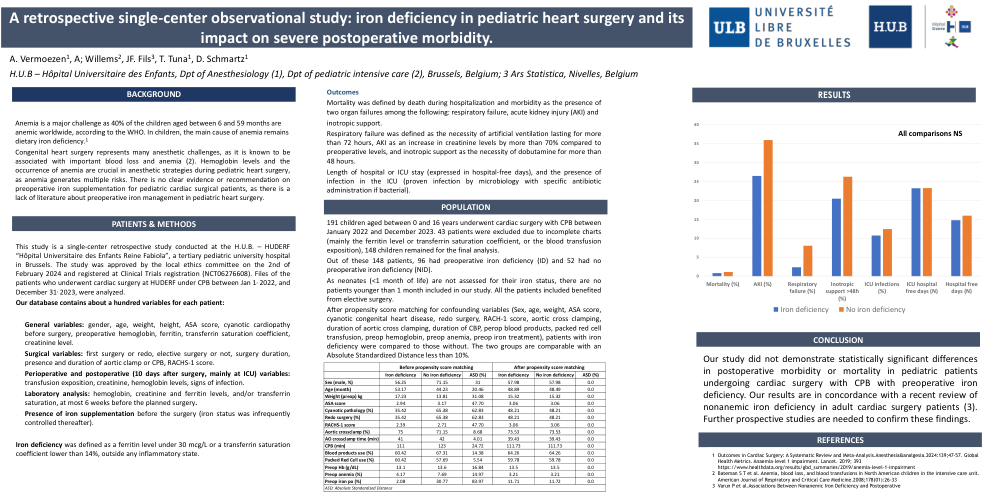
Mortality was defined by death during hospitalization and morbidity as the presence of two organ failures among the following: respiratory failure, acute kidney injury (AKI) and
inotropic support.
Respiratory failure was defined as the necessity of artificial ventilation lasting for more than 72 hours, AKI as an increase in creatinine levels by more than 70% compared to preoperative levels, and inotropic support as the necessity of dobutamine for more than 48 hours.
Length of hospital or ICU stay (expressed in hospital-free days), and the presence of infection in the ICU (proven infection by microbiology with specific antibiotic administration if bacterial).
191 children aged between 0 and 16 years underwent cardiac surgery with CPB between January 2022 and December 2023. 43 patients were excluded due to incomplete charts (mainly the ferritin level or transferrin saturation coefficient, or the blood transfusion exposition), 148 children remained for the final analysis.
Out of these 148 patients, 96 had preoperative iron deficiency (ID) and 52 had no preoperative iron deficiency (NID).
As neonates (<1 month of life) are not assessed for their iron status, there are no patients younger than 1 month included in our study. All the patients included benefited from elective surgery.
After propensity score matching for confounding variables (Sex, age, weight, ASA score, cyanotic congenital heart disease, redo surgery, RACH-1 score, aortic cross clamping, duration of aortic cross clamping, duration of CBP, perop blood products, packed red cell transfusion, preop hemoglobin, preop anemia, preop iron treatment), patients with iron deficiency were compared to those without. The two groups are comparable with an Absolute Standardized Distance less than 10%.
Conclusion:
Our study did not demonstrate statistically significant differences in postoperative morbidity or mortality in pediatric patients undergoing cardiac surgery with CPB with preoperative iron deficiency. Our results are in concordance with a recent review of nonanemic iron deficiency in adult cardiac surgery patients (3). Further prospective studies are needed to confirm these findings.