334 posters, 125 sessions, 831 authors, 236 institutions
ePostersLive by SciGen Technologies S.A. All rights reserved.
78th Annual PostGraduate Assembly in Anesthesiology (PGA78) 2024
December 6 - 9, 2024 | New York City

4074
Safety, Efficacy, and Ease of Insertion of a Novel Polyvinyl Chloride Designed Gnana Laryngeal Airway: A Prospective Clinical Study in GI Patients
Poster Presenter
Authors
Matthew Fredericks, Shahab Ahmadzadeh, William T. Barham, James Ilochi, Landyn Johnson, Sahar Shekoohi
Affiliations
St. George's University School of Medicine, SGUSOM, Louisiana State University Health Sciences Center at Shreveport, Louisiana State University School of Medicine New Orleans, Louisiana State University School of Medicine Shreveport
Part of Topic
The Effectiveness of the Gnana Laryngeal Mask Airway II (GLA-II) With Novel Suction Tubing in Gastrointestinal (GI) Cases
Shahab Ahmadzadeh, MD; Landyn D. Johnson, BS; William T. Barham, BS; James Ilochi, BS; Matthew Fredericks, BS; Sahar Shekoohi, Ph.D.; Alan D. Kaye, MD, Ph.D.
Department of Anesthesiology, LSU Health Shreveport
INTRODUCTION
The Laryngeal Mask Airway (LMA) has emerged as an alternative to an endotracheal tube (ETT) for the management of routine and emergent airways. The LMA device attaches to the respiratory tract at the level of the hypopharynx, rather than traversing the vocal folds to rest in the trachea, which has been shown in clinical practice to decrease hoarseness, coughing, sore throat, as well as laryngospasm. LMAs exhibit efficacy in both routine clinical practice and urgent situations-where securing an airway is time sensitive, or to allow for adequate ventilation for difficult intubations bridging to endotracheal intubation.
The second generation Gnana Laryngeal Airway 4 (GLA-4) is made of silicone while the GLA-II is made of polyvinyl chloride. These both have a suction tube incorporated into the dorsal part of the cuff of the laryngeal mask to remove any liquids in the hypopharynx. This study aims to expand the evaluation of the second generation GLA-II, and to determine its effectiveness and tolerability.
MATERIALS & METHODS
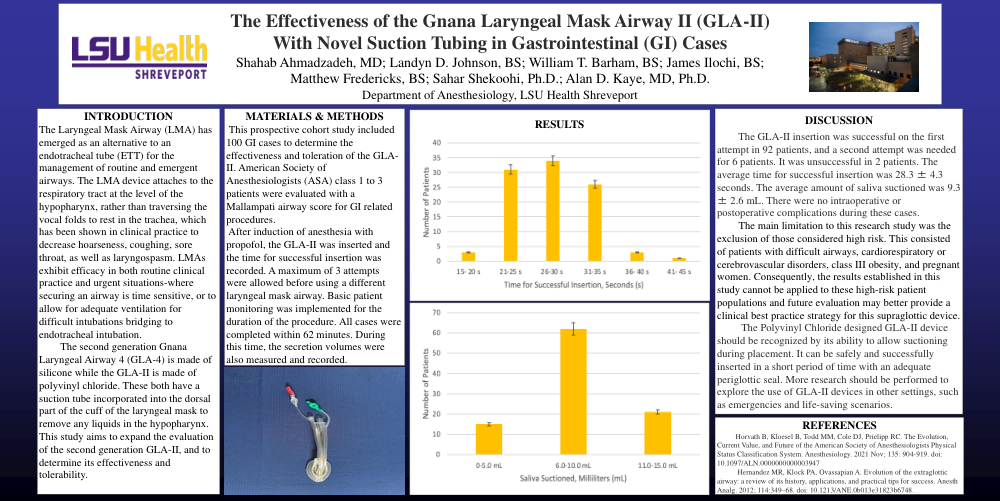
This prospective cohort study included 100 GI cases to determine the effectiveness and toleration of the GLA-II. American Society of Anesthesiologists (ASA) class 1 to 3 patients were evaluated with a Mallampati airway score for GI related procedures.
After induction of anesthesia with propofol, the GLA-II was inserted and the time for successful insertion was recorded. A maximum of 3 attempts were allowed before using a different laryngeal mask airway. Basic patient monitoring was implemented for the duration of the procedure. All cases were completed within 62 minutes. During this time, the secretion volumes were also measured and recorded.
DISCUSSION
The GLA-II insertion was successful on the first attempt in 92 patients, and a second attempt was needed for 6 patients. It was unsuccessful in 2 patients. The average time for successful insertion was 28.3 ± 4.3 seconds. The average amount of saliva suctioned was 9.3 ± 2.6 mL. There were no intraoperative or postoperative complications during these cases.
The main limitation to this research study was the exclusion of those considered high risk. This consisted of patients with difficult airways, cardiorespiratory or cerebrovascular disorders, class III obesity, and pregnant women. Consequently, the results established in this study cannot be applied to these high-risk patient populations and future evaluation may better provide a clinical best practice strategy for this supraglottic device.
The Polyvinyl Chloride designed GLA-II device should be recognized by its ability to allow suctioning during placement. It can be safely and successfully inserted in a short period of time with an adequate periglottic seal. More research should be performed to explore the use of GLA-II devices in other settings, such as emergencies and life-saving scenarios.
REFERENCES
Horvath B, Kloesel B, Todd MM, Cole DJ, Prielipp RC. The Evolution, Current Value, and Future of the American Society of Anesthesiologists Physical Status Classification System. Anesthesiology. 2021 Nov; 135: 904-919. doi: 10.1097/ALN.0000000000003947
Hernandez MR, Klock PA, Ovassapian A. Evolution of the extraglottic airway: a review of its history, applications, and practical tips for success. Anesth Analg. 2012; 114:349–68. doi: 10.1213/ANE.0b013e31823b6748.