334 posters, 125 sessions, 831 authors, 236 institutions
ePostersLive by SciGen Technologies S.A. All rights reserved.
78th Annual PostGraduate Assembly in Anesthesiology (PGA78) 2024
December 6 - 9, 2024 | New York City

4072
Risk and Predictability for Sepsis in Patients Receiving Mechanical Circulatory Support
Poster Presenter
Authors
Kelsey Gore, Joshua Baguley, Junxi Bragg, Cortland Kolesnikowicz, Dean Linder, Juan Martinez Duque, Bobby Nossaman
Affiliations
Part of Topic
Risk and Predictability for Sepsis in Patients receiving Mechanical Circulatory Support
Kelsey Gore, BS, RRT, Dean Linder, Jr., CCP, LP, Juan José Martinez Duque, MD, Junxi Bragg, BS, Joshua Baguley, BS,
Cortland Kolesnikowicz, BS, Brett Wester, DO, Shaun Yockelson, MD, Manila Singh, MD, Adrian Alexis Ruiz, MD, and Bobby D. Nossaman, MD
Ochsner Health, 1514 Jefferson Hwy, New Orleans, Louisiana 70121
Introduction:
Patients receiving mechanical circulatory support (MCS) risk development of sepsis.1,2Examining risk factors for the development of sepsis and their relationships to MCS may allow improved understanding of these complications.3-4
Methods:
Following institutional review board approval, patient characteristics, previously reported comorbidities and the incidence sepsis were studied in 199 patients who required 244 MCS devices from January 2017 to October 2023.1-4The clinical variables underwent machine learning analysis.5Significant comorbidities from the ensemble models predicting sepsis subsequently underwent decision-tree analysis.6
Matthews Correlation Coefficient was calculated for the decision-tree analysis used in this cohort of patients. JMP Pro® 18.0 was used for all statistical analyses.
Results:
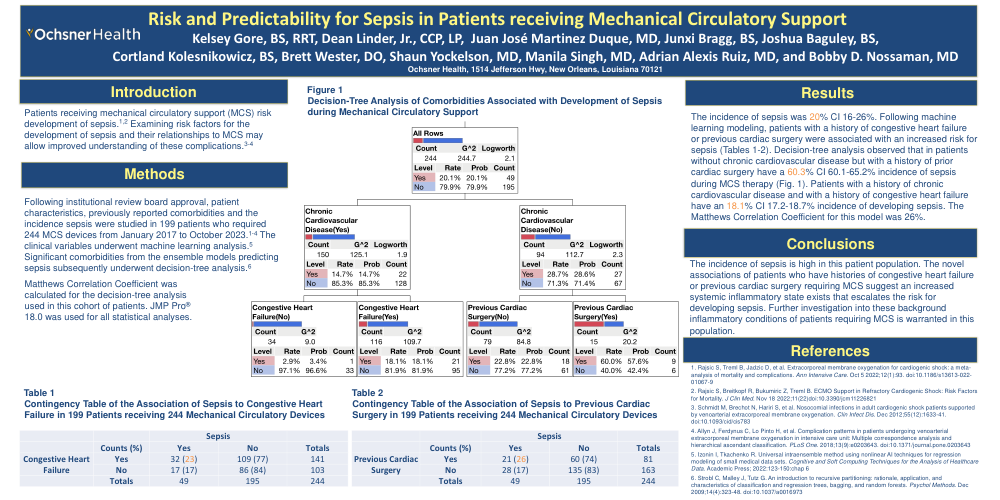
The incidence of sepsis was 20% CI 16-26%. Following machine learning modeling, patients with a history of congestive heart failure or previous cardiac surgery were associated with an increased risk for sepsis (Tables 1-2). Decision-tree analysis observed that in patients without chronic cardiovascular disease but with a history of prior cardiac surgery have a 60.3% CI 60.1-65.2% incidence of sepsis during MCS therapy (Fig. 1). Patients with a history of chronic cardiovascular disease and with a history of congestive heart failure have an 18.1% CI 17.2-18.7% incidence of developing sepsis. The Matthews Correlation Coefficient for this model was 26%.
Conclusions:
The incidence of sepsis is high in this patient population. The novel associations of patients who have histories of congestive heart failure or previous cardiac surgery requiring MCS suggest an increased systemic inflammatory state exists that escalates the risk for developing sepsis. Further investigation into these background inflammatory conditions of patients requiring MCS is warranted in this population.
References:
1. Rajsic S, Treml B, Jadzic D, et al. Extracorporeal membrane oxygenation for cardiogenic shock: a meta-analysis of mortality and complications. Ann Intensive Care. Oct 5 2022;12(1):93. doi:10.1186/s13613-022-01067-9
2. Rajsic S, Breitkopf R, Bukumiric Z, Treml B. ECMO Support in Refractory Cardiogenic Shock: Risk Factors for Mortality. J Clin Med. Nov 182022;11(22)doi:10.3390/jcm11226821
3. Schmidt M, Brechot N, Hariri S, et al. Nosocomial infections in adult cardiogenic shock patients supported by venoarterial extracorporeal membrane oxygenation. Clin Infect Dis. Dec 2012;55(12):1633-41. doi:10.1093/cid/cis783
4. Allyn J, Ferdynus C, Lo Pinto H, et al. Complication patterns in patients undergoing venoarterialextracorporeal membrane oxygenation in intensive care unit: Multiple correspondence analysis and hierarchical ascendant classification. PLoS One. 2018;13(9):e0203643. doi:10.1371/journal.pone.0203643
5. Izonin I, Tkachenko R. Universal intraensemblemethod using nonlinear AI techniques for regression modeling of small medical data sets. Cognitive and Soft Computing Techniques for the Analysis of Healthcare Data. Academic Press; 2022:123-150:chap 6
6. Strobl C, Malley J, Tutz G. An introduction to recursive partitioning: rationale, application, and characteristics of classification and regression trees, bagging, and random forests. Psychol Methods. Dec 2009;14(4):323-48. doi:10.1037/a0016973