Loading...

334 posters, 125 sessions, 831 authors, 236 institutions

ePostersLive by SciGen Technologies S.A. All rights reserved.

4070

Review of the Anesthetic Management of Patients with Post-Polio Syndrome
Part of Topic

INTRODUCTION 

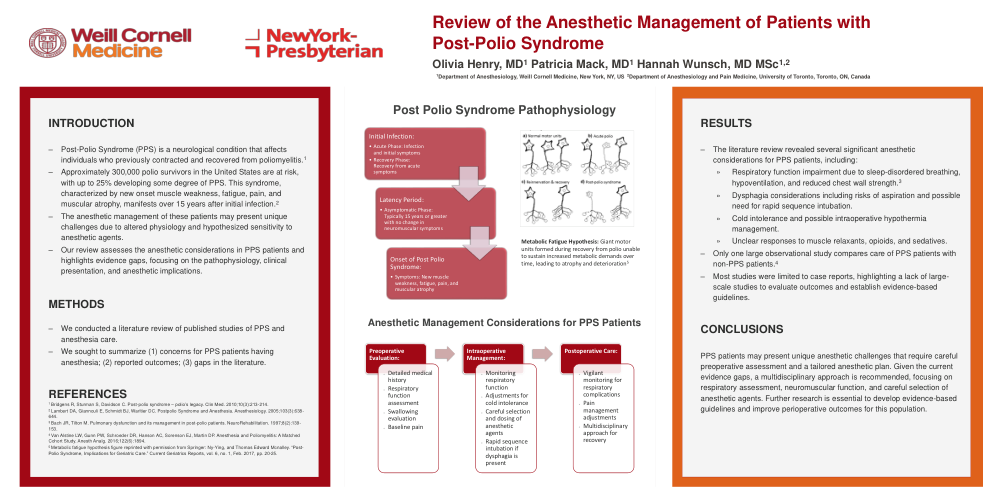
–Post-Polio Syndrome (PPS) is a neurological condition that affects individuals who previously contracted and recovered from poliomyelitis.1
–Approximately 300,000 polio survivors in the United States are at risk, with up to 25% developing some degree of PPS. This syndrome, characterized by new onset muscle weakness, fatigue, pain, and muscular atrophy, manifests over 15 years after initial infection.2
–The anesthetic management of these patients may present unique challenges due to altered physiology and hypothesized sensitivity to anesthetic agents.
–Our review assesses the anesthetic considerations in PPS patients and highlights evidence gaps, focusing on the pathophysiology, clinical presentation, and anesthetic implications.


METHODS

–We conducted a literature review of published studies of PPS and anesthesia care.
–We sought to summarize (1) concerns for PPS patients having anesthesia; (2) reported outcomes; (3) gaps in the literature.
 

RESULTS

–The literature review revealed several significant anesthetic considerations for PPS patients, including:
»Respiratory function impairment due to sleep-disordered breathing, hypoventilation, and reduced chest wall strength.3
»Dysphagia considerations including risks of aspiration and possible need for rapid sequence intubation.
»Cold intolerance and possible intraoperative hypothermia management.
»Unclear responses to muscle relaxants, opioids, and sedatives.
–Only one large observational study compares care of PPS patients with non-PPS patients.4
–Most studies were limited to case reports, highlighting a lack of large-scale studies to evaluate outcomes and establish evidence-based guidelines.


CONCLUSIONS

PPS patients may present unique anesthetic challenges that require careful preoperative assessment and a tailored anesthetic plan. Given the current evidence gaps, a multidisciplinary approach is recommended, focusing on respiratory assessment, neuromuscular function, and careful selection of anesthetic agents. Further research is essential to develop evidence-based guidelines and improve perioperative outcomes for this population.


REFERENCES

1 Bridgens R, Sturman S, Davidson C. Post-polio syndrome – polio’s legacy. Clin Med. 2010;10(3):213-214.

2 Lambert DA, Giannouli E, Schmidt BJ, Warltier DC. Postpolio Syndrome and Anesthesia. Anesthesiology. 2005;103(3):638-644.

3 Bach JR, Tilton M. Pulmonary dysfunction and its management in post-polio patients. NeuroRehabilitation. 1997;8(2):139-153.

4 Van Alstine LW, Gunn PW, Schroeder DR, Hanson AC, Sorenson EJ, Martin DP. Anesthesia and Poliomyelitis: A Matched Cohort Study. Anesth Analg. 2016;122(6):1894.

5 Metabolic fatigue hypothesis figure reprinted with permission from Springer: Ny-Ying, and Thomas Edward Mcnalley. “Post-Polio Syndrome, Implications for Geriatric Care.” Current Geriatrics Reports, vol. 6, no. 1, Feb. 2017, pp. 20-25.


78th Annual PostGraduate Assembly in Anesthesiology (PGA78) 2024 » banner
Copyright © 2015-2026, ePostersLive® SciGen is a registered trademark of SciGen Technologies S.A. Patent pending.

This website and third-party tools we use rely on cookies for the best user experience. By selecting "I agree", you agree to cookie usage as described in our Privacy Policy.
