334 posters, 125 sessions, 831 authors, 236 institutions
ePostersLive by SciGen Technologies S.A. All rights reserved.
78th Annual PostGraduate Assembly in Anesthesiology (PGA78) 2024
December 6 - 9, 2024 | New York City

4066
The Influence of Ongoing Opioid Use in Patients with Ultrasound Guided Blocks for Shoulder and Knee Surgeries, a 6-Month Clinical Review
Part of Topic
The Influence of Ongoing Opioid Use in Patients with Ultrasound
Guided Blocks for Shoulder and Knee Surgeries, a 6-Month Review
C. Gibbs, M. Fredericks S. Ahmadzadeh, K. Skidmore, D. Duplechin, C. Rodriguez, S. Shekoohi, A. Kaye
Department of Anesthesiology, Louisiana State University Health Shreveport
INTRODUCTION
Opioid prescriptions postoperatively have
increased over the last several decades. While
effective at treating acute pain following surgery,
prolonged use is associated with risks of
tolerance, addiction, and overdose. The opioid
crisis has pushed legislature and medical
groups to investigate alternative methods to
control acute postoperative pain. The literature
shows that regional anesthesia is strongly
associated with reduced opioid use in the
immediate 72 hours postoperatively, but little
research tracks how opioid consumption varies
long term (1, 2).
This study tests the hypothesis that regional
anesthesia utilization is associated with a
sustained reduction in opioid consumption at 1, 3,
and 6 months postoperatively.
GOALS AND OBJECTIVES
We hypothesize that controlling acute pain after
orthopedic surgeries reduces the incidence of
chronic opioid use. To examine whether there is a
dose-response effect, we built upon the fact that
the peripheral nerve block (PNB) we utilize before
upper body orthopedic surgery (interscalene
nerve block) may be more effective than our most
performed PNB before lower body surgery
(adductor canal). This stems from the FDA
indication allowing long-acting local anesthetic
injection in the interscalene PNB, while not in the
adductor canal block. Additionally, the adductor
canal block often misses additional pain fibers. To
control for confounding variables, we examined if
patients were preoperatively prescribed opioids,
along with other baseline characteristics.
MATERIALS & METHODS
We obtained IRB approval from Louisiana State
University Health Sciences Shreveport for our
retrospective study of electronic medical records.
All patients undergoing orthopedic surgery in the
ambulatory center at St Mary Medical
Center between July 2021 and July 2024 were
included for screening. The inclusion criteria
included total shoulder arthroplasty (TSA), reverse
total shoulder arthroplasty (TRSA), or knee
arthroscopy. The primary outcome was an opioid
refill prescription at 1 month, 3 months, and 6
months postoperatively. The confounding variables
examined were preoperative prescription of opioids,
age, sex, race, obesity, diabetes, hypertension,
chronic pulmonary disease, arthritis, and the
identity of the prescribing surgeon. The primary
research variable was placement of a PNB. A
secondary research variable was upper or lower
body surgery. Chi square analysis was used for
one-month opioid refill incidence of the primary and
secondary variables, as well as the preop
confounding variables using SAS software.
RESULTS
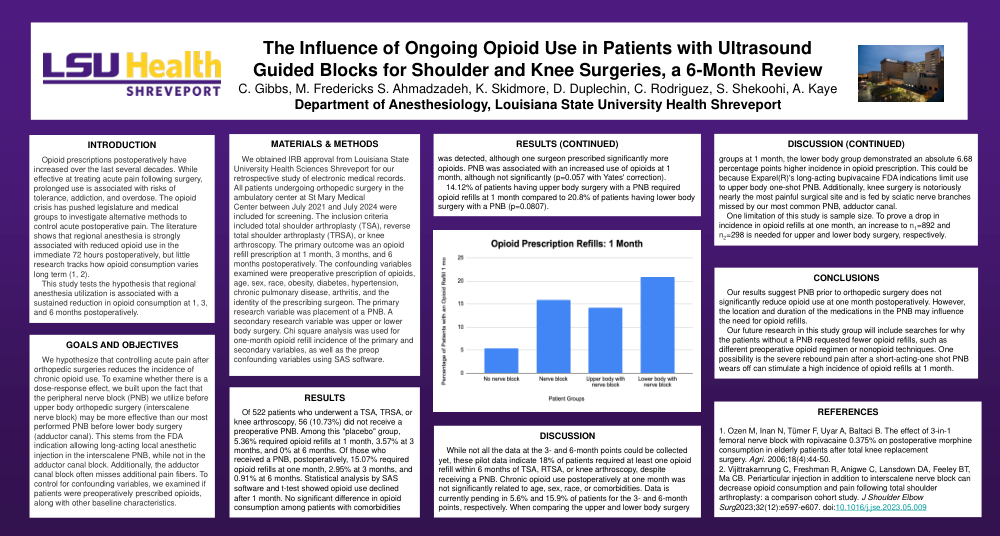
Of 522 patients who underwent a TSA, TRSA, or
knee arthroscopy, 56 (10.73%) did not receive a
preoperative PNB. Among this "placebo" group,
5.36% required opioid refills at 1 month, 3.57% at 3
months, and 0% at 6 months. Of those who
received a PNB, postoperatively, 15.07% required
opioid refills at one month, 2.95% at 3 months, and
0.91% at 6 months. Statistical analysis by SAS
software and t-test showed opioid use declined
after 1 month. No significant difference in opioid
consumption among patients with comorbidities
RESULTS (CONTINUED)
was detected, although one surgeon prescribed significantly more
opioids. PNB was associated with an increased use of opioids at 1
month, although not significantly (p=0.057 with Yates' correction).
14.12% of patients having upper body surgery with a PNB required
opioid refills at 1 month compared to 20.8% of patients having lower body
surgery with a PNB (p=0.0807).
DISCUSSION
While not all the data at the 3- and 6-month points could be collected
yet, these pilot data indicate 18% of patients required at least one opioid
refill within 6 months of TSA, RTSA, or knee arthroscopy, despite
receiving a PNB. Chronic opioid use postoperatively at one month was
not significantly related to age, sex, race, or comorbidities. Data is
currently pending in 5.6% and 15.9% of patients for the 3- and 6-month
points, respectively. When comparing the upper and lower body surgery
DISCUSSION (CONTINUED)
groups at 1 month, the lower body group demonstrated an absolute 6.68
percentage points higher incidence in opioid prescription. This could be
because Exparel(R)'s long-acting bupivacaine FDA indications limit use
to upper body one-shot PNB. Additionally, knee surgery is notoriously
nearly the most painful surgical site and is fed by sciatic nerve branches
missed by our most common PNB, adductor canal.
One limitation of this study is sample size. To prove a drop in
incidence in opioid refills at one month, an increase to n1=892 and
n2=298 is needed for upper and lower body surgery, respectively.
CONCLUSIONS
Our results suggest PNB prior to orthopedic surgery does not
significantly reduce opioid use at one month postoperatively. However,
the location and duration of the medications in the PNB may influence
the need for opioid refills.
Our future research in this study group will include searches for why
the patients without a PNB requested fewer opioid refills, such as
different preoperative opioid regimen or nonopioid techniques. One
possibility is the severe rebound pain after a short-acting-one shot PNB
wears off can stimulate a high incidence of opioid refills at 1 month.
REFERENCES
1. Ozen M, Inan N, Tümer F, Uyar A, Baltaci B. The effect of 3-in-1
femoral nerve block with ropivacaine 0.375% on postoperative morphine
consumption in elderly patients after total knee replacement
surgery. Agri. 2006;18(4):44-50.
2. Vijittrakarnrung C, Freshman R, Anigwe C, Lansdown DA, Feeley BT,
Ma CB. Periarticular injection in addition to interscalene nerve block can
decrease opioid consumption and pain following total shoulder
arthroplasty: a comparison cohort study. J Shoulder Elbow
Surg2023;32(12):e597-e607. doi:10.1016/j.jse.2023.05.009