334 posters, 125 sessions, 831 authors, 236 institutions
ePostersLive by SciGen Technologies S.A. All rights reserved.
78th Annual PostGraduate Assembly in Anesthesiology (PGA78) 2024
December 6 - 9, 2024 | New York City

4065
Retrospective Review of Deep Inhalational Sedation for Pediatric Oral Surgery Patients.
Part of Topic
Retrospective Review of Deep Inhalational Sedation for Pediatric Oral Surgery Patients
Christopher Heard, Julie Heard, Ahmad Alnuaimy, Jonathan Malinovsky.
Department of Anesthesiology, University @ Buffalo.
INTRODUCTION
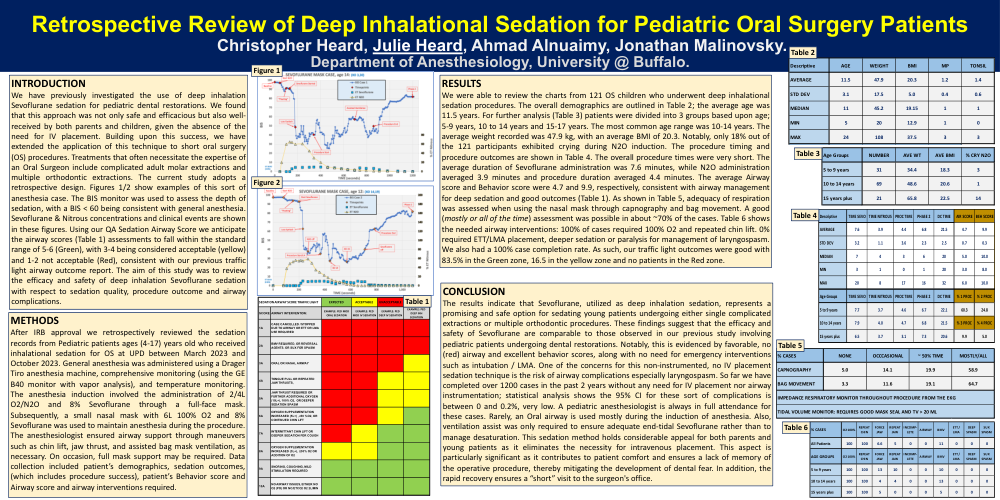
We have previously investigated the use of deep inhalation Sevoflurane sedation for pediatric dental restorations. We found that this approach was not only safe and efficacious but also well-received by both parents and children, given the absence of the need for IV placement. Building upon this success, we have extended the application of this technique to short oral surgery (OS) procedures. Treatments that often necessitate the expertise of an Oral Surgeon include complicated adult molar extractions and multiple orthodontic extractions. The current study adopts a retrospective design. Figures 1/2 show examples of this sort of anesthesia case. The BIS monitor was used to assess the depth of sedation, with a BIS < 60 being consistent with general anesthesia. Sevoflurane & Nitrous concentrations and clinical events are shown in these figures. Using our QA Sedation Airway Score we anticipate the airway scores (Table 1) assessments to fall within the standard range of 5-6 (Green), with 3-4 being considered acceptable (yellow) and 1-2 not acceptable (Red), consistent with our previous traffic light airway outcome report. The aim of this study was to review the efficacy and safety of deep inhalation Sevoflurane sedation with respect to sedation quality, procedure outcome and airway complications.