334 posters, 125 sessions, 831 authors, 236 institutions
ePostersLive by SciGen Technologies S.A. All rights reserved.
78th Annual PostGraduate Assembly in Anesthesiology (PGA78) 2024
December 6 - 9, 2024 | New York City

4063
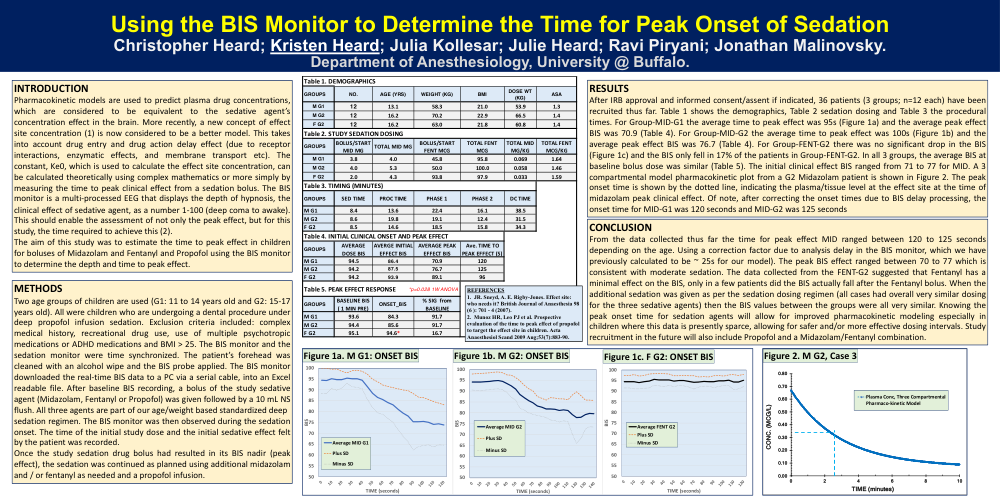
Using the BIS Monitor to Determine the Time for Peak Onset of Sedation
Poster Presenter
Part of Topic
Using the BIS Monitor to Determine the Time for Peak Onset of Sedation
Christopher Heard; Kristen Heard; Julia Kollesar; Julie Heard; Ravi Piryani; Jonathan Malinovsky.
Department of Anesthesiology, University @ Buffalo.
INTRODUCTION
Pharmacokinetic models are used to predict plasma drug concentrations, which are considered to be equivalent to the sedative agent’s concentration effect in the brain. More recently, a new concept of effect site concentration (1) is now considered to be a better model. This takes into account drug entry and drug action delay effect (due to receptor interactions, enzymatic effects, and membrane transport etc). The constant, Ke0, which is used to calculate the effect site concentration, can be calculated theoretically using complex mathematics or more simply by measuring the time to peak clinical effect from a sedation bolus. The BIS monitor is a multi-processed EEG that displays the depth of hypnosis, the clinical effect of sedative agent, as a number 1-100 (deep coma to awake). This should enable the assessment of not only the peak effect, but for this study, the time required to achieve this (2).
The aim of this study was to estimate the time to peak effect in children for boluses of Midazolam and Fentanyl and Propofol using the BIS monitor to determine the depth and time to peak effect.