334 posters, 125 sessions, 831 authors, 236 institutions
ePostersLive by SciGen Technologies S.A. All rights reserved.
78th Annual PostGraduate Assembly in Anesthesiology (PGA78) 2024
December 6 - 9, 2024 | New York City

4060
Cervical Plexus Anesthesia in Carotid Surgery: A Retrospective Cohort Study
Part of Topic
Cervical Plexus Anesthesia in Carotid Surgery: A Retrospective Cohort Study
Introduction
Patients undergoing carotid surgery remain a challenge in anesthesiologic management, mainly due to patients’ characteristics and surgical
procedures. Analyzing outcomes from various multicenter trials has not shown any significant difference between the use of regional anesthesia
(RA), general anesthesia (GA) or a combination thereof. However, anesthetic techniques used for surgery on the carotid artery are freely chosen
by the providers. Therefore, a corresponding bias influencing the decision and its results cannot be ruled out. We aimed to answer two main
research questions: first, does a significant difference in hemodynamic stability between RA and GA procedures exist and is there a difference in
mortality between the two procedures?
Methods
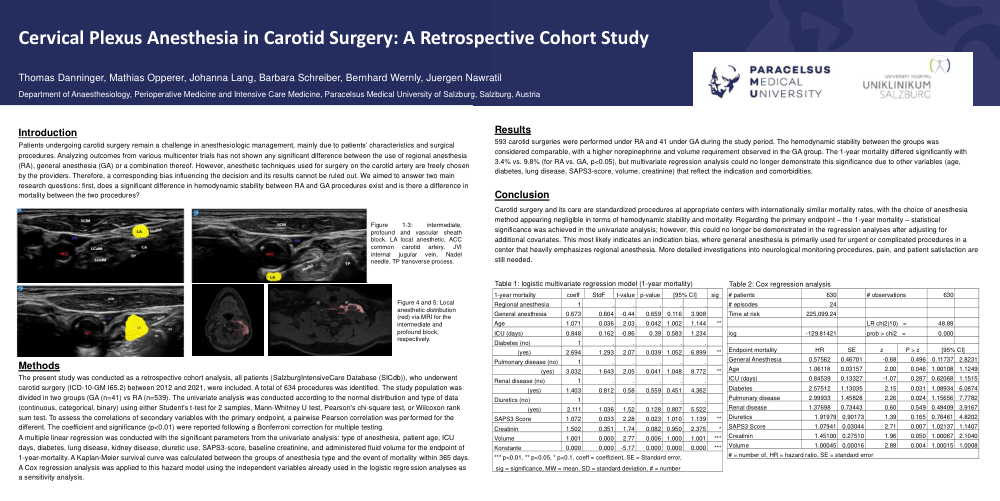
The present study was conducted as a retrospective cohort analysis, all patients (SalzburgIntensiveCare Database (SICdb)), who underwent
carotid surgery (ICD-10-GM I65.2) between 2012 and 2021, were included. A total of 634 procedures was identified. The study population was
divided in two groups (GA (n=41) vs RA (n=539). The univariate analysis was conducted according to the normal distribution and type of data
(continuous, categorical, binary) using either Student's t-test for 2 samples, Mann-Whitney U test, Pearson's chi-square test, or Wilcoxon rank
sum test. To assess the correlations of secondary variables with the primary endpoint, a pairwise Pearson correlation was performed for the
different. The coefficient and significance (p<0.01) were reported following a Bonferroni correction for multiple testing.
A multiple linear regression was conducted with the significant parameters from the univariate analysis: type of anesthesia, patient age, ICU
days, diabetes, lung disease, kidney disease, diuretic use, SAPS3-score, baseline creatinine, and administered fluid volume for the endpoint of
1-year-mortality. A Kaplan-Meier survival curve was calculated between the groups of anesthesia type and the event of mortality within 365 days.
A Cox regression analysis was applied to this hazard model using the independent variables already used in the logistic regression analyses as
a sensitivity analysis.
Results
593 carotid surgeries were performed under RA and 41 under GA during the study period. The hemodynamic stability between the groups was
considered comparable, with a higher norepinephrine and volume requirement observed in the GA group. The 1-year mortality differed significantly with
3.4% vs. 9.8% (for RA vs. GA, p<0.05), but multivariate regression analysis could no longer demonstrate this significance due to other variables (age,
diabetes, lung disease, SAPS3-score, volume, creatinine) that reflect the indication and comorbidities.
Conclusion
Carotid surgery and its care are standardized procedures at appropriate centers with internationally similar mortality rates, with the choice of anesthesia
method appearing negligible in terms of hemodynamic stability and mortality. Regarding the primary endpoint – the 1-year mortality – statistical
significance was achieved in the univariate analysis; however, this could no longer be demonstrated in the regression analyses after adjusting for
additional covariates. This most likely indicates an indication bias, where general anesthesia is primarily used for urgent or complicated procedures in a
center that heavily emphasizes regional anesthesia. More detailed investigations into neurological monitoring procedures, pain, and patient satisfaction are
still needed.