334 posters, 125 sessions, 831 authors, 236 institutions
ePostersLive by SciGen Technologies S.A. All rights reserved.
78th Annual PostGraduate Assembly in Anesthesiology (PGA78) 2024
December 6 - 9, 2024 | New York City

4059
Association of Sequential Troponin T Measurement Values with 1-Year Mortality in 2179 Cardiothoracic Surgical Patients: A Retrospective Database Study
Poster Presenter
Authors
Thomas Danninger, Andreas Koköfer, Johanna Lang, Mathias Opperer, Sylvia Reichl, Barbara Schreiber
Affiliations
Part of Topic
Association of Sequential Troponin T Measurement Values with 1-Year Mortality in 2179 Cardiothoracic Surgical Patients: A Retrospective Database Study
Introduction
Cardiovascular disease (CVD) is responsible for more deaths than any other category of disease. It is a common reason for death in the elder population (> 75 yrs) reaching up to 40% of total attributed deaths. CVD may not only present as an ischemic disease but also as valvular heart disease. In recent years less invasive treatment options for some forms of valvular diseases have emerged (e.g.transcatheter aortic valve implantation/replacement).
The above-mentioned procedures may sometimes carry serious perioperative risk with them, a tool for improving individual risk stratification of patients with an already well-established biomarker may be useful to further improve patient outcomes and focus treatment and care on vulnerable patients. Current literature has demonstrated the predictive value of high-sensitive Troponin I (hsTnI) in this context. Therefore, we aim to explore the utility and effectiveness of postoperative high-sensitivity cardiac Troponin-T levels as a biomarker in predicting patient outcomes.
Methods
This study was a retrospective cohort analysis of patients aged 18 and older who received either elective or emergency heart surgery with cardiopulmonary bypass (CPB) at the University Hospital Salzburg, Austria between the years 2013 and 2021 using data provided by the SalzburgIntensiveCaredatabase (SICdb) which included a total of 2,179 procedures.
Depending on the distribution and type of data (continuous, categorical, binary), univariate analyses were conducted using the Student's t-test for two samples, Mann-Whitney U test, Pearson's chi-squared test, or Wilcoxon rank-sum test.
To assess correlations between secondary variables and the primary endpoint, a pairwise Pearson correlation was performed for variables including age on admission, SAPS3, EuroSCORE, average Lactate levels on the first postoperative day, the max Creatinine level during the first week, 1st through 4th Troponin measurements and 1-year mortality. The correlation coefficient and significance (p < 0.01), adjusted for multiple testing with Bonferroni correction, were reported.
Receiver Operating Characteristic (ROC) curves were generated for each of the four sequential Troponin T measurements to determine the Youden Index cutoff points, which optimize the sensitivity and specificity of 1-year mortality prediction.
Results
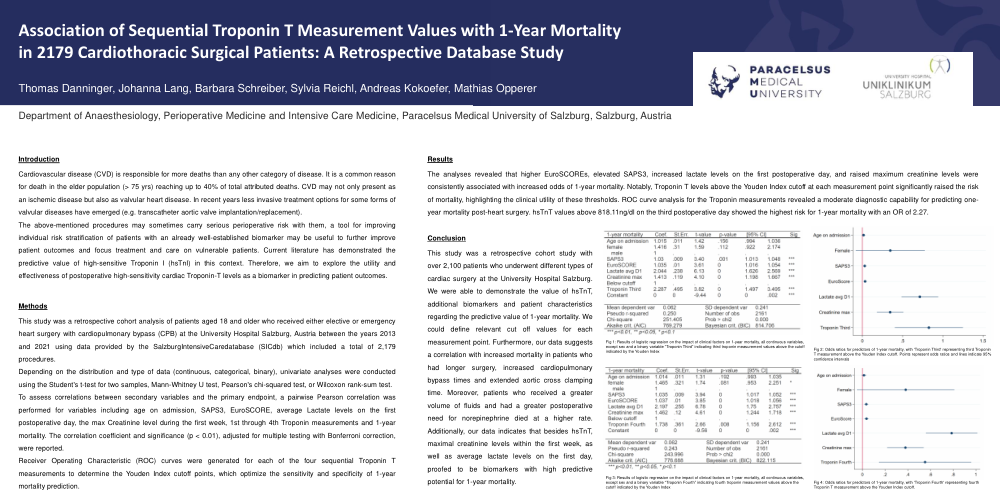
The analyses revealed that higher EuroSCOREs, elevated SAPS3, increased lactate levels on the first postoperative day, and raised maximum creatinine levels were consistently associated with increased odds of 1-year mortality. Notably, Troponin T levels above the Youden Index cutoff at each measurement point significantly raised the risk of mortality, highlighting the clinical utility of these thresholds. ROC curve analysis for the Troponin measurements revealed a moderate diagnostic capability for predicting one-year mortality post-heart surgery. hsTnT values above 818.11ng/dl on the third postoperative day showed the highest risk for 1-year mortality with an OR of 2.27.
Conclusion
This study was a retrospective cohort study with over 2,100 patients who underwent different types of cardiac surgery at the University Hospital Salzburg. We were able to demonstrate the value of hsTnT, additional biomarkers and patient characteristics regarding the predictive value of 1-year mortality. We could define relevant cut off values for each measurement point. Furthermore, our data suggests a correlation with increased mortality in patients who had longer surgery, increased cardiopulmonary bypass times and extended aortic cross clamping time. Moreover, patients who received a greater volume of fluids and had a greater postoperative need for norepinephrine died at a higher rate. Additionally, our data indicates that besides hsTnT, maximal creatinine levels within the first week, as well as average lactate levels on the first day, proofed to be biomarkers with high predictive potential for 1-year mortality.