334 posters, 125 sessions, 831 authors, 236 institutions
ePostersLive by SciGen Technologies S.A. All rights reserved.
78th Annual PostGraduate Assembly in Anesthesiology (PGA78) 2024
December 6 - 9, 2024 | New York City

4056
Preliminary Results of ETT180 Maneuver: A Randomized Double-Blind Prospective Trial for Stylet-loaded Endotracheal Tube (ETT) Rotation to Mitigate Postoperative Sore Throat
Part of Topic
Preliminary Results of ETT180 Maneuver: A Randomized Double-Blind Prospective Trial for Stylet-loaded Endotracheal Tube (ETT) Rotation to Mitigate Postoperative Sore Throat
Haosheng Li, Lukas Croner, Andrew Devine, Srija Konduru, Valeria Gamarra, Chloe Evering, Kimmy Bais, Plato Lysandrou, Xiaobin Wang, Ling-Qun Hu,Suren Soghomonyan
-
Postoperative sore throat (POST) is a common complaint following general anesthesia which can significantly affect patient satisfaction. The incidence of POST following insertion of a stylet-loaded endotracheal tube (ETT) occurs in roughly 62% of patients.
-
The mechanism of postoperative sore throat after intubation includes the load resulting from stylet removal and the high focal pressure on the anterior wall of trachea during ETT insertion, because of the stylet’s rigidity and poor alignment with the oral-pharyngeal-tracheal axes.
-
ETT 180 is a novel maneuver described to reduce the trauma caused by the stylet. It involves rotating the stylet-loaded ETT 180-degrees clockwise on its axis immediately after the tip of the ETT passes the patient’s vocal cords (glottis), before fully inserting the ETT and removing the stylet.
-
The study investigates the efficacy of this maneuver to decrease incidence of POST in combination with direct laryngoscopy (DL) versus video laryngoscopy (VL) to better understand the mechanism of intubation-related injuries due to the different viewing angles.
-
This is an IRB approved randomized, double-blind prospective trial
-
Population: Age 18-90, ASA I-III, BMI <50, ambulatory or admitted patients undergoing GA with endotracheal tube placement
-
Three study groups: Direct Laryngoscopy Conventional (DLC), Direct Laryngoscopy with ETT 180 maneuver (DLE), and McGrath Video Laryngoscopy with ETT 180 maneuver (VLE)
-
Null Hypothesis: There is no significant difference in the incidence of postoperative sore throat and hoarseness between subjects who had a conventional intubation with direct laryngoscopy, or the ETT 180 maneuver with either direct or video (McGrath) laryngoscopy
-
Primary Outcomes: incidence of postoperative sore throat and hoarseness in each group
-
Secondary Outcomes: severity of postoperative sore throat and hoarseness, length of surgery, duration of time spent in the PACU, and time from PACU to discharge
-
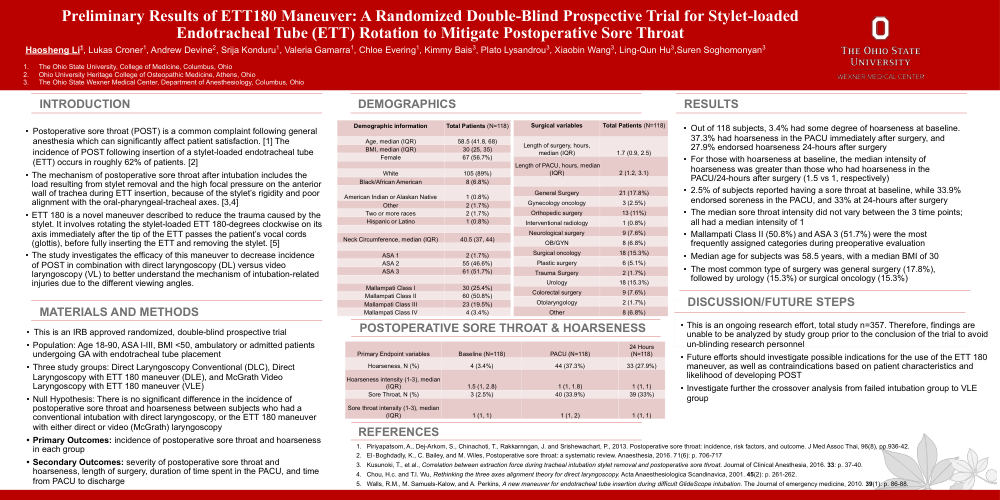
Out of 118 subjects, 3.4% had some degree of hoarseness at baseline. 37.3% had hoarseness in the PACU immediately after surgery, and 27.9% endorsed hoarseness 24-hours after surgery
-
For those with hoarseness at baseline, the median intensity of hoarseness was greater than those who had hoarseness in the PACU/24-hours after surgery (1.5 vs 1, respectively)
-
2.5% of subjects reported having a sore throat at baseline, while 33.9% endorsed soreness in the PACU, and 33% at 24-hours after surgery
-
The median sore throat intensity did not vary between the 3 time points; all had a median intensity of 1
-
Mallampati Class II (50.8%) and ASA 3 (51.7%) were the most frequently assigned categories during preoperative evaluation
-
Median age for subjects was 58.5 years, with a median BMI of 30
-
The most common type of surgery was general surgery (17.8%), followed by urology (15.3%) or surgical oncology (15.3%)
-
This is an ongoing research effort, total study n=357. Therefore, findings are unable to be analyzed by study group prior to the conclusion of the trial to avoid un-blinding research personnel
-
Future efforts should investigate possible indications for the use of the ETT 180 maneuver, as well as contraindications based on patient characteristics and likelihood of developing POST
-
Investigate further the crossover analysis from failed intubation group to VLE group