334 posters, 125 sessions, 831 authors, 236 institutions
ePostersLive by SciGen Technologies S.A. All rights reserved.
78th Annual PostGraduate Assembly in Anesthesiology (PGA78) 2024
December 6 - 9, 2024 | New York City

4053
Optimizing Anesthesia Management for Cesarean Delivery in Placenta Accreta Spectrum Disorders: Systematic Review
Poster Presenter
Authors
Kiana Farahbod, Hope Fozo, Matthew Fredericks, Bansari Patel, Ethan Slouha
Affiliations
Part of Topic
Optimizing Anesthesia Management for Cesarean Delivery in Placenta Accreta Spectrum Disorders: Systematic Review
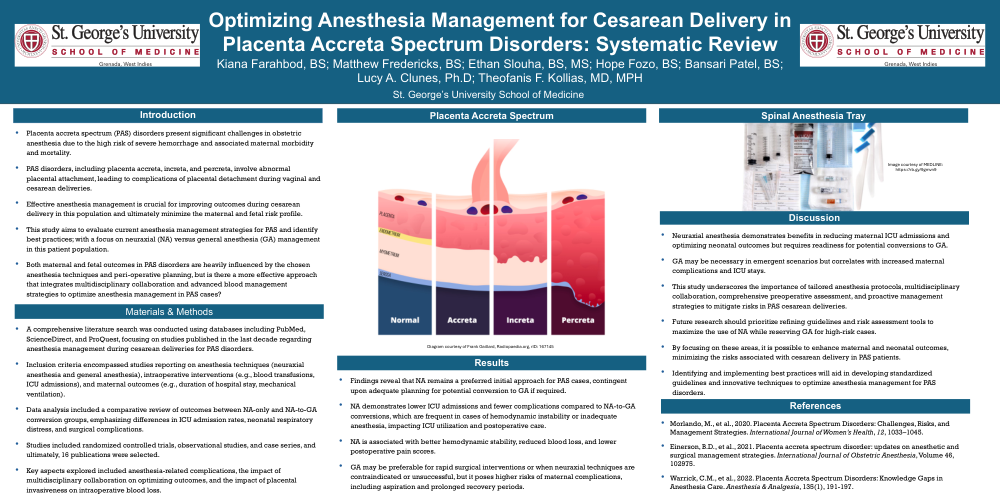
•Placenta accreta spectrum (PAS) disorders present significant challenges in obstetric anesthesia due to the high risk of severe hemorrhage and associated maternal morbidity and mortality.
•PAS disorders, including placenta accreta, increta, and percreta, involve abnormal placental attachment, leading to complications of placental detachment during vaginal and cesarean deliveries.
•Effective anesthesia management is crucial for improving outcomes during cesarean delivery in this population and ultimately minimize the maternal and fetal risk profile.
•This study aims to evaluate current anesthesia management strategies for PAS and identify best practices; with a focus on neuraxial (NA) versus general anesthesia (GA) management in this patient population.
•Both maternal and fetal outcomes in PAS disorders are heavily influenced by the chosen anesthesia techniques and peri-operative planning, but is there a more effective approach that integrates multidisciplinary collaboration and advanced blood management strategies to optimize anesthesia management in PAS cases?
•A comprehensive literature search was conducted using databases including PubMed, ScienceDirect, and ProQuest, focusing on studies published in the last decade regarding anesthesia management during cesarean deliveries for PAS disorders.
•Inclusion criteria encompassed studies reporting on anesthesia techniques (neuraxial anesthesia and general anesthesia), intraoperative interventions (e.g., blood transfusions, ICU admissions), and maternal outcomes (e.g., duration of hospital stay, mechanical ventilation).
•Data analysis included a comparative review of outcomes between NA-only and NA-to-GA conversion groups, emphasizing differences in ICU admission rates, neonatal respiratory distress, and surgical complications.
•Studies included randomized controlled trials, observational studies, and case series, and ultimately, 16 publications were selected.
•Key aspects explored included anesthesia-related complications, the impact of multidisciplinary collaboration on optimizing outcomes, and the impact of placental invasiveness on intraoperative blood loss.
•Findings reveal that NA remains a preferred initial approach for PAS cases, contingent upon adequate planning for potential conversion to GA if required.
•NA demonstrates lower ICU admissions and fewer complications compared to NA-to-GA conversions, which are frequent in cases of hemodynamic instability or inadequate anesthesia, impacting ICU utilization and postoperative care.
•NA is associated with better hemodynamic stability, reduced blood loss, and lower postoperative pain scores.
•GA may be preferable for rapid surgical interventions or when neuraxial techniques are contraindicated or unsuccessful, but it poses higher risks of maternal complications, including aspiration and prolonged recovery periods.
•Neuraxial anesthesia demonstrates benefits in reducing maternal ICU admissions and optimizing neonatal outcomes but requires readiness for potential conversions to GA.
•GA may be necessary in emergent scenarios but correlates with increased maternal complications and ICU stays.
•This study underscores the importance of tailored anesthesia protocols, multidisciplinary collaboration, comprehensive preoperative assessment, and proactive management strategies to mitigate risks in PAS cesarean deliveries.
•Future research should prioritize refining guidelines and risk assessment tools to maximize the use of NA while reserving GA for high-risk cases.
•By focusing on these areas, it is possible to enhance maternal and neonatal outcomes, minimizing the risks associated with cesarean delivery in PAS patients.
•Identifying and implementing best practices will aid in developing standardized guidelines and innovative techniques to optimize anesthesia management for PAS disorders.