334 posters, 125 sessions, 831 authors, 236 institutions
ePostersLive by SciGen Technologies S.A. All rights reserved.
78th Annual PostGraduate Assembly in Anesthesiology (PGA78) 2024
December 6 - 9, 2024 | New York City

4050
Oishei Children’s Club Cards
Poster Presenter
Authors
Affiliations
Part of Topic
Oishei Children’s Club Cards
Stacey Watt M.D., Mickael Khouzami M.D., Carson Ence D.O., Mackensey Saxton M.D., Sydney Pigott B.S.
Introduction
Pediatric patients often do not understand the importance of their surgery and may fear disfigurement or separation from their family. Anesthesiology residents usually have minimal background in caring for and communicating with the pediatric population. Patient-physician communication has both the potential to increase or minimize anxiety in the patient and family.
Methods
Club Cards were handed out to approximately 100 different families by 6 anesthesia residents over the course of 2 months. The Cards asked for the kids' favorite songs, movie/tv characters, books, smell, food, toys, and other personal preferences. Additionally, to foster a deeper connection with residents and/or attending physicians, the worksheet contained a section with the statement, “It is important to me that my doctor knows." Anesthesia residents were then given surveys to provide feedback on the Club Cards. The survey consisted of 13 questions, 9 of which assessed the viability of the Cards based on a Likert scale (i.e. strongly disagree, disagree, neutral, agree, strongly agree). The remaining 4 questions assessed the overall perception of the Club Cards in the form of an open-ended question.
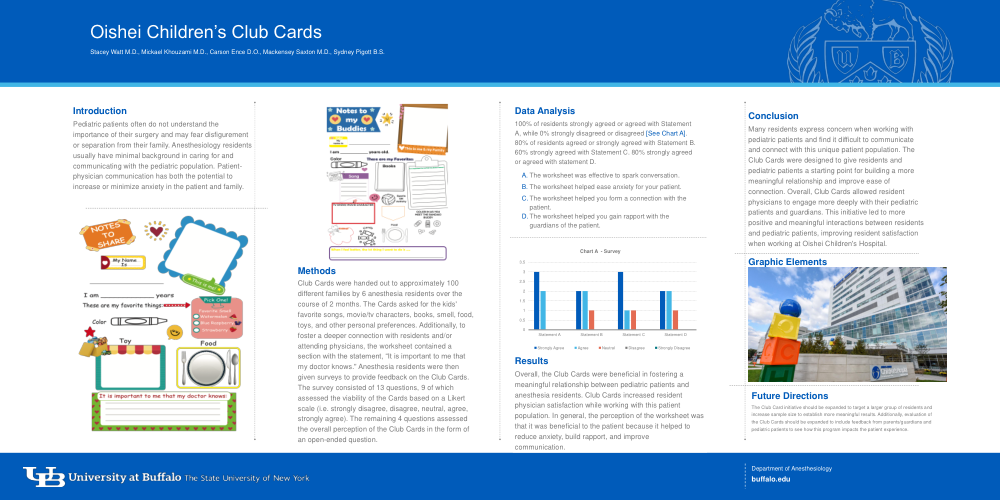
100% of residents strongly agreed or agreed with Statement A, while 0% strongly disagreed or disagreed [See Chart A]. 80% of residents agreed or strongly agreed with Statement B. 60% strongly agreed with Statement C. 80% strongly agreed or agreed with statement D.
Results
Overall, the Club Cards were beneficial in fostering a meaningful relationship between pediatric patients and anesthesia residents. Club Cards increased resident physician satisfaction while working with this patient population. In general, the perception of the worksheet was that it was beneficial to the patient because it helped to reduce anxiety, build rapport, and improve communication.
Conclusion
Many residents express concern when working with pediatric patients and find it difficult to communicate and connect with this unique patient population. The Club Cards were designed to give residents and pediatric patients a starting point for building a more meaningful relationship and improve ease of connection. Overall, Club Cards allowed resident physicians to engage more deeply with their pediatric patients and guardians. This initiative led to more positive and meaningful interactions between residents and pediatric patients, improving resident satisfaction when working at Oishei Children's Hospital.
Future Directions
The Club Card initiative should be expanded to target a larger group of residents and increase sample size to establish more meaningful results. Additionally, evaluation of the Club Cards should be expanded to include feedback from parents/guardians and pediatric patients to see how this program impacts the patient experience.