334 posters, 125 sessions, 831 authors, 236 institutions
ePostersLive by SciGen Technologies S.A. All rights reserved.
78th Annual PostGraduate Assembly in Anesthesiology (PGA78) 2024
December 6 - 9, 2024 | New York City

3035
Conversion Confusion
Poster Presenter
Authors
David Feller, Ryan D'Souza, Edwin Rho, Laurence Torsher, Matthew Vogt
Affiliations
Part of Topic
Conversion Confusion: A Case of Functional Neurologic Symptom Disorder Elicited via Monitored Anesthesia Care
objective
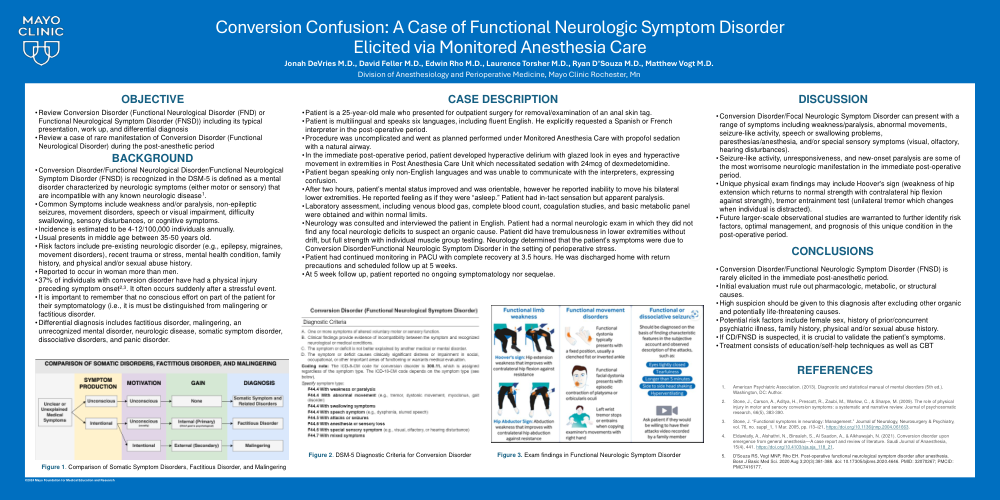
•Review Conversion Disorder (Functional Neurological Disorder (FND) or Functional Neurological Symptom Disorder (FNSD)) including its typical presentation, work up, and differential diagnosis
•Review a case of rare manifestation of Conversion Disorder (Functional Neurological Disorder) during the post-anesthetic period
Background
•Conversion Disorder/Functional Neurological Disorder/Functional Neurological Symptom Disorder (FNSD) is recognized in the DSM-5 is defined as a mental disorder characterized by neurologic symptoms (either motor or sensory) that are incompatible with any known neurologic disease1.
•Common Symptoms include weakness and/or paralysis, non-epileptic seizures, movement disorders, speech or visual impairment, difficulty swallowing, sensory disturbances, or cognitive symptoms.
•Incidence is estimated to be 4-12/100,000 individuals annually.
•Usual presents in middle age between 35-50 years old.
•Risk factors include pre-existing neurologic disorder (e.g., epilepsy, migraines, movement disorders), recent trauma or stress, mental health condition, family history, and physical and/or sexual abuse history.
•Reported to occur in woman more than men.
•37% of individuals with conversion disorder have had a physical injury preceding symptom onset2,3. It often occurs suddenly after a stressful event.
•It is important to remember that no conscious effort on part of the patient for their symptomatology (i.e., it is must be distinguished from malingering or factitious disorder.
•Differential diagnosis includes factitious disorder, malingering, an unrecognized mental disorder, neurologic disease, somatic symptom disorder, dissociative disorders, and panic disorder.
Case Description
•Patient is a 25-year-old male who presented for outpatient surgery for removal/examination of an anal skin tag.
•Patient is multilingual and speaks six languages, including fluent English. He explicitly requested a Spanish or French interpreter in the post-operative period.
•Procedure was uncomplicated and went as planned performed under Monitored Anesthesia Care with propofol sedation with a natural airway.
•In the immediate post-operative period, patient developed hyperactive delirium with glazed look in eyes and hyperactive movement in extremities in Post Anesthesia Care Unit which necessitated sedation with 24mcg of dexmedetomidine.
•Patient began speaking only non-English languages and was unable to communicate with the interpreters, expressing confusion.
•After two hours, patient’s mental status improved and was orientable, however he reported inability to move his bilateral lower extremities. He reported feeling as if they were “asleep.” Patient had in-tact sensation but apparent paralysis.
•Laboratory assessment, including venous blood gas, complete blood count, coagulation studies, and basic metabolic panel were obtained and within normal limits.
•Neurology was consulted and interviewed the patient in English. Patient had a normal neurologic exam in which they did not find any focal neurologic deficits to suspect an organic cause. Patient did have tremulousness in lower extremities without drift, but full strength with individual muscle group testing. Neurology determined that the patient’s symptoms were due to Conversion Disorder/Functional Neurologic Symptom Disorder in the setting of perioperative stress.
•Patient had continued monitoring in PACU with complete recovery at 3.5 hours. He was discharged home with return precautions and scheduled follow up at 5 weeks.
•At 5 week follow up, patient reported no ongoing symptomatology nor sequelae.
Discussion
•Conversion Disorder/Focal Neurologic Symptom Disorder can present with a range of symptoms including weakness/paralysis, abnormal movements, seizure-like activity, speech or swallowing problems, paresthesias/anesthesia, and/or special sensory symptoms (visual, olfactory, hearing disturbances).
•Seizure-like activity, unresponsiveness, and new-onset paralysis are some of the most worrisome neurologic manifestation in the immediate post-operative period.
•Unique physical exam findings may include Hoover's sign (weakness of hip extension which returns to normal strength with contralateral hip flexion against strength), tremor entrainment test (unilateral tremor which changes when individual is distracted).
•Future larger-scale observational studies are warranted to further identify risk factors, optimal management, and prognosis of this unique condition in the post-operative period.
Conclusions
•Conversion Disorder/Functional Neurologic Symptom Disorder (FNSD) is rarely elicited in the immediate post-anesthetic period.
•Initial evaluation must rule out pharmacologic, metabolic, or structural causes.
•High suspicion should be given to this diagnosis after excluding other organic and potentially life-threatening causes.
•Potential risk factors include female sex, history of prior/concurrent psychiatric illness, family history, physical and/or sexual abuse history.
•If CD/FNSD is suspected, it is crucial to validate the patient’s symptoms.
•Treatment consists of education/self-help techniques as well as CBT
References
1.American Psychiatric Association. (2013). Diagnostic and statistical manual of mental disorders (5th ed.). Washington, DC: Author.
2.Stone, J., Carson, A., Aditya, H., Prescott, R., Zaubi, M., Warlow, C., & Sharpe, M. (2009). The role of physical injury in motor and sensory conversion symptoms: a systematic and narrative review. Journal of psychosomatic research, 66(5), 383-390.
3.Stone, J. “Functional symptoms in neurology: Management.” Journal of Neurology, Neurosurgery & Psychiatry, vol. 76, no. suppl_1, 1 Mar. 2005, pp. i13–i21, https://doi.org/10.1136/jnnp.2004.061663.
4.Eldawlatly, A., Alshathri, N., Binsaleh, S., Al Saadon, A., & Alkhawajah, N. (2021). Conversion disorder upon emergence from general anesthesia—A case report and review of literature. Saudi Journal of Anaesthesia, 15(4), 441. https://doi.org/10.4103/sja.sja_118_21.
5.D'Souza RS, Vogt MNP, Rho EH. Post-operative functional neurological symptom disorder after anesthesia. Bosn J Basic Med Sci. 2020 Aug 3;20(3):381-388. doi: 10.17305/bjbms.2020.4646. PMID: 32070267; PMCID: PMC7416177.