334 posters, 125 sessions, 831 authors, 236 institutions
ePostersLive by SciGen Technologies S.A. All rights reserved.
78th Annual PostGraduate Assembly in Anesthesiology (PGA78) 2024
December 6 - 9, 2024 | New York City

4045
Epidemiology and Its results in hip fractures followed in postoperative intensive care
Poster Presenter
Part of Topic
Introduction/Hypothesis: Hip fractures are one of the leading injuries in the elderly population all over the world. Although there are many current discussions about the use of intensive care to improve postoperative care of patients with hip fractures, data on this subject are limited. Postoperative follow-up is as important as preoperative follow-up of elderly patients with hip fractures who have more than one comorbidity.The mortality and morbidity of elderly patients with hip fractures can be reduced by careful preoperative preparation of elderly patients, not delaying the operation, follow-up in the postoperative intensive care unit (ICU) and transferring them to the service from the ICU in a short time. For this reason, we wanted to retrospectively evaluate the outcomes of patients with hip fractures followed in the postoperative intensive care unit at 30 days, 90 days and one year mortality.
Design/Methods: Age, gender, admission diagnosis, comorbidities, length of stay in ICU, APACHE II scores, NIM, IMV, length of stay on mechanical ventilator of 68 patients with femur fracture followed in the intensive care unit, need for inotropic support, RRT and HD requirement, blood transfusion, presence of central venous catheter , arterial catheterization status, length of stay in the intensive care unit, 30, 90-day and 1-year mortality, day of the operation and anesthesia technique performed was recorded.
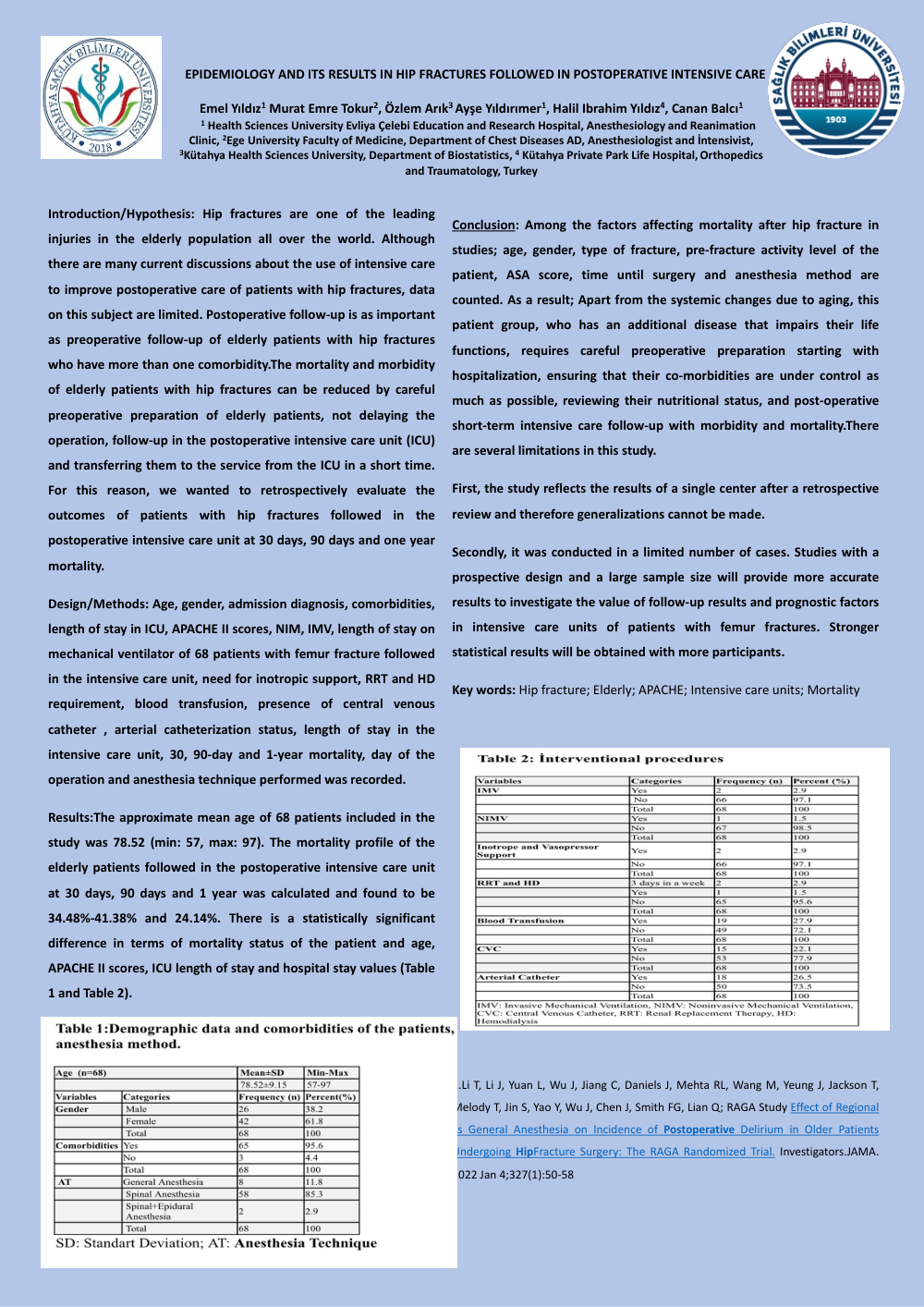
Results:The approximate mean age of 68 patients included in the study was 78.52 (min: 57, max: 97). The mortality profile of the elderly patients followed in the postoperative intensive care unit at 30 days, 90 days and 1 year was calculated and found to be 34.48%-41.38% and 24.14%. There is a statistically significant difference in terms of mortality status of the patient and age, APACHE II scores, ICU length of stay and hospital stay values.
Conclusion: Among the factors affecting mortality after hip fracture in studies; age, gender, type of fracture, pre-fracture activity level of the patient, ASA score, time until surgery and anesthesia method are counted. As a result; Apart from the systemic changes due to aging, this patient group, who has an additional disease that impairs their life functions, requires careful preoperative preparation starting with hospitalization, ensuring that their co-morbidities are under control as much as possible, reviewing their nutritional status, and post-operative short-term intensive care follow-up with morbidity and mortality.
1.Li T, Li J, Yuan L, Wu J, Jiang C, Daniels J, Mehta RL, Wang M, Yeung J, Jackson T, Melody T, Jin S, Yao Y, Wu J, Chen J, Smith FG, Lian Q; RAGA Study Effect of Regional vs General Anesthesia on Incidence of Postoperative Delirium in Older Patients Undergoing HipFracture Surgery: The RAGA Randomized Trial. Investigators.JAMA. 2022 Jan 4;327(1):50-58.