334 posters, 125 sessions, 831 authors, 236 institutions
ePostersLive by SciGen Technologies S.A. All rights reserved.
78th Annual PostGraduate Assembly in Anesthesiology (PGA78) 2024
December 6 - 9, 2024 | New York City

4043
Impact of Intraoperative Blood Transfusions on Survival Rates in Ovarian Cancer Patients
Poster Presenter
Part of Topic
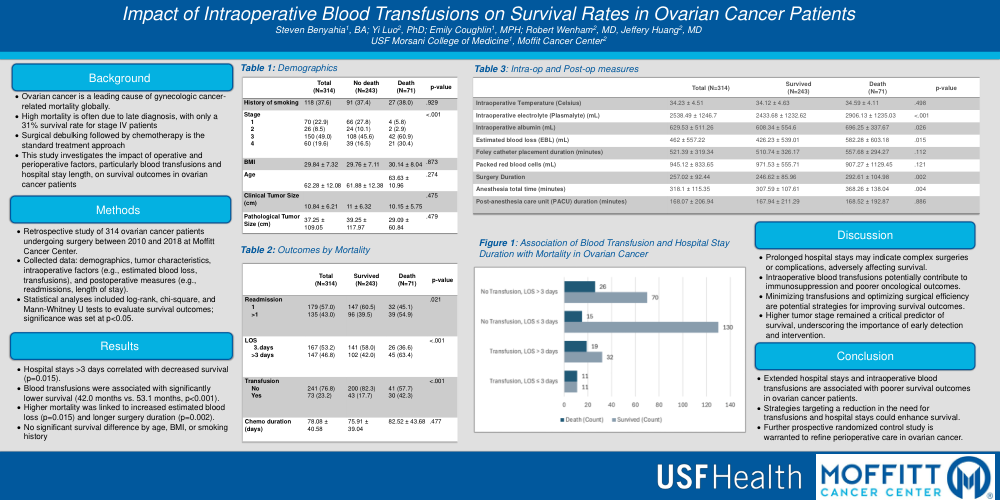
Impact of Intraoperative Blood Transfusions on Survival Rates in Ovarian Cancer Patients Steven Benyahia, BA; Yi Luoz, PhD; Emily Coughlin, MPH; Robert Wenham, MD, Jeffery Huang, MD USF Morsani College of Medicine, Moffit Cancer Center
Background
• Ovarian cancer is a leading cause of gynecologic cancer-
related mortality globally.
• High mortality is often due to late diagnosis, with only a
31% survival rate for stage IV patients
• Surgical debulking followed by chemotherapy is the
standard treatment approach
• This study investigates the impact of operative and
perioperative factors, particularly blood transfusions and
hospital stay length, on survival outcomes in ovarian
cancer patients
Methods
• Retrospective study of 314 ovarian cancer patients
undergoing surgery between 2010 and 2018 at Moffitt
Cancer Center.
• Collected data: demographics, tumor characteristics,
intraoperative factors (e.g., estimated blood loss,
transfusions), and postoperative measures (e.g.,
readmissions, length of stay).
• Statistical analyses included log-rank, chi-square, and
Mann-Whitney U tests to evaluate survival outcomes;
significance was set at p<0.05.
Results
• Hospital stays >3 days correlated with decreased survival
(p=0.015).
• Blood transfusions were associated with significantly lower
survival (42.0 months vs. 53.1 months, p<0.001).
• Higher mortality was linked to increased estimated blood loss
(p=0.015) and longer surgery duration (p=0.002).
• No significant survival difference by age, BMI, or smoking
history
Discussion
• Prolonged hospital stays may indicate complex surgeries
or complications, adversely affecting survival.
• Intraoperative blood transfusions potentially contribute to
immunosuppression and poorer oncological outcomes.
• Minimizing transfusions and optimizing surgical efficiency
are potential strategies for improving survival outcomes.
• Higher tumor stage remained a critical predictor of
survival, underscoring the importance of early detection
and intervention.
Conclusion
• Extended hospital stays and intraoperative blood
transfusions are associated with poorer survival outcomes
in ovarian cancer patients.
• Strategies targeting a reduction in the need for
transfusions and hospital stays could enhance survival.
• Further prospective randomized control study is
warranted to refine perioperative care in ovarian cancer.