334 posters, 125 sessions, 831 authors, 236 institutions
ePostersLive by SciGen Technologies S.A. All rights reserved.
78th Annual PostGraduate Assembly in Anesthesiology (PGA78) 2024
December 6 - 9, 2024 | New York City

4033
Comparative Efficacy of Erector Spinae Plane Block versus Pecto-Intercostal Fascial Plane Block versus Control in Mitigating Postoperative Opioid Requirements following Median Sternotomy: A Prospective, Randomized Controlled Trial
Poster Presenter
Part of Topic
Background
•Uncontrolled postoperative pain from sternal incisions causes prolonged intubation, impairs surgical recovery, and can lead to the development of chronic pain syndromes, with reports of incidence varying between 11 - 56% at one-year follow up.1
•Early adequate pain control, especially in the immediate postoperative period, may enable faster surgical recovery as well as improve patient experience.1
•Recently, the erector spinae plane (ESP) block and the ultrasound-guided pecto-intercostal fascial (PIF) plane block have been used for multimodal analgesia during sternotomy.2,3
Study aims
•The purpose of this study is to compare the post surgical analgesic efficacy of bilateral ESP blocks, bilateral PIF blocks, and no blocks in patients undergoing cardiac surgical procedures via sternotomy.
•The primary endpoint is opioid consumption (in mg IV morphine equivalents [MME]) during post operative days (POD) 0, 1, 2, 3, 4, and 5. Secondary endpoints include ICU length of stay (LOS), total postoperative LOS, and nausea/vomiting after extubation.
Methods
•This prospective randomized control trial received approval from the IRB at the Icahn School of Medicine at Mount Sinai in New York City.
•Inclusion criteria included patients of all genders, ages 18 - 85, undergoing cardiac surgical procedures involving median sternotomy; exclusion criteria included patients ASA class V, urgent or emergent surgeries, contraindications to administration of local anesthesia, and history of disordered substance use or chronic opioid use.
•Patients were assigned randomly using a computer-generated table of numbers to either the ESP, PIF, or control groups.
•Univariate analyses were assessed using t tests for numerical values and chi square tests for categorical values.
Results
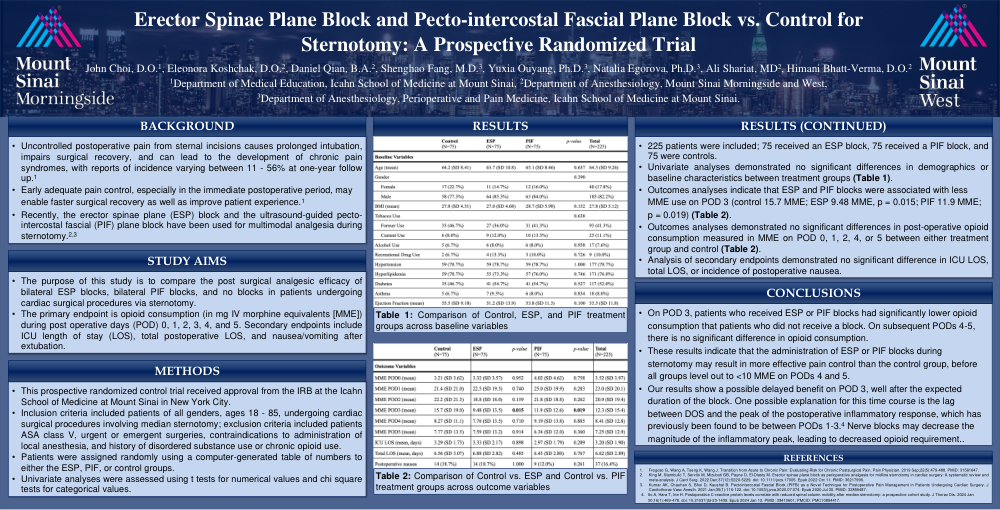
•225 patients were included; 75received an ESP block, 75received a PIF block, and 75 were controls.
•Univariate analyses demonstrated no significant differences in demographics or baseline characteristics between treatment groups (Table 1).
•Outcomes analyses indicate that ESP and PIF blocks were associated with less MME use on POD 3 (control 15.7 MME; ESP 9.48 MME, p = 0.015; PIF 11.9 MME; p = 0.019) (Table 2).
•Outcomes analyses demonstrated no significant differences in post-operative opioid consumption measured in MME on POD 0, 1, 2,4, or 5 between either treatment group and control (Table 2).
•Analysis of secondary endpoints demonstrated no significant difference in ICU LOS, total LOS, or incidence of postoperative nausea.
Conclusion
•On POD 3, patients who received ESP or PIF blocks had significantly lower opioid consumption that patients who did not receive a block. On subsequent PODs 4-5, there is no significant difference in opioid consumption.
•These results indicate that the administration of ESP or PIF blocks during sternotomy may result in more effective pain control than the control group, before all groups level out to <10 MME on PODs 4 and 5.
•Our results show a possible delayed benefit on POD 3, well after the expected duration of the block. One possible explanation for this time course is the lag between DOS and the peak of the postoperative inflammatory response, which has previously been found to be between PODs 1-3.4 Nerve blocks may decrease the magnitude of the inflammatory peak, leading to decreased opioid requirement..