334 posters, 125 sessions, 831 authors, 236 institutions
ePostersLive by SciGen Technologies S.A. All rights reserved.
78th Annual PostGraduate Assembly in Anesthesiology (PGA78) 2024
December 6 - 9, 2024 | New York City

4029
The efficacy and safety of norepinephrine versus phenylephrine in the treatment of post-spinal hypotension in parturients undergoing cesarean section: A systematic review & meta-analysis
Poster Presenter
Authors
Affiliations
Part of Topic
The safety of norepinephrine versus phenylephrine in the treatment of post-spinal hypotension in parturients undergoing cesarean section: A systematic review & meta-analysis
Alexandra Christine K. Lao
BACKGROUND
-
By 2030 the global cesarean section rate will be nearing 30% with 38 million CS being performed worldwide. Majority of these cesarean sections are performed under spinal anesthesia.
-
Spinal-induced hypotension has adverse effects on the fetus. Thus, it is often treated with phenylephrine. However, while it is an effective treatment for the hypotension, phenylephrine being an alpha agonist also results in bradycardia.
-
Repeated doses of phenylephrine may cause prolonged as well as severe bradycardia.
-
Phenylephrine-induced bradycardia has been shown to decrease cardiac output and, subsequently, uteroplacental perfusion.
-
Uteroplacental perfusion is the major determinant of fetal oxygenation and nutrient delivery, but due to its limited autoregulation, it is particularly dependent on maternal hemodynamics. Decreased perfusion has been associated with fetal acidosis, and lower APGAR scores.
-
Thus, there is a potential advantage of norepinephrine as a safer alternative, in reducing maternal hypotension and improving neonatal outcomes. The combination of alpha and beta agonist activity is less likely to decrease maternal heart rate and cardiac output.
RESEARCH QUESTION
In parturients undergoing cesarean sections, does norepinephrine have a decreased incidence of bradycardia compared to phenylephrine for treating post-spinal hypotension?
OBJECTIVES
-
Primarily, to conduct a systematic review and meta-analysis of randomized control trials to determine the safety profile of norepinephrine and phenylephrine.
-
Safety would be defined as a lower incidence of bradycardia as found in the given studies.
-
Secondary outcomes would focus on hypotension as well as nausea, and vomiting
METHODS
Step 1: Selection of studies
A systematic search was conducted in the following databases; PubMed, clinicaltrial.gov, and Cochrane Library. Two independent researchers screened the studies based on the ff. inclusion and exclusion criteria
-
Inclusion Criteria: Elective cesarean delivery under subarachnoid block; the intervention involved the use of norepinephrine and phenylephrine to treat post-spinal hypotension, the article was peer-reviewed, and the study was a randomized controlled trial from August 2022-February 2024.
-
Exclusion Criteria: Emergency surgery, cesarean section performed under general anesthesia, non-RCT, and literature for which information on inclusion to the study could not be obtained and was inaccessible even after contacting the original authors.
Step 2: Data Extraction
Two authors (AKL and TDM) selected and independently reviewed each article included.
Step 3: Risk of Bias
Two independent reviewers (AKL and TDM) critically appraised each trial using the Cochrane Risk of Bias tool. A third reviewer (MC) was available to settle discrepancies in the appraisal process.
Step 4: Data Analysis
RESULTS
Incidence of Bradycardia
-
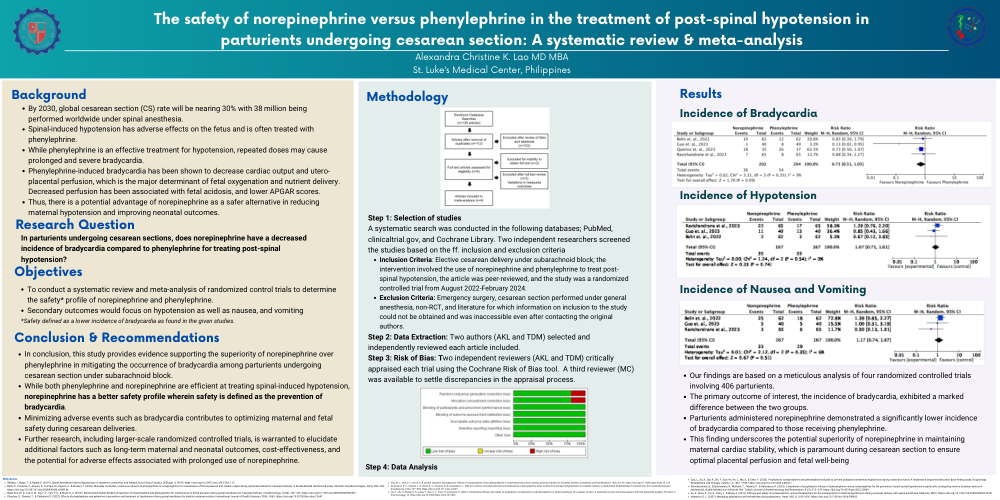
Our findings are based on a meticulous analysis of four randomized controlled trials involving 406 parturients.
-
Notably, the primary outcome of interest, the incidence of bradycardia, exhibited a marked difference between the two groups.
-
Parturients administered norepinephrine demonstrated a significantly lower incidence of bradycardia compared to those receiving phenylephrine.
-
This finding underscores the potential superiority of norepinephrine in maintaining maternal cardiac stability, which is paramount during cesarean section to ensure optimal placental perfusion and fetal well-being
CONCLUSIONS & RECOMMENDATIONS
-
In conclusion, this study provides evidence supporting the superiority of norepinephrine over phenylephrine in mitigating the occurrence of bradycardia among parturients undergoing cesarean section under subarachnoid block.
-
While both phenylephrine and norepinephrine are efficient at treating spinal-induced hypotension. Norepinephrine has a better safety profile wherein safety is defined as the prevention of bradycardia.
-
The implications of our findings extend beyond immediate perioperative management, as minimizing adverse events such as bradycardia contributes to optimizing maternal and fetal safety during cesarean deliveries. Furthermore, the maintenance of maternal cardiac output and improved placental perfusion associated with norepinephrine administration underscores its potential to positively impact perinatal outcomes.
-
Further research, including larger-scale randomized controlled trials, is warranted to validate our findings and elucidate additional factors such as long-term maternal and neonatal outcomes, cost-effectiveness, and the potential for adverse effects associated with prolonged use of norepinephrine.