334 posters, 125 sessions, 831 authors, 236 institutions
ePostersLive by SciGen Technologies S.A. All rights reserved.
78th Annual PostGraduate Assembly in Anesthesiology (PGA78) 2024
December 6 - 9, 2024 | New York City

4024
Mental models of anesthesiologists and surgeons in the operating room – a qualitive study
Poster Presenter
Authors
Affiliations
Part of Topic
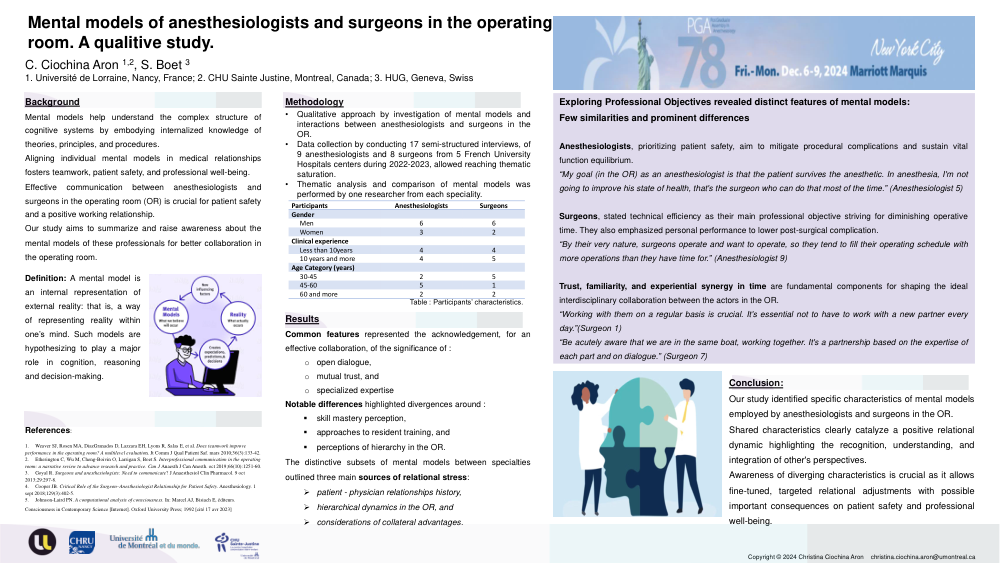
Mental models of anesthesiologists and surgeons in the operating room. A qualitive study.
C. Ciochina Aron 1,2, S. Boet 3
1. Université de Lorraine, Nancy, France; 2. CHU Sainte Justine, Montreal, Canada; 3. Geneva University Hospital, Geneva Swiss
Background:
Mental models help understand the complex structure of cognitive systems by embodying internalized knowledge of theories, principles, and procedures.
Aligning individual mental models in medical relationships fosters teamwork, patient safety, and professional well-being.
Effective communication between anesthesiologists and surgeons in the operating room (OR) is crucial for patient safety and a positive working relationship.
Our study aims to summarize and raise awareness about the mental models of these professionals for better collaboration in the operating room.
Definition:
A mental model is an internal representation of external reality: that is, a way of representing reality within one’s mind. Such models are hypothesizing to play a major role in cognition, reasoning and decision-making.
Methodology
Results
Common features represented the acknowledgement, for an effective collaboration, of the significance of :
Notable differences highlighted divergences around :
The distinctive subsets of mental models between specialties outlined three main sources of relational stress:
Exploring Professional Objectives revealed distinct features of mental models: Few similarities and prominent differences.
Anesthesiologists, prioritizing patient safety, aim to mitigate procedural complications and sustain vital function equilibrium.
“My goal (in the OR) as an anesthesiologist is that the patient survives the anesthetic. In anesthesia, I'm not going to improve his state of health, that's the surgeon who can do that most of the time.” (Anesthesiologist 5)
Surgeons, stated technical efficiency as their main professional objective striving for diminishing operative time. They also emphasized personal performance to lower post-surgical complication.
“By their very nature, surgeons operate and want to operate, so they tend to fill their operating schedule with more operations than they have time for.” (Anesthesiologist 9)
Trust, familiarity, and experiential synergy in time are fundamental components for shaping the ideal interdisciplinary collaboration between the actors in the OR.
“Working with them on a regular basis is crucial. It's essential not to have to work with a new partner every day.”(Surgeon 1)
“Be acutely aware that we are in the same boat, working together. It's a partnership based on the expertise of each part and on dialogue.” (Surgeon 7)
Conclusion:
Our study identified specific characteristics of mental models employed by anesthesiologists and surgeons in the OR.
Shared characteristics clearly catalyze a positive relational dynamic highlighting the recognition, understanding, and integration of other's perspectives.
Awareness of diverging characteristics is crucial as it allows fine-tuned, targeted relational adjustments with possible important consequences on patient safety and professional well-being.