334 posters, 125 sessions, 831 authors, 236 institutions
ePostersLive by SciGen Technologies S.A. All rights reserved.
78th Annual PostGraduate Assembly in Anesthesiology (PGA78) 2024
December 6 - 9, 2024 | New York City

4023
Potential Adverse Effects of Sugammadex Administration: A Scoping Review
Poster Presenter
Authors
Luis Periel, Gowtham Anche, Wei Ming Liang, Danny Nguyen, Brian Obinero, Robert Valencia
Affiliations
Part of Topic
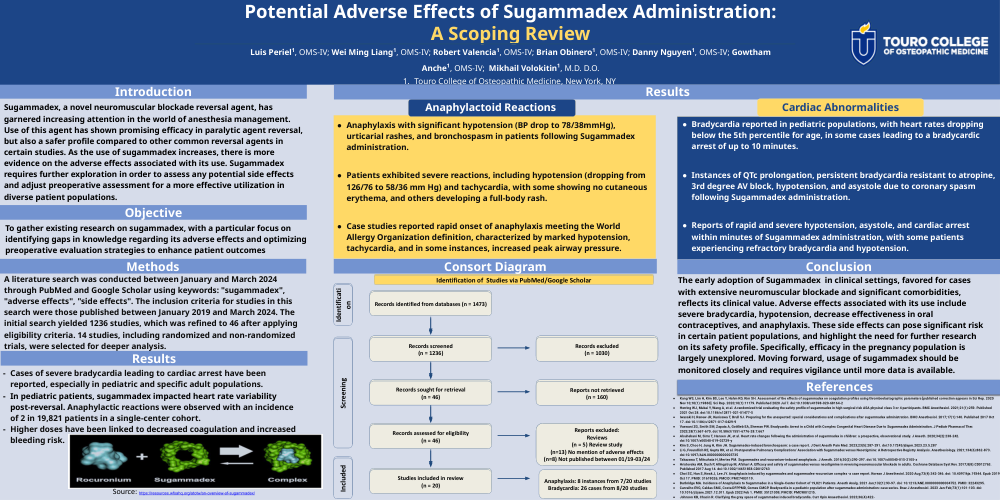
Sugammadex, a novel neuromuscular blockade reversal agent, has garnered increasing attention in the world of anesthesia management due its relatively safe clinical profile. Use of this agent has shown promising efficacy in paralytic agent reversal, but also a relatively safe clinical profile. Its relatively recent adoption shows a need for a comprehensive exploration of its safety profile and potential side effects. Despite this, Sugammadex requires further exploration in order to assess any potential side effects and adjust preoperative assessment for a more effective utilization in diverse patient populations. To gather existing research on sugammadex, with a particular focus on identifying gaps in knowledge regarding its adverse effects and optimizing preoperative evaluation strategies to enhance patient outcomes A literature search was conducted between January and March 2024 through PubMed and Google Scholar using keywords: "sugammadex", "adverse effects", "side effects". The inclusion criteria for studies in this search were those published between January 2019 and March 2024. The initial search yielded 1236 studies, which was refined to 46 after applying eligibility criteria. 14 studies, including randomized and non-randomized trials, were selected for deeper analysis. Higher doses have been linked to decreased coagulation and increased bleeding risk. Cases of severe bradycardia leading to cardiac arrest have been reported, especially in pediatric and specific adult populations. In pediatric patients, sugammadex impacted heart rate variability post-reversal. Anaphylactic reactions were observed with an incidence of 2 in 19,821 patients in a single-center cohort. Anaphylaxis with significant hypotension (BP drop to 78/38mmHg), urticarial rashes, and bronchospasm in patients following Sugammadex administration. Patients exhibited severe reactions, including hypotension (dropping from 126/76 to 58/36 mm Hg) and tachycardia, with some showing no cutaneous erythema, and others developing a full-body rash. Case studies reported rapid onset of anaphylaxis meeting the World Allergy Organization definition, characterized by marked hypotension, tachycardia, and in some instances, increased peak airway pressure. Bradycardia reported in pediatric populations, with heart rates dropping below the 5th percentile for age, in some cases leading to a bradycardic arrest of up to 10 minutes. Instances of QTc prolongation, persistent bradycardia resistant to atropine, 3rd degree AV block, hypotension, and asystole due to coronary spasm following Sugammadex administration. Reports of rapid and severe hypotension, asystole, and cardiac arrest within minutes of Sugammadex administration, with some patients experiencing refractory bradycardia and hypotension. The early adoption of Sugammadex in clinical settings, favored for cases with extensive neuromuscular blockade and significant comorbidities, reflects its clinical value. Adverse effects associated with its use include severe bradycardia, hypotension, decrease effectiveness in oral contraceptives, and anaphylaxis. These side effects can pose significant risk in certain patient populations, and highlight the need for further research on its safety profile. Specifically, efficacy in the pregnancy population is largelyl unexplored. Moving forward, usage of sugammadex should be monitored closely and requires vigilance until more data is available.