334 posters, 125 sessions, 831 authors, 236 institutions
ePostersLive by SciGen Technologies S.A. All rights reserved.
78th Annual PostGraduate Assembly in Anesthesiology (PGA78) 2024
December 6 - 9, 2024 | New York City

4021
Post-Cesarean Section Pain and Pain Management Requirements in Marijuana Non-Users and Users
Poster Presenter
Authors
Colette B. Gazonas, George A. Popa, Damanveer Singh, Nivetha Srinivasan
Affiliations
Part of Topic
Post-Cesarean Section Pain and Pain Management Requirements in Marijuana Non-Users and Users
Colette B. Gazonas, Damanveer Singh, George A. Popa, Nivetha Srinivasan, Ming Xiong, Dongchen Li, Jean D. Eloy
Rutgers New Jersey Medical School
Introduction
The current literature regarding the relationship between marijuana and opioids is limited. While some studies suggest that marijuana may have a synergistic effect on opioids, enhancing their analgesic properties, there is insufficient research to address whether or not the use of marijuana reduces the opioid dose required to achieve its desired effect.1 Thus, this study aims to answer two main questions: (1) do marijuana non-users and users differ in the level of pain they experience postoperatively following cesarean section? and (2) do marijuana non-users and users require different amounts of analgesia in the early postoperative period following cesarean section?
Methods
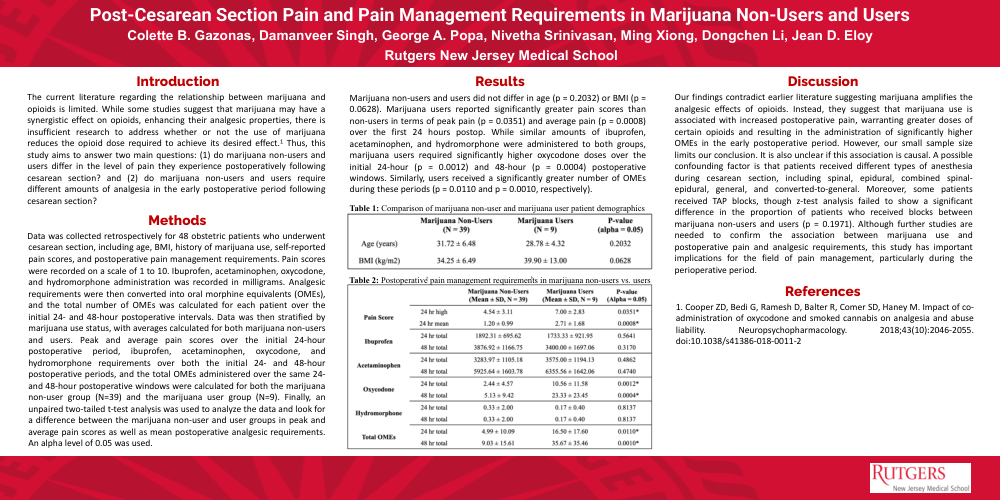
Data was collected retrospectively for 48 obstetric patients who underwent cesarean section, including age, BMI, history of marijuana use, self-reported pain scores, and postoperative pain management requirements. Pain scores were recorded on a scale of 1 to 10. Ibuprofen, acetaminophen, oxycodone, and hydromorphone administration was recorded in milligrams. Analgesic requirements were then converted into oral morphine equivalents (OMEs), and the total number of OMEs was calculated for each patient over the initial 24- and 48-hour postoperative intervals. Data was then stratified by marijuana use status, with averages calculated for both marijuana non-users and users. Peak and average pain scores over the initial 24-hour postoperative period, ibuprofen, acetaminophen, oxycodone, and hydromorphone requirements over both the initial 24- and 48-hour postoperative periods, and the total OMEs administered over the same 24- and 48-hour postoperative windows were calculated for both the marijuana non-user group (N=39) and the marijuana user group (N=9). Finally, an unpaired two-tailed t-test analysis was used to analyze the data and look for a difference between the marijuana non-user and user groups in peak and average pain scores as well as mean postoperative analgesic requirements. An alpha level of 0.05 was used.
Results
Marijuana non-users and users did not differ in age (p = 0.2032) or BMI (p = 0.0628). Marijuana users reported significantly greater pain scores than non-users in terms of peak pain (p = 0.0351) and average pain (p = 0.0008) over the first 24 hours postop. While similar amounts of ibuprofen, acetaminophen, and hydromorphone were administered to both groups, marijuana users required significantly higher oxycodone doses over the initial 24-hour (p = 0.0012) and 48-hour (p = 0.0004) postoperative windows. Similarly, users received a significantly greater number of OMEs during these periods (p = 0.0110 and p = 0.0010, respectively).
Discussion
Our findings contradict earlier literature suggesting marijuana amplifies the analgesic effects of opioids. Instead, they suggest that marijuana use is associated with increased postoperative pain, warranting greater doses of certain opioids and resulting in the administration of significantly higher OMEs in the early postoperative period. However, our small sample size limits our conclusion. It is also unclear if this association is causal. A possible confounding factor is that patients received different types of anesthesia during cesarean section, including spinal, epidural, combined spinal-epidural, general, and converted-to-general. Moreover, some patients received TAP blocks, though z-test analysis failed to show a significant difference in the proportion of patients who received blocks between marijuana non-users and users (p = 0.1971). Although further studies are needed to confirm the association between marijuana use and postoperative pain and analgesic requirements, this study has important implications for the field of pain management, particularly during the perioperative period.
References
1. Cooper ZD, Bedi G, Ramesh D, Balter R, Comer SD, Haney M. Impact of co-administration of oxycodone and smoked cannabis on analgesia and abuse liability. Neuropsychopharmacology. 2018;43(10):2046-2055. doi:10.1038/s41386-018-0011-2