334 posters, 125 sessions, 831 authors, 236 institutions
ePostersLive by SciGen Technologies S.A. All rights reserved.
78th Annual PostGraduate Assembly in Anesthesiology (PGA78) 2024
December 6 - 9, 2024 | New York City

4012
Recovery Education Following Surgery: Providers are Informing, but are Patients Receiving? A Survey-Based Approach
Poster Presenter
Part of Topic
Recovery Education Following Surgery: Providers are Informing, but are Patients Receiving? A Survey-Based Approach.
Wael Saasouh MD, Kristina Ghanem BSc, Juan Sebastian Rivera Becerra MD
Introduction: Patient-reported outcomes (PROs) are essential to consider when optimizing perioperative care and patient outcomes. They are a critical component of assessing whether clinicians are improving the health of patients. Patients' views of their health status have rarely been sought outside of clinical trials for new drugs or medical devices. Despite the standardized methods of educating patients, there is a lack of feedback on patient receptivity and level of understanding when being taught by providers. Real-Time Interactive Worldwide Intelligence (RIWI), a commercial survey provider, provides a novel wide-scale approach to collecting PROs via Random Domain Intercept Technology (RDIT). This review is aimed at investigating how much patients understand what is being taught to them in a perioperative setting through patient-reported outcomes.
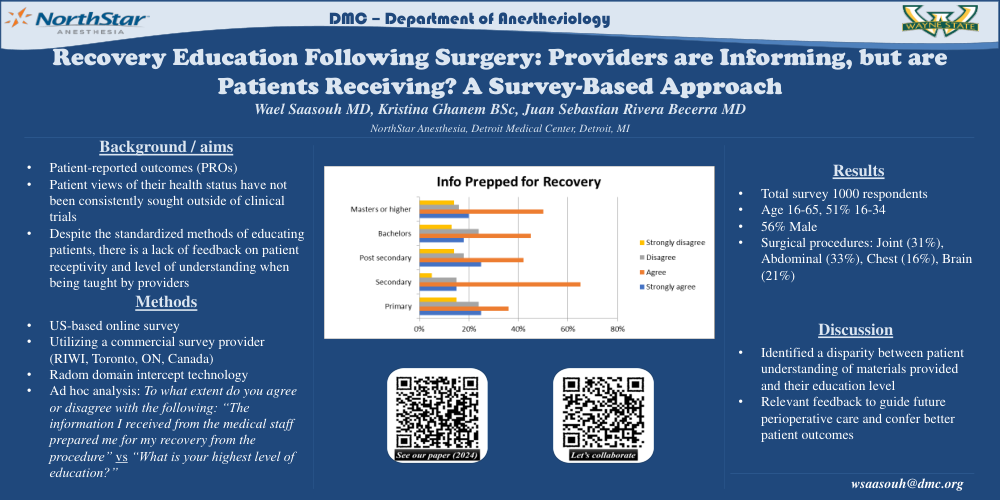
Methods: A survey “Patient Sentiment on Perioperative Best Practices” was obtained from US participants. Survey questions were collected online via an anonymous survey of web users using a commercial survey provider (RIWI, Toronto, ON, Canada). This work is a sub-analysis of the parent dataset. Participants were asked to identify their highest level of education with the options being: primary, secondary, bachelors, or masters/higher. Participants were then asked to respond with the options strongly agree, agree, disagree, and strongly disagree to the question: “To what extent do you agree or disagree with the following: “The information I received from the medical staff prepared me for my recovery from the procedure”. IRB approval was obtained.
Results: A total of 2369 respondents answered the survey. The age of respondents ranged from 16 to over 65 and was skewed towards younger respondents with 51% of responses obtained from the 16-34 yr demographic. Gender balance of respondents was 56% Male: 44% Female. Respondents were categorized into those experiencing a surgical procedure resulting in loss of consciousness (27%) versus those not experiencing any surgical procedure (72%). Surveyed surgical procedures comprised of: Joint surgeries (31%), Abdominal surgeries (33%), Chest surgeries (16%) and Brain surgeries (21%). Surgical respondents were asked a range of questions to describe their perioperative experience. Participants were asked to indicate their education level with primary, secondary, post-secondary, bachelors, or masters/higher. They were then asked to report how agreeable they were to the statement “The information I received from the medical staff prepared me for my recovery from the procedure”. Those who selected “agree” to the statement consisted of 36% primary level and 65% secondary level education participants. Those who selected “Strongly disagree” consisted of 15% primary level and 5% secondary level education participants.
Conclusion: Survey participants whose highest level of education was primary school were less agreeable to the information being provided by medical staff as having helped them prepare for their postoperative recovery. The use of this surveying technique has allowed for a disparity to be identified between patient understanding and patient education level. Patient reported outcomes give providers relevant feedback which can help guide perioperative care and confer better patient outcomes. The commercial use of a standardized surveying technique is a novel step towards inviting patients to become a key part of patient-centered care with optimal outcomes.