334 posters, 125 sessions, 831 authors, 236 institutions
ePostersLive by SciGen Technologies S.A. All rights reserved.
78th Annual PostGraduate Assembly in Anesthesiology (PGA78) 2024
December 6 - 9, 2024 | New York City

4011
A Novel Approach to Surveying Patients Undergoing Anesthesia
Poster Presenter
Part of Topic
A Novel Approach to Surveying Patients Undergoing Anesthesia
Wael Saasouh MD, Kristina Ghanem BSc, Asifa Manzoor MD
Background: Patient-reported outcomes (PROs) play a pivotal role in optimizing perioperative care and patient outcomes. Until recently, there has been a lack of standardization in collecting PROs across hospital systems and specialties. We report the use of a novel real-time surveying technology through a commercial survey provider that allows large scale collection of responder input. This technology utilizes Random Domain Intercept Technology (RDIT) and permits survey dissemination across geographical and political barriers.
Methods: We conducted a survey titled “Patient Sentiment on Perioperative Best Practices”, consisting of specific questions written by the lead study author (WS) obtained from US participants. Survey questions were collected online via an anonymous opt-in survey of web users using a commercial survey provider (RIWI, Toronto, ON, Canada). This work is a sub-analysis of the parent dataset. Patients who underwent an abdominal procedure were asked to respond with pain medication usage duration during the post-operative period.
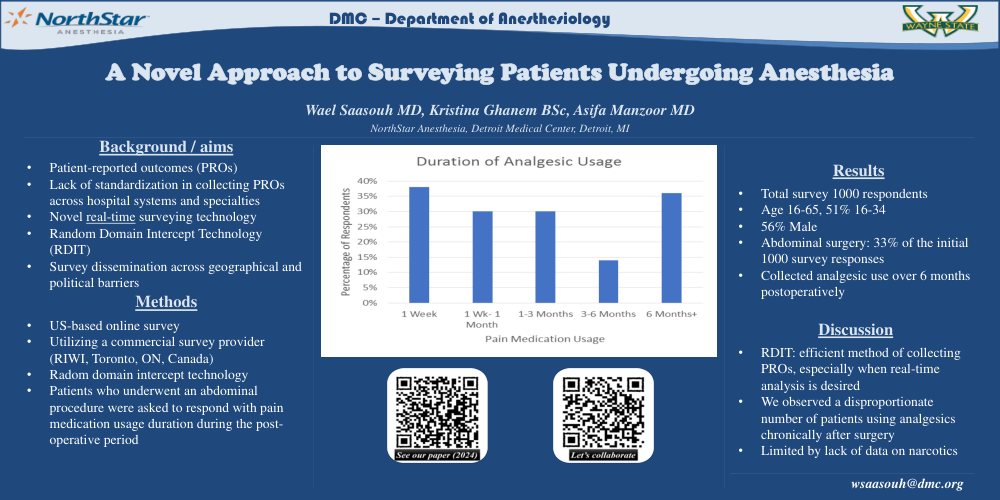
Results: A total of 2369 respondents participated in the original survey, spanning an age range from 16 to over 65. Responses were skewed towards younger participants, with 51% falling within the 16-34 age range. Gender balance of respondents was 56% Male: 44% Female. Of the respondents to this question, 37% reported analgesic use less than 1 week, 30% reported 1-4 weeks, 30% reported 1-3 months, 14% reported 3-6 months, and 26% reported analgesic use for over 6 months postoperatively.
Conclusion: RDIT promises to be an efficient method of collecting PROs, especially when answers are required in a timely manner for near real-time implementation of quality initiatives. In a sample subset of our parent data, we observed a disproportionate number of patients using analgesics chronically after surgery. Further analysis of associated answers may shed more light on the types of surgeries involved, although over 6 months of analgesic use can hardly be attributed to justifiable postoperative pain.