334 posters, 125 sessions, 831 authors, 236 institutions
ePostersLive by SciGen Technologies S.A. All rights reserved.
78th Annual PostGraduate Assembly in Anesthesiology (PGA78) 2024
December 6 - 9, 2024 | New York City

4010
Patterns of Intraoperative Hypotension (IOH) in Community Anesthesia Practice
Poster Presenter
Part of Topic
Patterns of Intraoperative Hypotension (IOH) in Community Anesthesia Practice
Wael Saasouh, MD1,2; Anna L. Christensen, PhD3; Jonathan Gellar, PhD3; Desirée Chappell, CRNA1; Josh Lumbley, MD1; Richard P. Dutton, MD4
- NorthStar Anesthesia, Irving, TX
- Outcomes Research Consortium, Cleveland, OH
- Mathematica, Washington, DC
- University of Maryland, Largo, MD
References
- Gregory A, Stapelfeldt WH, Khanna AK, et al. Intraoperative Hypotension Is Associated With Adverse Clinical Outcomes After Noncardiac Surgery. Anesth Analg. 2021;132(6):1654-1665. doi:10.1213/ANE.0000000000005250
- Sessler DI, Bloomstone JA, Aronson S, et al. Perioperative Quality Initiative consensus statement on intraoperative blood pressure, risk and outcomes for elective surgery. Br J Anaesth. 2019;122(5):563-574. doi:10.1016/j.bja.2019.01.013
- Saasouh, W., Christensen, A.L., Xing, F. et al. Incidence of intraoperative hypotension during non-cardiac surgery in community anesthesia practice: a retrospective observational analysis. Perioper Med 12, 29 (2023). https://doi.org/10.1186/s13741-023-00318-y
Introduction
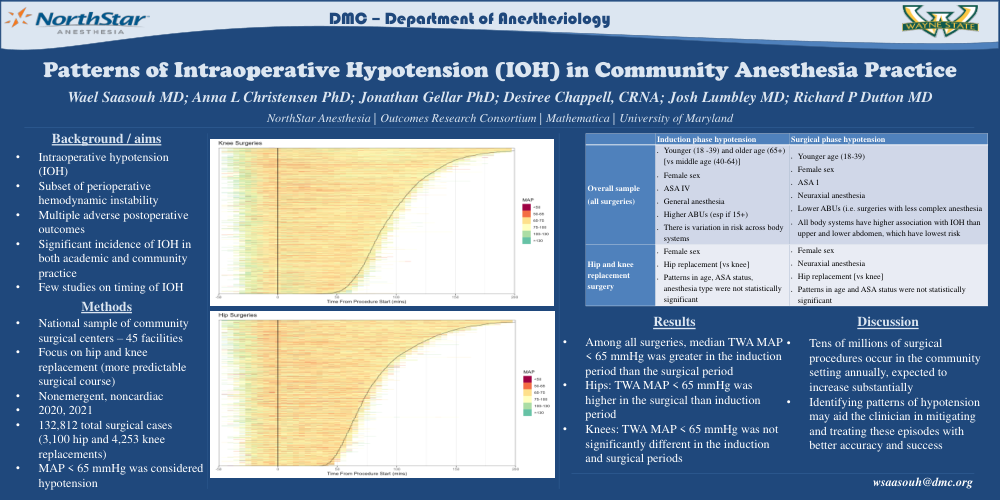
Intraoperative hypotension (IOH), a subset of perioperative hemodynamic instability, has been linked to multiple adverse postoperative outcomes, including renal, cardiac, and neurologic injury[1]. Recent evidence shows a significant incidence of IOH in both academic and community practice, where it affects around 30% of all surgical patients[2,3]. Few studies have examined the incidence of and risk factors for hypotension in the induction versus surgical periods. We have analyzed a series of procedures performed at a national sample of community surgical centers, focusing on hip and knee replacement due to their more predictable sequence of events.
Methods
Two large US anesthesia practices contributed retrospective data on nonemergent, noncardiac surgical cases between 2020 and 2021 from 45 facilities. Inclusion criteria: patients aged 18 years or older; non-emergent surgery (including elective and urgent); general, neuraxial, or regional anesthesia care; ASA physical status classification of 1, 2, 3, or 4. The final sample consisted of 132,812 total surgical cases. Among them were 3,100 hip replacement surgeries and 4,253 knee replacement surgeries. The data was expressed graphically via lasagna plots to visualize temporal patterns of hypotension [7,8]. A mean arterial pressure (MAP) below 65 mmHg was considered hypotension. We compared time-weighted average (TWA) MAP < 65 mmHg during the induction and surgical periods, and also estimated multivariate regression models to identify factors associated with hypotension during these periods.
Results
Among all surgeries, the median TWA MAP < 65 mmHg was greater in the induction period than the surgical period. In knee replacement surgeries the TWA MAP < 65 mmHg was not significantly different in the induction and surgical periods, and in hip replacement surgeries, TWA MAP < 65 mmHg was higher in the surgical than induction period . In the overall sample and the subset of hip and knee replacement surgeries, the factors associated with induction phase and surgical phase hypotension were identified and reported.
Discussion
Considering that tens of millions surgical procedures occur in the community setting annually, a number that is projected to increase substantially, this topic is timely and important from a patient outcomes perspective. Identifying patterns of hypotension may aid the clinician in mitigating and treating these episodes with better accuracy and success. This is especially true since at least a portion of these hypotensive periods are deemed preventable according to previous work.