334 posters, 125 sessions, 831 authors, 236 institutions
ePostersLive by SciGen Technologies S.A. All rights reserved.
78th Annual PostGraduate Assembly in Anesthesiology (PGA78) 2024
December 6 - 9, 2024 | New York City

4009
Financial Wellness in Anesthesia: A Fair Isaac Corporation (FICO) Score Cross-Sectional Analysis of United States Anesthesia Trainees and Attendings
Poster Presenter
Authors
Wael Saasouh, Timothy Flanagan, Zwade Marshall, Peter Palumbo, Christopher Robinson
Affiliations
Part of Topic
Financial Wellness in Anesthesia: A Fair Isaac Corporation (FICO) Score Cross-Sectional Analysis of United States Anesthesia Trainees and Attendings
Wael Saasouh, MD1,2; Peter Palumbo, BA1; Christopher L. Robinson, MD PhD1; Timothy Flanagan, MD1; Zwade J. Marshall, MD3
- Scientific Research Committee, Doc2Doc Lending, Inc, Atlanta, GA, USA.
- Outcomes Research Consortium, Cleveland, OH, USA.
- Doc2Doc Lending, Inc, Atlanta, GA, USA.
References
- Youngclaus J, Fresne JA. Physician Education Debt and the Cost to Attend Medical School: 2020 Update. 2020.
- Average Medical School Debt [2023]: Student Loan Statistics. https://educationdata.org/average-medical-school-debt (accessed Oct 28, 2023).
Introduction
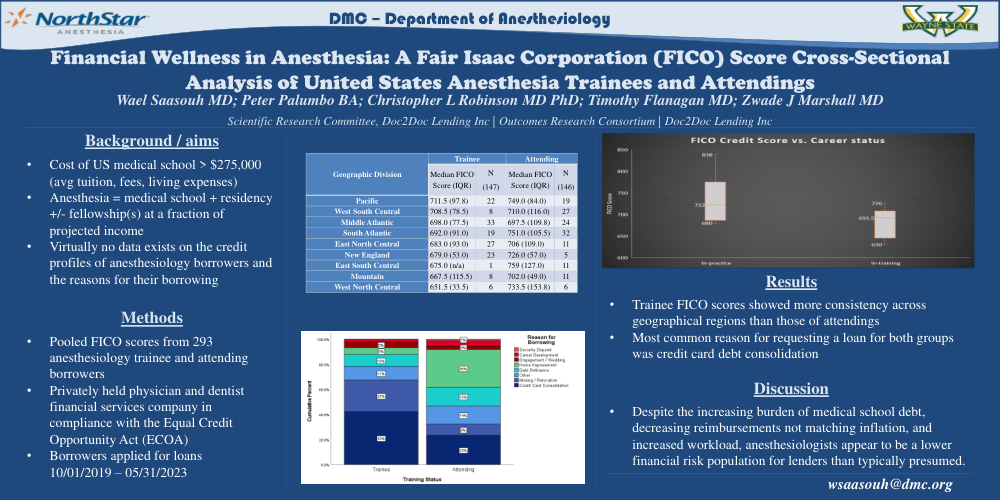
The average cost for tuition, fees, and living expenses at 50% of United States medical schools exceeds $275,000[1,2]. In addition, anesthesiologists receive 4 years of residency training and 1-2 years fellowship training at a fraction of their projected income. Virtually no data exists on the credit profiles of anesthesiology borrowers and the reasons for their borrowing. In the first analysis of its kind, we assessed the credit profiles of anesthesiology borrowers by FICO score, training or career stage, regional distribution, and reasons for borrowing.
Methods
This cross-sectional study was based on pooled FICO scores from 293 anesthesiology trainee and attending borrowers from 2019-2023 sourced from a privately held physician and dentist financial services company in compliance with the Equal Credit Opportunity Act (ECOA). Borrowers applied for loans from October 1, 2019 to May 31, 2023. Descriptive analyses were performed characterizing the median borrower FICO score based on status (trainee vs. attending), geographical distribution, and reasons for loan requests.
Results
The median FICO score of the 147 trainees was 690 and of the 146 attendings was 724 with a difference of 34 points. Trainee FICO scores showed more consistency across geographical regions than those of attendings. The most common reason for requesting a loan for both groups was credit card debt consolidation, followed by moving/relocation expenses.
Conclusions
Despite the increasing burden of medical school debt, decreasing reimbursements not matching inflation, and increased workload, anesthesiologists appear to be a lower financial risk population for lenders than typically presumed.