334 posters, 125 sessions, 831 authors, 236 institutions
ePostersLive by SciGen Technologies S.A. All rights reserved.
78th Annual PostGraduate Assembly in Anesthesiology (PGA78) 2024
December 6 - 9, 2024 | New York City

4008
Investigating the Relationship Between Education Level and Return to Preoperative Functional Status After Surgery
Poster Presenter
Part of Topic
Investigating the Relationship Between Education Level and Return to Preoperative Functional Status After Surgery
Wael Saasouh MD, Kristina Ghanem BSc, Navid Manafi MD
Background: Patient-reported outcomes (PROs) play a pivotal role in optimizing perioperative care and patient outcomes. Until recently, there has been a lack of standardization in collecting PROs across hospital systems and specialties. Real-Time Interactive Worldwide Intelligence (RIWI), a commercial survey provider, has introduced an innovative, large-scale approach to PRO data collection via Random Domain Intercept Technology (RDIT). Higher levels of education have been implicated in patients’ ability to understand and implement postoperative instructions promoting a faster return to baseline level of function. This analysis aimed to investigate this relationship.
Methods: We conducted a survey titled “Patient Sentiment on Perioperative Best Practices”, consisting of specific questions written by the lead study author (WS) obtained from US participants. Survey questions were collected online via an anonymous opt-in survey of web users using a commercial survey provider (RIWI, Toronto, ON, Canada). This work is a sub-analysis of the parent dataset. Participants were requested to disclose their highest level of education, with the options including: primary, secondary, bachelors, or masters/higher. Participants were then to identify the length of time passed before returning to their preoperative level of function with the options being: less than one week, one week to one month, one month to three months, three months to six months, or more than six months.
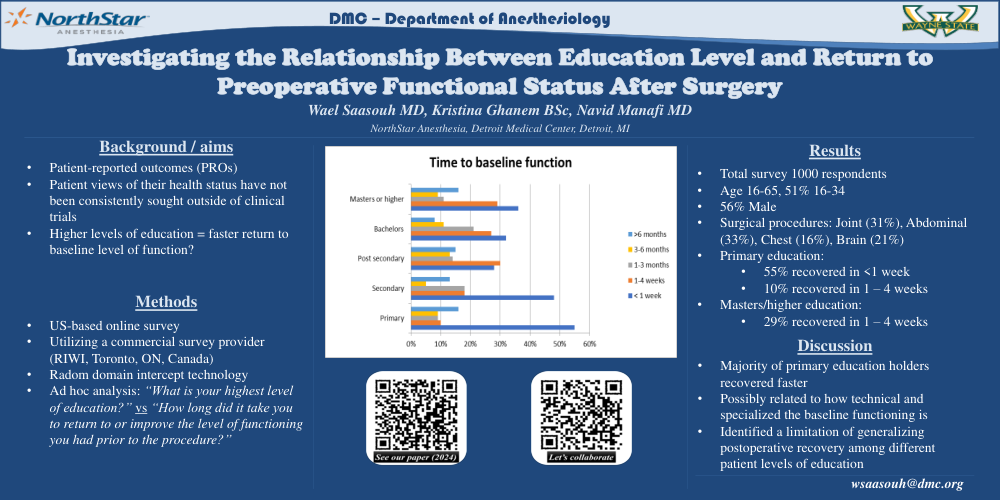
Results: A total of 2369 respondents participated in the original survey, spanning an age range from 16 to over 65. Responses were skewed towards younger participants, with 51% falling within the 16-34 age range. Gender balance of respondents was 56% Male: 44% Female. A total of 269 respondents answered both education and baseline functioning status. Among those with a primary level of education, 55% reported returning to baseline functioning in less than 1 week postoperatively, while 10% indicated a recovery period of one week and one month to return to baseline. Of those who reported having a masters/higher, 29% reported returning to baseline functioning between one week and one month. Participants with a post-secondary degree, 30% reported returning to baseline functioning between one week and one month.
Conclusion: The majority of participants whose highest level of education was primary or secondary school reported taking less than one week to return to baseline functioning. Longer recovery times were observed in groups with a higher level of education. While the implications of this data are unclear, and accepting the limitations of survey research, the presumed relationship between higher levels of education and improved postoperative outcomes may need to be revised.