334 posters, 125 sessions, 831 authors, 236 institutions
ePostersLive by SciGen Technologies S.A. All rights reserved.
78th Annual PostGraduate Assembly in Anesthesiology (PGA78) 2024
December 6 - 9, 2024 | New York City

4007
Intra-Operative Hypotension is an Important Modifiable Risk Factor for Major Complications in Spinal Fusion Surgery
Poster Presenter
Part of Topic
Intra-Operative Hypotension is an Important Modifiable Risk Factor for Major Complications in Spinal Fusion Surgery
Wael Saasouh, MD1,3, Steven D. Glassman MD2, Leah Y. Carreon MD, MSc2, Mladen Djurasovic MD2, Desiree Chappell, MSNA, CRNA, FAAN1, Christy Daniels, MS2, Colleen Mahoney, BA2, Morgan Brown, MS2, Jeffrey Gum, MD2
1 NorthStar Anesthesia, 6225 State Hwy 161 #200, Irving, TX, 75038 USA
2 Norton Leatherman Spine Center, 210 East Gray Street, Suite 900, Louisville, KY 40202
3 Outcomes Research Consortium, Cleveland Clinic, 9500 Euclid Ave, L1-407, Cleveland, OH 44195
Study Design: Retropsective observational cohort
Objectives: This study examines the association betweenIntraoperative hypotension and on postoperative complications for major thoracolumbar spine fusion procedures.
Summary of Background Data: Intraoperative hypotension (IOH) with mean arterial pressure (MAP) < 65 mmHg is associated with post-op acute kidney injury (AKI) in general surgery.1 In spinal deformity surgery, IOH is a contributing factor to MEP changes and spinal cord dysfunction with deformity correction.2
Methods: IRB exemption was obtained. 539 thoracolumbar fusion cases, > 6 surgical levels and > 3 hours duration were identified. Anesthetic/surgical data included OR time, fluid volume, blood loss, blood product replacement and use of vasopressors. Arterial-line based MAP data was collected at 1 min intervals. Cumulative duration of MAP < 65 mmHg was recorded. Timing of IOH within the procedure was assessed. Post-op course and complications including SSI, GI complications, pulmonary complications, MI, DVT, PE, AKI and encephalopathy were noted. Cumulative complications were grouped as “None”, “1-2 complications”, or “>3 complications”.
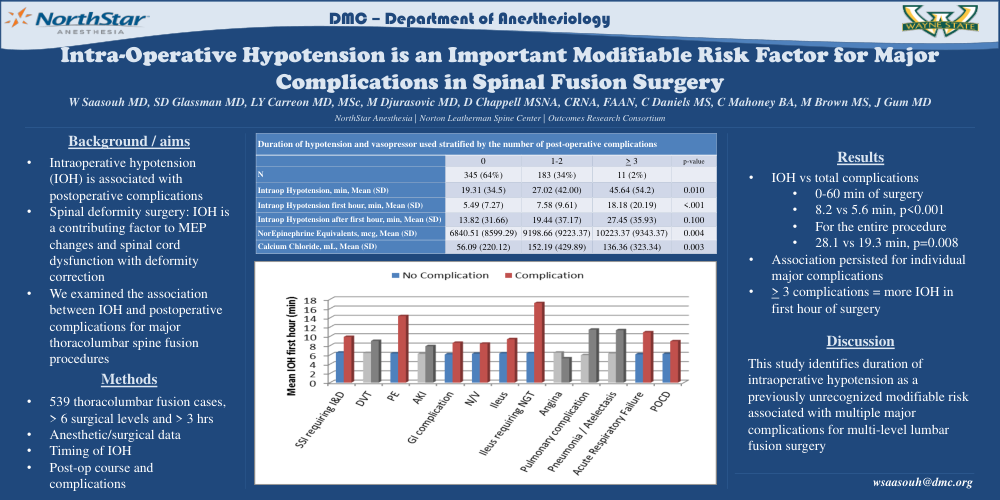
Results: There was a significant association between occurrence of complications and duration of IOH within the first hour of surgery (8.2 vs 5.6 min, p<0.001) and for the entire procedure (28.1 vs 19.3 min, p=0.008). This association persisted for individual major complications including SSI, acute respiratory failure, PE, ileus requiring NGT and post-operative cognitive dysfunction.
Comparison of patients with 0 vs. 1-2 vs. 3 or more complications demonstrated that patients with 3 or more complications had a longer duration of IOH in the first hour of the surgery and that patients who had no complications received less vasopressor than patients who had 1-2 or 3 or more complications.
Conclusion: This study identifies duration of intraoperative hypotension as a previously unrecognized modifiable risk associated with multiple major complications for multi-level lumbar fusion surgery.
References
- Sessler DI, Bloomstone JA, Aronson S, et al. Perioperative Quality Initiative consensus statement on intraoperative blood pressure, risk and outcomes for elective surgery. Br J Anaesth. 2019;122(5):563-574. doi:10.1016/j.bja.2019.01.013
- Yang J, Skaggs DL, Chan P, et al. Raising Mean Arterial Pressure Alone Restores 20% of Intraoperative Neuromonitoring Losses. Spine (Phila Pa 1976). 2018;43(13):890-894. doi:10.1097/BRS.0000000000002461