334 posters, 125 sessions, 831 authors, 236 institutions
ePostersLive by SciGen Technologies S.A. All rights reserved.
78th Annual PostGraduate Assembly in Anesthesiology (PGA78) 2024
December 6 - 9, 2024 | New York City

3266
Pressure-Controlled Ventilation versus Volume-Controlled Ventilation for Adult Patients with Acute Respiratory Failure: A Systematic Review and Meta-Analysis
Poster Presenter
Authors
Affiliations
Part of Topic
Authors and Contact details
Sitta Suntrawanichakul, Faculty of Medicine, Khon Kaen University, Thailand (Email: firstsitta@kkumail.com)
Sittichai Khamsai, M.D., Department of Medicine, Faculty of Medicine, Khon Kaen University, Thailand
Kittisak Sawanyawisuth, M.D., Ph.D., Department of Medicine, Faculty of Medicine, Khon Kaen University, Thailand
Background
Mechanical ventilator is the mainstay treatment for patients with acute respiratory failure. The common ventilation modes include pressure-controlled ventilation (PCV) and volume-controlled ventilation (VCV). However, there was controversy about the benefits of PCV when comparing with VCV from previous studies. This study aimed to compare the effectiveness of the two ventilations in adult patients with any causes of acute respiratory failure.
Methodology
This systematic review included any randomized controlled trials compared VCV and PCV ventilator mode in intubated adult patients with acute respiratory failure from any conditions. There were two interesting outcomes of this review including incidence of barotrauma, pneumothorax and in-hospital mortality rate. We performed a comprehensive search of four electronic databases including PubMed, Central, Scopus, and CINAHL from inception to July 14, 2023. Two reviewers independently conducted the screening titles and abstracts, extracting data, and evaluating risk of bias. Meta-analysis with fixed- effect model was used to pool the results of included studies.
Results
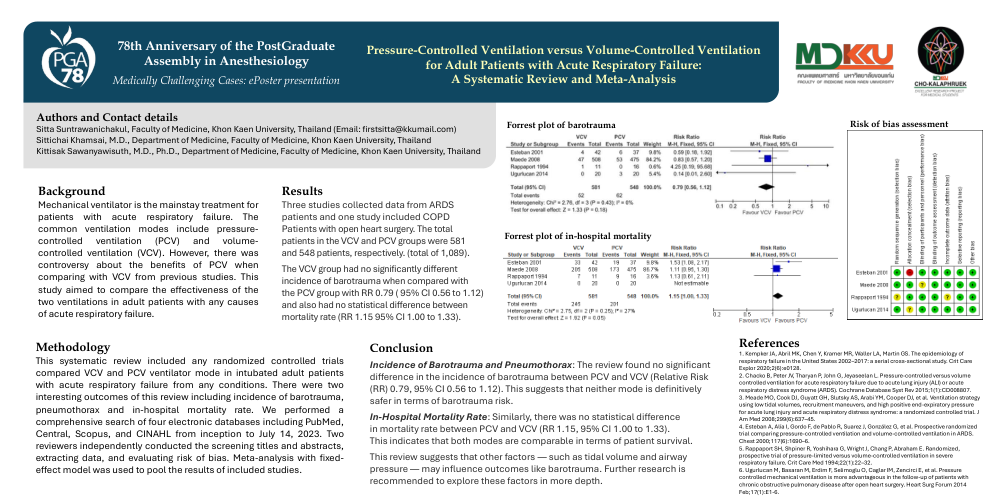
Three studies collected data from ARDS patients and one study included COPD Patients with open heart surgery. The total patients in the VCV and PCV groups were 581 and 548 patients, respectively. (total of 1,089). The VCV group had no significantly different incidence of barotrauma when compared with the PCV group with RR 0.79 ( 95% CI 0.56 to 1.12) and also had no statistical difference between mortality rate (RR 1.15 95% CI 1.00 to 1.33).
Conclusion
Incidence of Barotrauma and Pneumothorax: The review found no significant difference in the incidence of barotrauma between PCV and VCV (Relative Risk (RR) 0.79, 95% CI 0.56 to 1.12). This suggests that neither mode is definitively safer in terms of barotrauma risk.
In-Hospital Mortality Rate: Similarly, there was no statistical difference in mortality rate between PCV and VCV (RR 1.15, 95% CI 1.00 to 1.33). This indicates that both modes are comparable in terms of patient survival.
This review suggests that other factors — such as tidal volume and airway pressure — may influence outcomes like barotrauma. Further research is recommended to explore these factors in more depth.
References
1. Kempker JA, Abril MK, Chen Y, Kramer MR, Waller LA, Martin GS. The epidemiology of respiratory failure in the United States 2002–2017: a serial cross-sectional study. Crit Care Explor 2020;2(6):e0128.
2. Chacko B, Peter JV, Tharyan P, John G, Jeyaseelan L. Pressure-controlled versus volume controlled ventilation for acute respiratory failure due to acute lung injury (ALI) or acute respiratory distress syndrome (ARDS). Cochrane Database Syst Rev 2015;1(1):CD008807.
3. Meade MO, Cook DJ, Guyatt GH, Slutsky AS, Arabi YM, Cooper DJ, et al. Ventilation strategy using low tidal volumes, recruitment maneuvers, and high positive end-expiratory pressure for acute lung injury and acute respiratory distress syndrome: a randomized controlled trial. J Am Med 2008;299(6):637–45.
4. Esteban A, Alía I, Gordo F, de Pablo R, Suarez J, González G, et al. Prospective randomized trial comparing pressure-controlled ventilation and volume-controlled ventilation in ARDS. Chest 2000;117(6):1690–6.
5. Rappaport SH, Shpiner R, Yoshihara G, Wright J, Chang P, Abraham E. Randomized, prospective trial of pressure-limited versus volume-controlled ventilation in severe respiratory failure. Crit Care Med 1994;22(1):22–32.
6. Ugurlucan M, Basaran M, Erdim F, Selimoglu O, Caglar IM, Zencirci E, et al. Pressure controlled mechanical ventilation is more advantageous in the follow-up of patients with chronic obstructive pulmonary disease after open heart surgery. Heart Surg Forum 2014 Feb;17(1):E1-6.