334 posters, 125 sessions, 831 authors, 236 institutions
ePostersLive by SciGen Technologies S.A. All rights reserved.
78th Annual PostGraduate Assembly in Anesthesiology (PGA78) 2024
December 6 - 9, 2024 | New York City

3260
Difficult Airway Management in a Patient with Severe Rheumatoid Arthritis
Poster Presenter
Authors
Affiliations
New York Institute of Technology College of Osteopathic Medicine
Part of Topic
Difficult Airway Management in a Patient with Severe Rheumatoid Arthritis
Michelle Li, BS, Dr. Chunhua Li, MD, Dr. Farzana Afroze, MD
Department of Anesthesiology, Albany Medical Center – Albany, NY
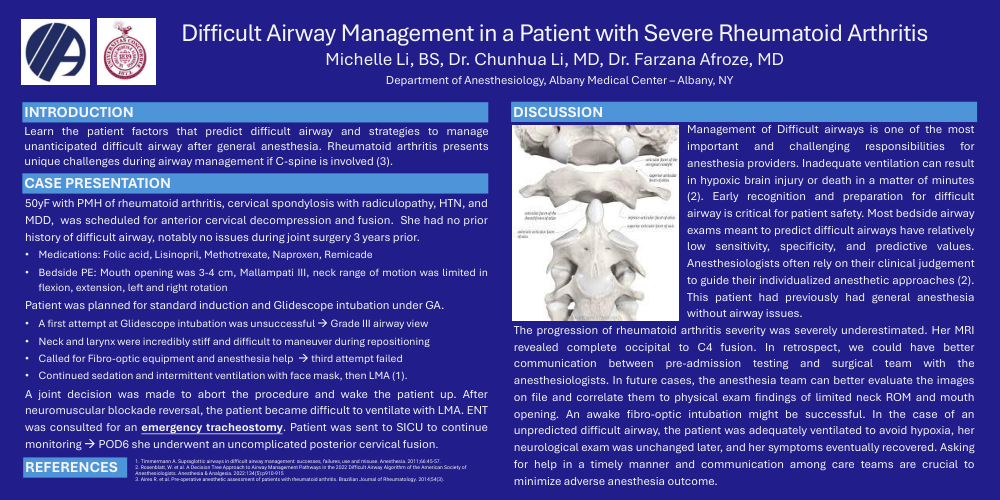
INTRODUCTION: Learn the patient factors that predict difficult airway and strategies to manage unanticipated difficult airway after general anesthesia. Rheumatoid arthritis presents unique challenges during airway management if C-spine is involved (3).
CASE PRESENTATION: 50yF with PMH of rheumatoid arthritis, cervical spondylosis with radiculopathy, HTN, and MDD, was scheduled for anterior cervical decompression and fusion. She had no prior history of difficult airway, notably no issues during joint surgery 3 years prior.
Patient was planned for standard induction and Glidescope intubation under GA.
A joint decision was made to abort the procedure and wake the patient up. After neuromuscular blockade reversal, the patient became difficult to ventilate with LMA. ENT was consulted for an emergency tracheostomy. Patient was sent to SICU to continue monitoring à POD6 she underwent an uncomplicated posterior cervical fusion.
DISCUSSION: Management of Difficult airways is one of the most important and challenging responsibilities for anesthesia providers. Inadequate ventilation can result in hypoxic brain injury or death in a matter of minutes (2). Early recognition and preparation for difficult airway is critical for patient safety. Most bedside airway exams meant to predict difficult airways have relatively low sensitivity, specificity, and predictive values. Anesthesiologists often rely on their clinical judgement to guide their individualized anesthetic approaches (2). This patient had previously had general anesthesia without airway issues.
The progression of rheumatoid arthritis severity was severely underestimated. Her MRI revealed complete occipital to C4 fusion. In retrospect, we could have better communication between pre-admission testing and surgical team with the anesthesiologists. In future cases, the anesthesia team can better evaluate the images on file and correlate them to physical exam findings of limited neck ROM and mouth opening. An awake fibro-optic intubation might be successful. In the case of an unpredicted difficult airway, the patient was adequately ventilated to avoid hypoxia, her neurological exam was unchanged later, and her symptoms eventually recovered. Asking for help in a timely manner and communication among care teams are crucial to minimize adverse anesthesia outcome.