334 posters, 125 sessions, 831 authors, 236 institutions
ePostersLive by SciGen Technologies S.A. All rights reserved.
78th Annual PostGraduate Assembly in Anesthesiology (PGA78) 2024
December 6 - 9, 2024 | New York City

3257
Successful Airway Management with Combined Use of Videolaryngoscope and Fiberoptic Bronchoscope in a Patient undergoing Radical Neck Dissection, Total Thyroidectomy and Tracheostomy
Poster Presenter
Authors
Affiliations
Part of Topic
Introduction
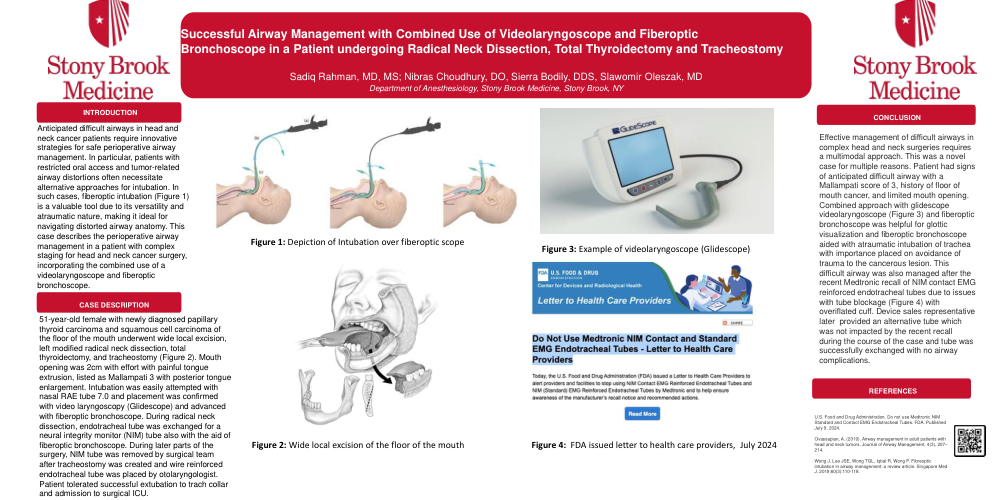
Anticipated difficult airways in head and neck cancer patients require innovative strategies for safe perioperative airway management. In particular, patients with restricted oral access and tumor-related airway distortions often necessitate alternative approaches for intubation. In such cases, fiberoptic intubation (Figure 1) is a valuable tool due to its versatility and atraumatic nature, making it ideal for navigating distorted airway anatomy. This case describes the perioperative airway management in a patient with complex staging for head and neck cancer surgery, incorporating the combined use of a videolaryngoscope and fiberoptic bronchoscope.
Case Description
51-year-old female with newly diagnosed papillary thyroid carcinoma and squamous cell carcinoma of the floor of the mouth underwent wide local excision, left modified radical neck dissection, total thyroidectomy, and tracheostomy (Figure 2). Mouth opening was 2cm with effort with painful tongue extrusion, listed as Mallampati 3 with posterior tongue enlargement. Intubation was easily attempted with nasal RAE tube 7.0 and placement was confirmed with video laryngoscopy (Glidescope) and advanced with fiberoptic bronchoscope. During radical neck dissection, endotracheal tube was exchanged for a neural integrity monitor (NIM) tube also with the aid of fiberoptic bronchoscope. During later parts of the surgery, NIM tube was removed by surgical team after tracheostomy was created and wire reinforced endotracheal tube was placed by otolaryngologist. Patient tolerated successful extubation to trach collar and admission to surgical ICU.
Conclusion
Effective management of difficult airways in complex head and neck surgeries requires a multimodal approach. This was a novel case for multiple reasons. Patient had signs of anticipated difficult airway with a Mallampati score of 3, history of floor of mouth cancer, and limited mouth opening. Combined approach with glidescopevideolaryngoscope (Figure 3) and fiberoptic bronchoscope was helpful for glottic visualization and fiberoptic bronchoscope aided with atraumatic intubation of trachea with importance placed on avoidance of trauma to the cancerous lesion. This difficult airway was also managed after the recent Medtronic recall of NIM contact EMG reinforced endotracheal tubes due to issues with tube blockage (Figure 4) with overiflated cuff. Device sales representative later provided an alternative tube which was not impacted by the recent recall during the course of the case and tube was successfully exchanged with no airway complications.