334 posters, 125 sessions, 831 authors, 236 institutions
ePostersLive by SciGen Technologies S.A. All rights reserved.
78th Annual PostGraduate Assembly in Anesthesiology (PGA78) 2024
December 6 - 9, 2024 | New York City

3027
Anesthetic Management of Acute Type A Aortic Dissection in a 27-week Pregnant Patient
Poster Presenter
Part of Topic
Learning Objective:
Describe the anesthetic considerations and multidisciplinary management of Type A aortic dissection in a pregnant patient with Marfan Syndrome.
Case Description:
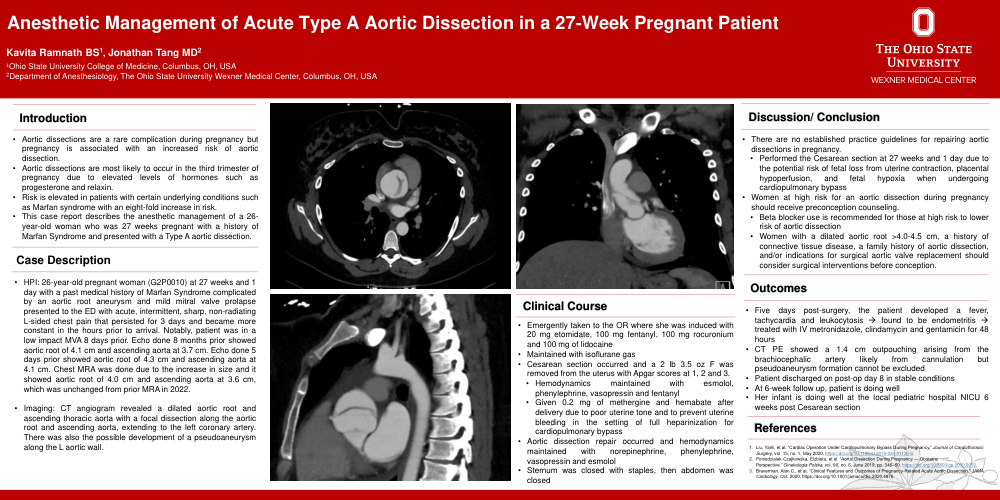
A 26-year-old pregnant woman (G2P0010) at 27 weeks and 1 day, with Marfan Syndrome complicated by an aortic root aneurysm and mild mitral valve prolapse, presented to the emergency department with acute, intermittent, sharp, non-radiating left-sided chest pain persisting for 3 days and becoming more constant in the hours prior to arrival. A CT angiogram revealed a dilated aortic root and ascending thoracic aorta with a focal dissection along the aortic root and ascending aorta, extending to the left coronary artery. The patient was emergently taken to the operating room for a cesarean section, followed by a Bentall procedure to repair the Type A dissection. The procedures were completed without complication. At a 6-week follow-up, both the patient and the infant were doing well, though the infant remained in the NICU at the local pediatric hospital.
Discussion:
This case highlights the early diagnosis and successful treatment of a Type A aortic dissection in a 26-year-old pregnant woman in her second trimester. The morbidity and mortality rates of Type A dissection in pregnant patients remain high, with the incidence rate increasing from 2002 to 2017 in the United States. While there are no firmly established practice guidelines, it is suggested that if a patient less than 28 weeks pregnant experiences an aortic dissection, repair should proceed without a cesarean section. In this case, the obstetrics team and the patient jointly decided to perform the cesarean section before the Type A dissection repair, despite being at 27 weeks and 1 day, due to the potential risk of fetal loss from uterine contraction, placental hypoperfusion, and fetal hypoxia during cardiopulmonary bypass.
Although the specific aortic diameter in pregnant patients with Marfan Syndrome that increases the risk of aortic dissection is unknown, case studies have shown that dissection is uncommon when the aortic diameter is below 4 cm. Women with a dilated aortic root >4.0-4.5 cm, a history of connective tissue disease, a family history of aortic dissection, and/or indications for surgical aortic valve replacement should consider surgical interventions before conception.