334 posters, 125 sessions, 831 authors, 236 institutions
ePostersLive by SciGen Technologies S.A. All rights reserved.
78th Annual PostGraduate Assembly in Anesthesiology (PGA78) 2024
December 6 - 9, 2024 | New York City

3252
Incidental ~4x4cm Lipomatous Hypertrophy of the Interatrial Septum (LHAS) in a Triple Coronary Artery Bypass Graft Surgery (CABG): Surgical and Anesthetic Considerations
Part of Topic
Introduction
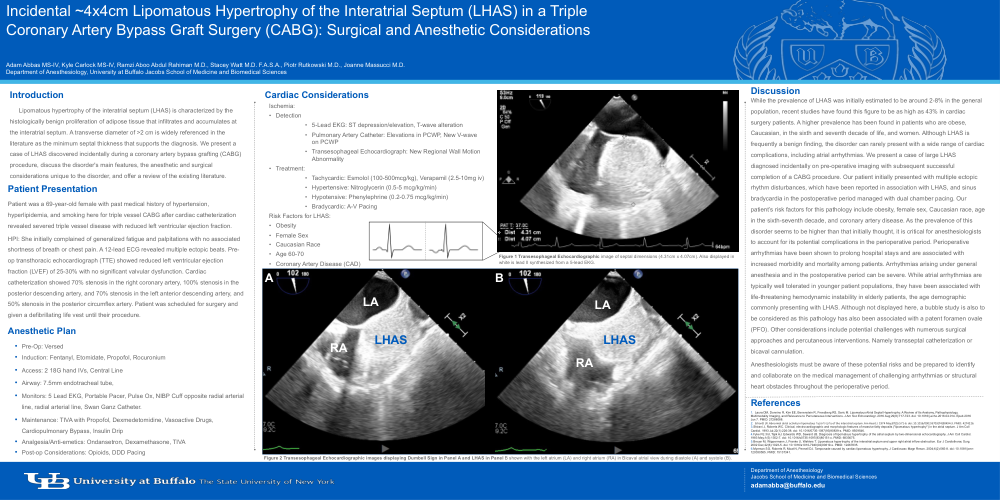
Lipomatous hypertrophy of the interatrial septum (LHAS) is characterized by the histologically benign proliferation of adipose tissue that infiltrates and accumulates at the interatrial septum. A transverse diameter of >2 cm is widely referenced in the literature as the minimum septal thickness that supports the diagnosis. We present a case of LHAS discovered incidentally during a coronary artery bypass grafting (CABG) procedure, discuss the disorder's main features, the anesthetic and surgical considerations unique to the disorder, and offer a review of the existing literature.
Patient Presentation
Patient was a 69-year-old female with past medical history of hypertension, hyperlipidemia, and smoking here for triple vessel CABG after cardiac catheterization revealed severed triple vessel disease with reduced left ventricular ejection fraction.
HPI: She initially complained of generalized fatigue and palpitations with no associated shortness of breath or chest pain. A 12-lead ECG revealed multiple ectopic beats. Pre-op transthoracic echocardiograph (TTE) showed reduced left ventricular ejection fraction (LVEF) of 25-30% with no significant valvular dysfunction. Cardiac catheterization showed 70% stenosis in the right coronary artery, 100% stenosis in the posterior descending artery, and 70% stenosis in the left anterior descending artery, and 50% stenosis in the posterior circumflex artery. Patient was scheduled for surgery and given a defibrillating life vest until their procedure.
Anesthetic Plan
Ischemia:
Risk Factors for LHAS:
While the prevalence of LHAS was initially estimated to be around 2-8% in the general population, recent studies have found this figure to be as high as 43% in cardiac surgery patients. A higher prevalence has been found in patients who are obese, Caucasian, in the sixth and seventh decade of life, and women. Although LHAS is frequently a benign finding, the disorder can rarely present with a wide range of cardiac complications, including atrial arrhythmias. We present a case of large LHAS diagnosed incidentally on pre-operative imaging with subsequent successful completion of a CABG procedure. Our patient initially presented with multiple ectopic rhythm disturbances, which have been reported in association with LHAS, and sinus bradycardia in the postoperative period managed with dual chamber pacing. Our patient’s risk factors for this pathology include obesity, female sex, Caucasian race, age in the sixth-seventh decade, and coronary artery disease. As the prevalence of this disorder seems to be higher than that initially thought, it is critical for anesthesiologists to account for its potential complications in the perioperative period. Perioperative arrhythmias have been shown to prolong hospital stays and are associated with increased morbidity and mortality among patients. Arrhythmias arising under general anesthesia and in the postoperative period can be severe. While atrial arrhythmias are typically well tolerated in younger patient populations, they have been associated with life-threatening hemodynamic instability in elderly patients, the age demographic commonly presenting with LHAS. Although not displayed here, a bubble study is also to be considered as this pathology has also been associated with a patent foramen ovale (PFO). Other considerations include potential challenges with numerous surgical approaches and percutaneous interventions. Namely transseptal catheterization or bicaval cannulation.
Anesthesiologists must be aware of these potential risks and be prepared to identify and collaborate on the medical management of challenging arrhythmias or structural heart obstacles throughout the perioperative period.
References