334 posters, 125 sessions, 831 authors, 236 institutions
ePostersLive by SciGen Technologies S.A. All rights reserved.
78th Annual PostGraduate Assembly in Anesthesiology (PGA78) 2024
December 6 - 9, 2024 | New York City

3243
Navigating the Airway Maze: Managing Laryngomalacia and Suspected Subglottic Stenosis in an Infant
Poster Presenter
Authors
Affiliations
Part of Topic
Navigating the Airway Maze: Managing Laryngomalacia and Suspected Subglottic Stenosis in an Infant
Samit Ghia M.D., Muhammad Afaq M.S.
Staten Island University Hospital, Staten Island, NY
PGA 2024 Conference: Medically Challenging Case
CASE DESCRIPTION/CHALLENGE:
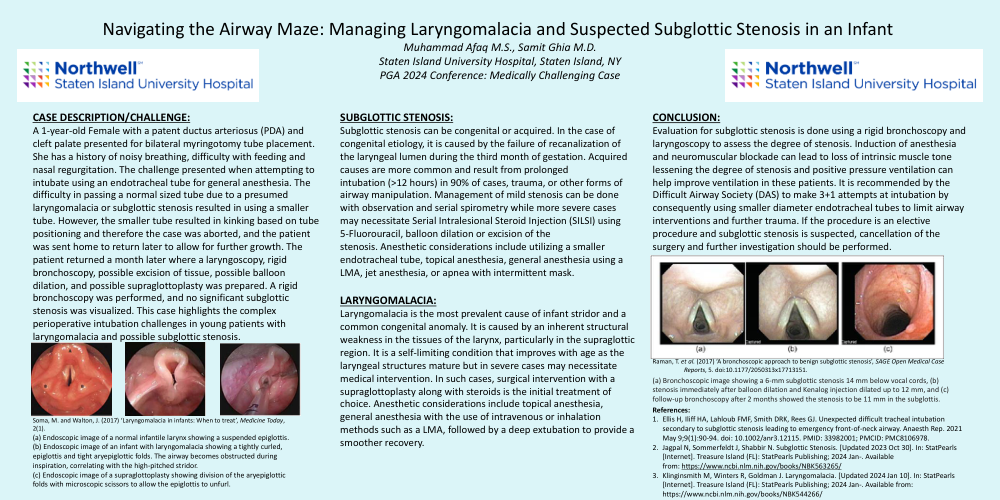
A 1-year-old Female with a patent ductus arteriosus (PDA) and cleft palate presented for bilateral myringotomy tube placement. She has a history of noisy breathing, difficulty with feeding and nasal regurgitation. The challenge presented when attempting to intubate using an endotracheal tube for general anesthesia. The difficulty in passing a normal sized tube due to a presumed laryngomalacia or subglottic stenosis resulted in using a smaller tube. However, the smaller tube resulted in kinking based on tube positioning and therefore the case was aborted, and the patient was sent home to return later to allow for further growth. The patient returned a month later where a laryngoscopy, rigid bronchoscopy, possible excision of tissue, possible balloon dilation, and possible supraglottoplasty was prepared. A rigid bronchoscopy was performed, and no significant subglottic stenosis was visualized. This case highlights the complex perioperative intubation challenges in young patients with laryngomalacia and possible subglottic stenosis.
SUBGLOTTIC STENOSIS:
Subglottic stenosis can be congenital or acquired. In the case of congenital etiology, it is caused by the failure of recanalization of the laryngeal lumen during the third month of gestation. Acquired causes are more common and result from prolonged intubation (>12 hours) in 90% of cases, trauma, or other forms of airway manipulation. Management of mild stenosis can be done with observation and serial spirometry while more severe cases may necessitate Serial Intralesional Steroid Injection (SILSI) using 5-Fluorouracil, balloon dilation or excision of the stenosis. Anesthetic considerations include utilizing a smaller endotracheal tube, topical anesthesia, general anesthesia using a LMA, jet anesthesia, or apnea with intermittent mask.
LARYNGOMALACIA:
Laryngomalacia is the most prevalent cause of infant stridor and a common congenital anomaly. It is caused by an inherent structural weakness in the tissues of the larynx, particularly in the supraglottic region. It is a self-limiting condition that improves with age as the laryngeal structures mature but in severe cases may necessitate medical intervention. In such cases, surgical intervention with a supraglottoplasty along with steroids is the initial treatment of choice. Anesthetic considerations include topical anesthesia, general anesthesia with the use of intravenous or inhalation methods such as a LMA, followed by a deep extubation to provide a smoother recovery.
CONCLUSION:
Evaluation for subglottic stenosis is done using a rigid bronchoscopy and laryngoscopy to assess the degree of stenosis. Induction of anesthesia and neuromuscular blockade can lead to loss of intrinsic muscle tone lessening the degree of stenosis and positive pressure ventilation can help improve ventilation in these patients. It is recommended by the Difficult Airway Society (DAS) to make 3+1 attempts at intubation by consequently using smaller diameter endotracheal tubes to limit airway interventions and further trauma. If the procedure is an elective procedure and subglottic stenosis is suspected, cancellation of the surgery and further investigation should be performed.