334 posters, 125 sessions, 831 authors, 236 institutions
ePostersLive by SciGen Technologies S.A. All rights reserved.
78th Annual PostGraduate Assembly in Anesthesiology (PGA78) 2024
December 6 - 9, 2024 | New York City

3242
Jet Ventilation and Airway Management for Patient with Idiopathic Subglottic Stenosis
Poster Presenter
Authors
Affiliations
Part of Topic
|
Jet Ventilation and Airway Management for Patient with Idiopathic Subglottic Stenosis Neveada Raventhiranathan, MD, Slawomir Oleszak MD Department of Anesthesiology, Stony Brook University Hospital Renaissance School of Medicine, Stony Brook University |
|
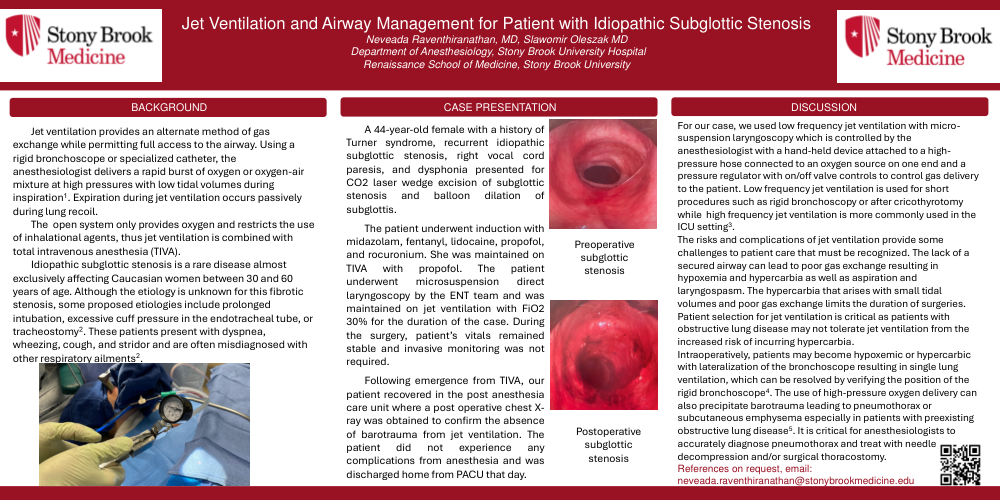
BACKGROUND Jet ventilation provides an alternate method of gas exchange while permitting full access to the airway. Using a rigid bronchoscope or specialized catheter, the anesthesiologist delivers a rapid burst of oxygen or oxygen-air mixture at high pressures with low tidal volumes during inspiration1. Expiration during jet ventilation occurs passively during lung recoil. The open system only provides oxygen and restricts the use of inhalational agents, thus jet ventilation is combined with total intravenous anesthesia (TIVA). Idiopathic subglottic stenosis is a rare disease almost exclusively affecting Caucasian women between 30 and 60 years of age. Although the etiology is unknown for this fibrotic stenosis, some proposed etiologies include prolonged intubation, excessive cuff pressure in the endotracheal tube, or tracheostomy2. These patients present with dyspnea, wheezing, cough, and stridor and are often misdiagnosed with other respiratory ailments2. CASE PRESENTATION A 44-year-old female with a history of Turner syndrome, recurrent idiopathic subglottic stenosis, right vocal cord paresis, and dysphonia presented for CO2 laser wedge excision of subglottic stenosis and balloon dilation of subglottis. The patient underwent induction with midazolam, fentanyl, lidocaine, propofol, and rocuronium. She was maintained on TIVA with propofol. The patient underwent microsuspension direct laryngoscopy by the ENT team and was maintained on jet ventilation with FiO2 30% for the duration of the case. During the surgery, patient’s vitals remained stable and invasive monitoring was not required. Following emergence from TIVA, our patient recovered in the post anesthesia care unit where a post operative chest X- ray was obtained to confirm the absence of barotrauma from jet ventilation. The patient did not experience any complications from anesthesia and was discharged home from PACU that day. DISCUSSION For our case, we used low frequency jet ventilation with micro- suspension laryngoscopy which is controlled by the anesthesiologist with a hand-held device attached to a high- pressure hose connected to an oxygen source on one end and a pressure regulator with on/off valve controls to control gas delivery to the patient. Low frequency jet ventilation is used for short procedures such as rigid bronchoscopy or after cricothyrotomy while high frequency jet ventilation is more commonly used in the ICU setting3. The risks and complications of jet ventilation provide some challenges to patient care that must be recognized. The lack of a secured airway can lead to poor gas exchange resulting in hypoxemia and hypercarbia as well as aspiration and laryngospasm. The hypercarbia that arises with small tidal volumes and poor gas exchange limits the duration of surgeries. Patient selection for jet ventilation is critical as patients with obstructive lung disease may not tolerate jet ventilation from the increased risk of incurring hypercarbia. Intraoperatively, patients may become hypoxemic or hypercarbic with lateralization of the bronchoscope resulting in single lung ventilation, which can be resolved by verifying the position of the rigid bronchoscope4. The use of high-pressure oxygen delivery can also precipitate barotrauma leading to pneumothorax or subcutaneous emphysema especially in patients with preexisting obstructive lung disease5. It is critical for anesthesiologists to accurately diagnose pneumothorax and treat with needle decompression and/or surgical thoracostomy. |