334 posters, 125 sessions, 831 authors, 236 institutions
ePostersLive by SciGen Technologies S.A. All rights reserved.
78th Annual PostGraduate Assembly in Anesthesiology (PGA78) 2024
December 6 - 9, 2024 | New York City

3026
Continuous Serratus Anterior Plane Block (SAPB) and Pectoral Fascial Blocks (PECS) in an Anticoagulated Patient after Left Ventricular Assisted Device Implantation via Thoracoscopic Approach
Poster Presenter
Authors
Affiliations
Part of Topic
Title: Continuous Serratus Anterior Plane Block (SAPB) and Pectoral Fascial Blocks (PECS) in an Anticoagulated Patient after Left Ventricular Assisted Device Implantation via Thoracoscopic Approach
Authors: Austin Puchany, DO; Yue Qiu, MD; Beverly Pearce-Smith, MD.
Department of Anesthesiology & Perioperative Medicine, University of Pittsburgh & University of Pittsburgh Medical Center, Pittsburgh, PA
Background:
Regional Anesthesia for cardiac can help reduce complications from the traditional primarily opioid driven intra-operative pain management strategy.
Reduced opiate requirements can decrease opioid induced hyperalgesia, respiratory depression, and constipation (amongst others) allowing for earlier extubation and decreased length of stay.
Cardiac surgery patients generally have greater anticoagulation medication requirements, posing a barrier to regional anesthesia given the risk for hemorrhage.
(ASRA) proposed guidelines for anticoagulation management surrounding regional anesthesia to help reduce the risk of bleeding complications[1].
Patient Case:
18-year-old male with PMH of NICM, HFrEF (11%), presented with chest pain and dizziness.
Found to be in cardiogenic shock, admitted to ICU, started on milrinone and eventually required Impella 5.5 placement.
Maintained on Bivalirudin infusion following Impella placement which was discontinued at 12am on the morning of surgery.
Underwent HM3 LVAD implant under minimally invasive robotic-assisted sternal sparing approach.
Following surgery was taken to the ICU. Patient was extubated on POD0 and endorsed extreme pain at surgical site.
Placed continuous Left SAP and left PEC blocks with some symptomatic relief.
24 hours prior to block he had received 500U IV Antithrombin III and Heparin boluses (total 40000U) in OR.
Patient was subsequently placed on IV Heparin 500 u/hr 24hrs following catheter placement, with bridge to warfarin 31hrs post block.
This was not discussed with our team. INR was 2.5 when catheters were removed Post block day 3, without complication
Methods:
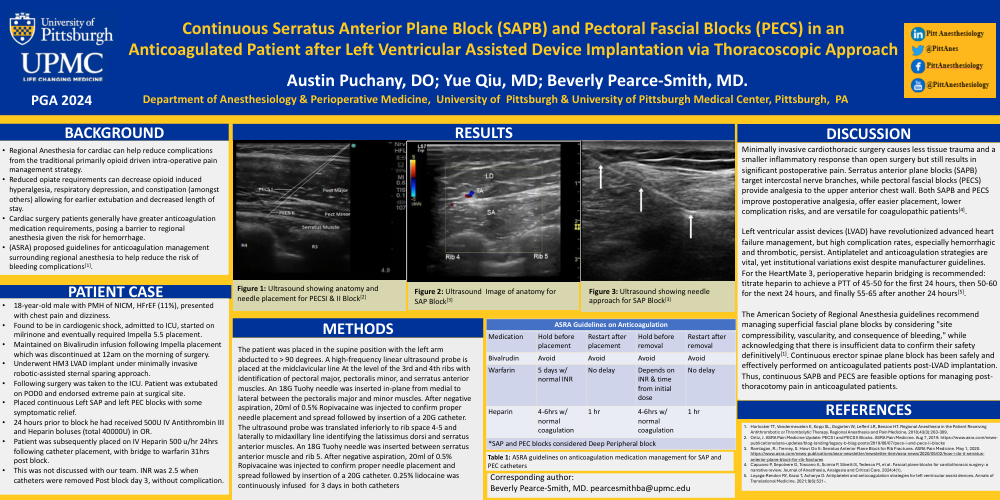
The patient was placed in the supine position with the left arm abducted to > 90 degrees. A high-frequency linear ultrasound probe is placed at the midclavicular line At the level of the 3rd and 4th ribs with identification of pectoral major, pectoralis minor, and serratus anterior muscles. An 18G Tuohy needle was inserted in-plane from medial to lateral between the pectoralis major and minor muscles. After negative
aspiration, 20ml of 0.5% Ropivacaine was injected to confirm proper needle placement and spread followed by insertion of a 20G catheter. The ultrasound probe was translated inferiorly to rib space 4-5 and laterally to midaxillary line identifying the latissimus dorsi and serratus anterior muscles. An 18G Tuohy needle was inserted between serratus anterior muscle and rib 5. After negative aspiration, 20ml of 0.5% Ropivacaine was injected to confirm proper needle placement and spread followed by insertion of a 20G catheter. 0.25% lidocaine was continuously infused for 3 days in both catheters
Discussion:
Minimally invasive cardiothoracic surgery causes less tissue trauma and a smaller inflammatory response than open surgery but still results in significant postoperative pain. Serratus anterior plane blocks (SAPB) target intercostal nerve branches, while pectoral fascial blocks (PECS) provide analgesia to the upper anterior chest wall. Both SAPB and PECS improve postoperative analgesia, offer easier placement, lower complication risks, and are versatile for coagulopathic patients[4].
Left ventricular assist devices (LVAD) have revolutionized advanced heart failure management, but high complication rates, especially hemorrhagic and thrombotic, persist. Antiplatelet and anticoagulation strategies are vital, yet institutional variations exist despite manufacturer guidelines. For the HeartMate 3, perioperative heparin bridging is recommended: titrate heparin to achieve a PTT of 45-50 for the first 24 hours, then 50-60 for the next 24 hours, and finally 55-65 after another 24 hours[5].
The American Society of Regional Anesthesia guidelines recommend managing superficial fascial plane blocks by considering "site compressibility, vascularity, and consequence of bleeding," while acknowledging that there is insufficient data to confirm their safety definitively[1]. Continuous erector spinae plane block has been safely and effectively performed on anticoagulated patients post-LVAD implantation. Thus, continuous SAPB and PECS are feasible options for managing post-thoracotomy pain in anticoagulated patients.
References:
Horlocker TT, Vandermeuelen E, Kopp SL, Gogarten W, Leffert LR, Benzon HT. Regional Anesthesia in the Patient Receiving Antithrombotic or Thrombolytic Therapy. Regional Anesthesia and Pain Medicine. 2018;43(3):263-309.
Ortiz, J. ASRA Pain Medicine Update: PECS I and PECS II Blocks. ASRA Pain Medicine. Aug 7, 2019. https://www.asra.com/news-publications/asra-updates/blog-landing/legacy-b-blog-posts/2019/08/07/pecs-i-and-pecs-ii-blocks
Ramlogan, R.; Tierney, S. How i Do It: Serratus Anterior Plane Block for Rib Fractures. ASRA Pain Medicine. May 1, 2020. https://www.asra.com/news-publications/asra-newsletter/newsletter-item/asra-news/2020/05/02/how-i-do-it-serratus-anterior-plane-block-for-rib-fractures
Capuano P, Sepolvere G, Toscano A, Scimia P, Silvetti S, Tedesco M, et al. Fascial plane blocks for cardiothoracic surgery: a narrative review. Journal of Anesthesia, Analgesia and Critical Care. 2024;4(1).
Loyaga-Rendon RY, Kazui T, Acharya D. Antiplatelet and anticoagulation strategies for left ventricular assist devices. Annals of Translational Medicine. 2021;9(6):521-.