334 posters, 125 sessions, 831 authors, 236 institutions
ePostersLive by SciGen Technologies S.A. All rights reserved.
78th Annual PostGraduate Assembly in Anesthesiology (PGA78) 2024
December 6 - 9, 2024 | New York City

3240
Managing Acute Biventricular Failure Due to an Unshockable, Shockable Rhythm
Poster Presenter
Authors
Affiliations
Part of Topic
Learning Objective: Anesthetic management and considerations of percutaneous MitraClip implantation in a young, high-risk patient with symptomatic severe mitral regurgitation who was not suitable for mitral valve replacement
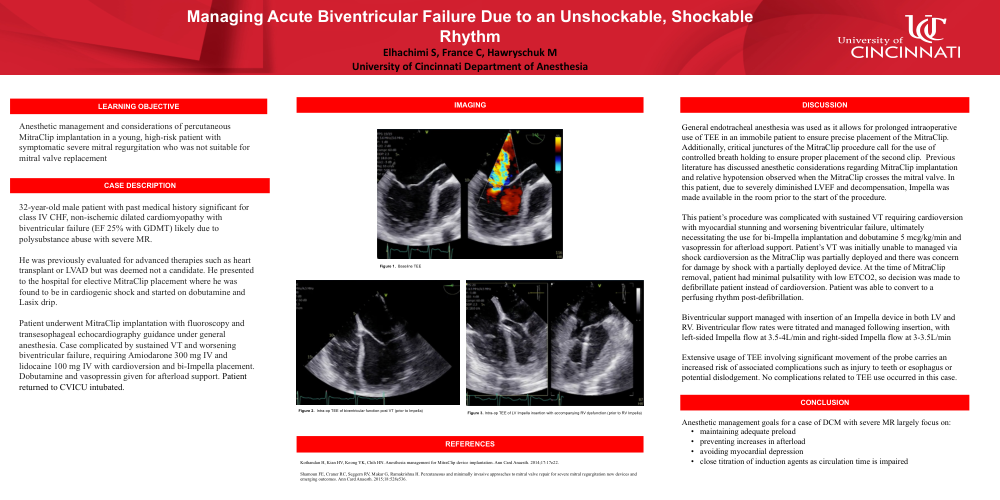
Case: 32-year-old male patient with past medical history significant for class IV CHF, non-ischemic dilated cardiomyopathy with biventricular failure (EF 25% with GDMT) likely due to polysubstance abuse with severe MR. He was previously evaluated for advanced therapies such as heart transplant or LVAD but was deemed not a candidate. He presented to the hospital for elective MitraClip placement where he was found to be in cardiogenic shock and started on dobutamine and Lasix drip. Patient underwent MitraClip implantation with fluoroscopy and transesophageal echocardiography guidance under general anesthesia. Case complicated by sustained VT and worsening biventricular failure, requiring Amiodarone 300 mg IV and lidocaine 100 mg IV with cardioversion and bi-Impella placement. Dobutamine and vasopressin given for afterload support. Patient returned to CVICU intubated.
Discussion: General endotracheal anesthesia was used as it allows for prolonged intraoperative use of TEE in an immobile patient to ensure precise placement of the MitraClip. Additionally, critical junctures of the MitraClip procedure call for the use of controlled breath holding to ensure proper placement of the second clip. Previous literature has discussed anesthetic considerations regarding MitraClip implantation and relative hypotension observed when the MitraClip crosses the mitral valve. In this patient, due to severely diminished LVEF and decompensation, Impella was made available in the room prior to the start of the procedure.
This patient’s procedure was complicated with sustained VT requiring cardioversion with myocardial stunning and worsening biventricular failure, ultimately necessitating the use for bi-Impella implantation and dobutamine 5 mcg/kg/min and vasopressin for afterload support. Patient’s VT was initially unable to managed via shock cardioversion as the MitraClip was partially deployed and there was concern for damage by shock with a partially deployed device. At the time of MitraClip removal, patient had minimal pulsatility with low ETCO2, so decision was made to defibrillate patient instead of cardioversion. Patient was able to convert to a perfusing rhythm post-defibrillation.
Biventricular support managed with insertion of an Impella device in both LV and RV. Biventricular flow rates were titrated and managed following insertion, with left-sided Impella flow at 3.5-4L/min and right-sided Impella flow at 3-3.5L/min
Extensive usage of TEE involving significant movement of the probe carries an increased risk of associated complications such as injury to teeth or esophagus or potential dislodgement. No complications related to TEE use occurred in this case.
Conclusion:
Anesthetic management goals for a case of DCM with severe MR largely focus on: