Loading...

334 posters, 125 sessions, 831 authors, 236 institutions

ePostersLive by SciGen Technologies S.A. All rights reserved.

3237

Local Anesthetic Resistance in Peripheral Nerve Blocks
Part of Topic

INTRODUCTION

●Local anesthetic resistance is a phenomenon where patients show a reduced or absent response to standard doses of local anesthetics  
●Resistance to these medications complicates anesthetic and pain management plans for surgical patients 
●Resistance can be caused by genetic factors, chronic pain syndromes or anatomical differences

CASE PRESENTATION

HPI: 63-year-old female with medical history of mixed connective tissue disease, DVT, anxiety, bipolar disorder, GERD, IBS, CKD stage 3A, OA and nickel allergy presented for right ankle surgery. Patient reported previous failures with peripheral nerve blocks. No records of these incidents were available and the team decided to proceed with regional anesthesia. Surgery was to be performed in prone positioning with a thigh tourniquet for hemostasis.

Procedure:

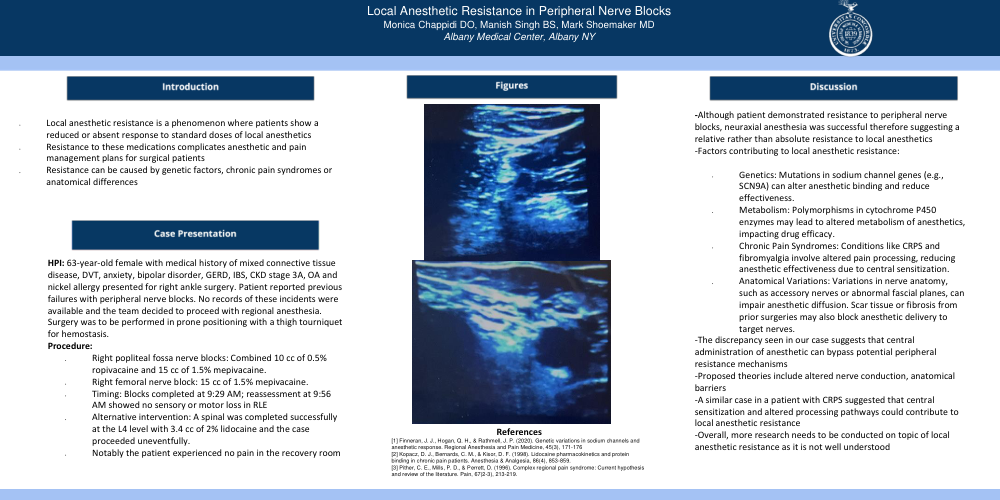
●Right popliteal fossa nerve blocks: Combined 10 cc of 0.5% ropivacaine and 15 cc of 1.5% mepivacaine.
●Right femoral nerve block: 15 cc of 1.5% mepivacaine.
●Timing: Blocks completed at 9:29 AM; reassessment at 9:56 AM showed no sensory or motor loss in RLE 
●Alternative intervention: A spinal was completed successfully at the L4 level with 3.4 cc of 2% lidocaine and the case proceeded uneventfully. 
●Notably the patient experienced no pain in the recovery room

DISCUSSION:

-Although patient demonstrated resistance to peripheral nerve blocks, neuraxial anesthesia was successful therefore suggesting a relative rather than absolute resistance to local anesthetics 

-Factors contributing to local anesthetic resistance: 

●Genetics: Mutations in sodium channel genes (e.g., SCN9A) can alter anesthetic binding and reduce effectiveness.
●Metabolism: Polymorphisms in cytochrome P450 enzymes may lead to altered metabolism of anesthetics, impacting drug efficacy.
●Chronic Pain Syndromes: Conditions like CRPS and fibromyalgia involve altered pain processing, reducing anesthetic effectiveness due to central sensitization.
●Anatomical Variations: Variations in nerve anatomy, such as accessory nerves or abnormal fascial planes, can impair anesthetic diffusion. Scar tissue or fibrosis from prior surgeries may also block anesthetic delivery to target nerves.

-The discrepancy seen in our case suggests that central administration of anesthetic can bypass potential peripheral resistance mechanisms

-Proposed theories include altered nerve conduction, anatomical barriers 

-A similar case in a patient with CRPS suggested that central sensitization and altered processing pathways could contribute to local anesthetic resistance 

-Overall, more research needs to be conducted on topic of local anesthetic resistance as it is not well understood

78th Annual PostGraduate Assembly in Anesthesiology (PGA78) 2024 » banner
Copyright © 2015-2026, ePostersLive® SciGen is a registered trademark of SciGen Technologies S.A. Patent pending.

This website and third-party tools we use rely on cookies for the best user experience. By selecting "I agree", you agree to cookie usage as described in our Privacy Policy.
