334 posters, 125 sessions, 831 authors, 236 institutions
ePostersLive by SciGen Technologies S.A. All rights reserved.
78th Annual PostGraduate Assembly in Anesthesiology (PGA78) 2024
December 6 - 9, 2024 | New York City

3234
Treatment Options for Symptomatic Management of Ossified Posterior Longitudinal Ligament
Poster Presenter
Authors
Affiliations
Part of Topic
INTRODUCTION:
-OPLL is a rare spinal condition characterized by abnormal ossification of the posterior longitudinal ligament
-Presentation is typically radicular symptoms such as pain, numbness, tingling and in severe cases, myelopathy
-Most commonly seen in elderly men and Asian populations, with an incidence of 2.4% in Asian populations and 0.16% in non-Asian populations [1]
-Currently, the pathogenesis is unclear which could suggest why there is no established treatment regimen
CASE PRESENTATION:
HPI: 54 y/o Caucasian female who presented to the chronic pain clinic with persistent, limited ROM across the entire spine despite failed conservative treatments (physical therapy, chiropractic therapy, topic and OTC medications)
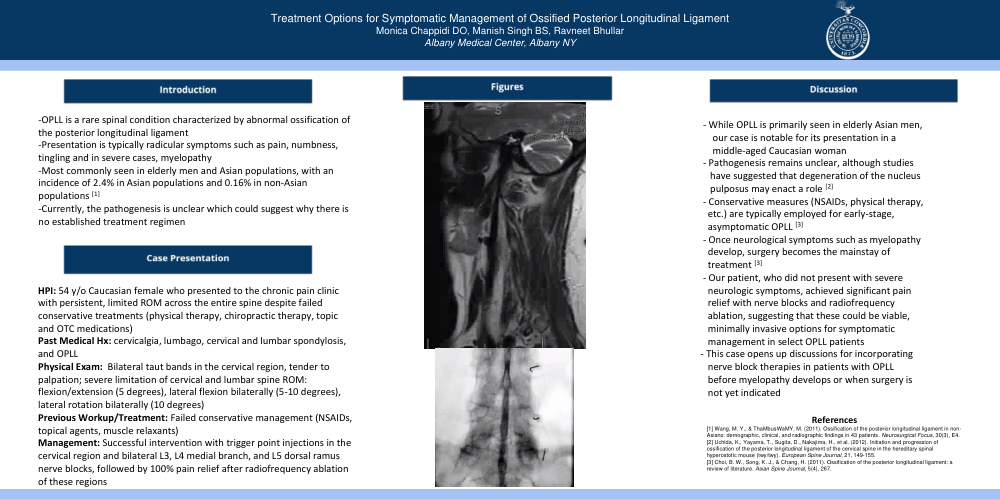
Past Medical Hx: cervicalgia, lumbago, cervical and lumbar spondylosis, and OPLL
Physical Exam: Bilateral taut bands in the cervical region, tender to palpation; severe limitation of cervical and lumbar spine ROM: flexion/extension (5 degrees), lateral flexion bilaterally (5-10 degrees), lateral rotation bilaterally (10 degrees)
Previous Workup/Treatment: Failed conservative management (NSAIDs, topical agents, muscle relaxants)
Management: Successful intervention with trigger point injections in the cervical region and bilateral L3, L4 medial branch, and L5 dorsal ramus nerve blocks, followed by 100% pain relief after radiofrequency ablation of these regions
DISCUSSION:
- While OPLL is primarily seen in elderly Asian men, our case is notable for its presentation in a middle-aged Caucasian woman
- Pathogenesis remains unclear, although studies have suggested that degeneration of the nucleus pulposus may enact a role [2]
- Conservative measures (NSAIDs, physical therapy, etc.) are typically employed for early-stage, asymptomatic OPLL [3]
- Once neurological symptoms such as myelopathy develop, surgery becomes the mainstay of treatment [3]
- Our patient, who did not present with severe neurologic symptoms, achieved significant pain relief with nerve blocks and radiofrequency ablation, suggesting that these could be viable, minimally invasive options for symptomatic management in select OPLL patients
- This case opens up discussions for incorporating nerve block therapies in patients with OPLL before myelopathy develops or when surgery is not yet indicated