334 posters, 125 sessions, 831 authors, 236 institutions
ePostersLive by SciGen Technologies S.A. All rights reserved.
78th Annual PostGraduate Assembly in Anesthesiology (PGA78) 2024
December 6 - 9, 2024 | New York City

3233
Anesthetic management of patient with refractory Guillain Barre Syndrome
Poster Presenter
Authors
Affiliations
Part of Topic
Anesthetic management of patient with refractory Guillain-Barre Syndrome
82 y/o male presents for Right Total Hip Arthroplasty (THA)
PMHx of:
•HTN, HLD, CAD/AWMI s/p LAD stent (2004), ICM s/p AICD (2016), CHF (EF 35-40%), Atrial Fibrillation s/p Watchman procedure
•BPH, SCC of the scalp, Osteoarthritis of bilateral hips
•Guillain-Barré Syndrome (GBS) with residual weakness of hip flexors and paresthesia with decreased sensation of UEs and LEs
vDiagnosed 3 years prior to THA
vAcute onset ascending lower extremity weakness thirteen days after a COVID19 vaccine-booster
vDespite treatment with IVIG and physical therapy, lower extremity weakness and paresthesia persisted
vAmbulates with the assistance of a cane
•GBS is an immune-mediated acute polyneuropathy with demyelination of nerves in the peripheral nervous system, which is ascending and may lead to flaccid paralysis, with possible respiratory muscle involvement
•Can occur after infection, medications, surgeries, and vaccinations
•GBS that results secondary to surgery is possibly more severe with a poorer prognosis (1)
•Limited data comparing general anesthetic versus Neuraxial (NA)/regional anesthetic techniques in patients with any history of GBS
•Potential for GBS exacerbation and lack of response to typical GBS treatment after administration of neuraxial analgesia (2)
•Potential exists for recovery after worsening of GBS after neuraxial anesthesia, but can require a severely prolonged course (3)
•Interaction between anesthetic agents used in neuraxial anesthesia and the peripheral nervous system myelin or local trauma have been postulated as possible risks of utilizing NA/regional anesthetic techniques (4)
•Such varied outcomes and risks create a challenge for anesthesiologists when determining safe anesthetic plans for patients with h/o GBS
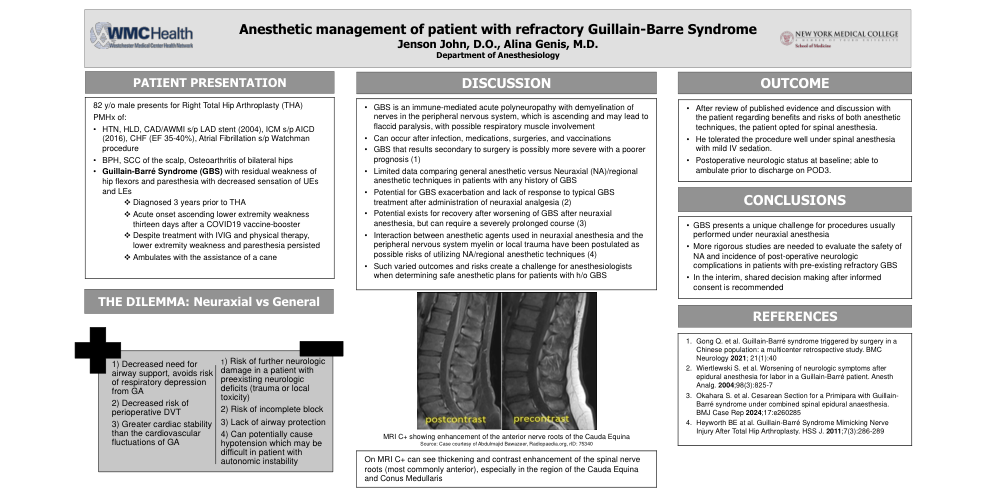
On MRI C+ can see thickening and contrast enhancement of the spinal nerve roots (most commonly anterior), especially in the region of the Cauda Equina and Conus Medullaris
•After review of published evidence and discussion with the patient regarding benefits and risks of both anesthetic techniques, the patient opted for spinal anesthesia.
•He tolerated the procedure well under spinal anesthesia with mild IV sedation.
•Postoperative neurologic status at baseline; able to ambulate prior to discharge on POD3.
•GBS presents a unique challenge for procedures usually performed under neuraxial anesthesia
•More rigorous studies are needed to evaluate the safety of NA and incidence of post-operative neurologic complications in patients with pre-existing refractory GBS
•In the interim, shared decision making after informed consent is recommended