334 posters, 125 sessions, 831 authors, 236 institutions
ePostersLive by SciGen Technologies S.A. All rights reserved.
78th Annual PostGraduate Assembly in Anesthesiology (PGA78) 2024
December 6 - 9, 2024 | New York City

3025
Anaesthesia management of caesarean delivery in a patient with a previous atrial switch procedure for D-transposition of the great arteries
Poster Presenter
Authors
Athika Sajeermohammed, Jawdat Alali, Mitko Kocarev, Annu Anna Suresh
Affiliations
Part of Topic
Anesthesia management of caesarean delivery in a patient with a previous atrial switch procedure for D-transposition of the great arteries
Athika Sajeermohammed, Annu Anna Suresh, Mitko Kocarev, Anwar Ul Huda, Jawdat Alali
Key words - Transposition of the great arteries (TGA), Atrial switch operation (ATSO), Combined spinal epidural anesthesia (CSE), pregnancy, cesarean delivery
INTRODUCTION
Transposition of the great arteries (TGA) is an congenital cardiac defect caused by embryological discordance of the aorta and pulmonary trunk. Historically, the surgical atrial switch operation (ATSO) was performed to reroute deoxygenated blood to the lungs and oxygenated blood to the body. Currently the arterial switch operation (ASO), which restores normal anatomical circulation, has become the preferred surgical approach. In this case, we present the anesthetic management for a cesarean delivery in a woman with dextro-transposition of the great arteries (d-TGA), corrected in childhood by the ATSO.
CASE DESCRIPTION
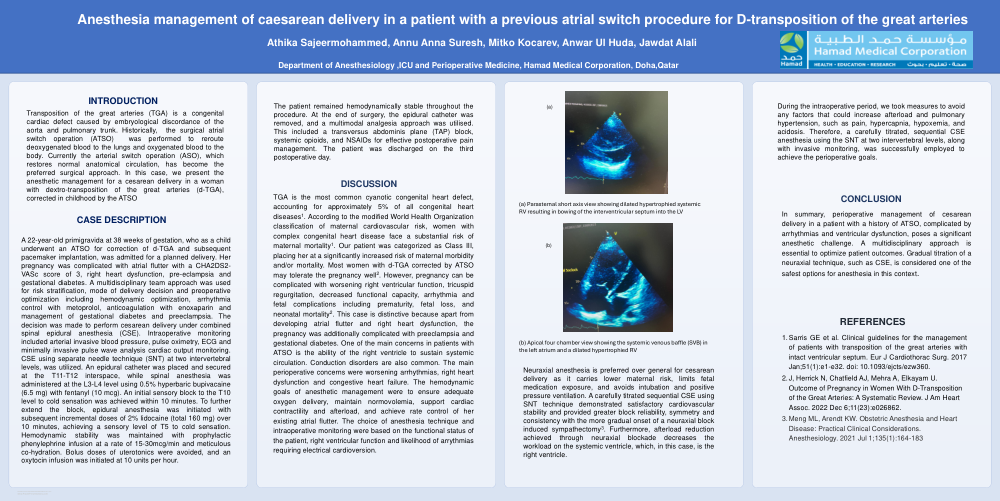
A 22-year-old primigravida at 38 weeks of gestation, who as a child underwent an ATSO for correction of dextro-transposition of the great arteries (d-TGA) and subsequent pacemaker implantation, was admitted for a planned delivery. Her pregnancy was complicated with atrial flutter with a CHA2DS2-VASc (check spelling again) score of 3, right heart dysfunction, pre-eclampsia and gestational diabetes. A multidisciplinary team approach was used for risk stratification, mode of delivery decision and preoperative optimization including hemodynamic optimization, arrhythmia control with metoprolol, anticoagulation with enoxaparin and management of gestational diabetes and preeclampsia. The decision was made to perform cesarean delivery under combined spinal epidural anesthesia (CSE). On the day of surgery, the patient was given aspiration prophylaxis. Intraoperative monitoring included arterial invasive blood pressure, pulse oximetry, ECG, perfusion index and minimally invasive pulse wave analysis cardiac output monitoring. CSE using separate needle technique (SNT) at two intervertebral levels, was utilized. An epidural catheter was placed and secured at the T11-T12 interspace, while spinal anesthesia was administered at the L3-L4 level using 0.5% hyperbaric bupivacaine (6.5 mg) with fentanyl (10 mcg). An initial sensory block to the T10 level to cold sensation was achieved within 10 minutes. To further extend the block, epidural anesthesia was initiated with subsequent incremental doses of 2% lidocaine (totaling 160 mg) over 10 minutes, achieving a sensory level of T5 to cold sensation. Hemodynamic stability was maintained with prophylactic phenylephrine infusion at a rate of 15-30mcg/min and meticulous co-hydration. Following delivery, bolus doses of uterotonics were avoided, and an oxytocin infusion was initiated at 10 units per hour. The patient remained hemodynamically stable throughout the procedure. At the end of surgery, the epidural catheter was removed, and a multimodal analgesia approach was utilised. This included a transversus abdominis plane (TAP) block, systemic opioids, and NSAIDs for effective postoperative pain management. Medical treatment and supportive care were continued in the postoperative period, and the patient was discharged on the third postoperative day.
Discussion:
TGA is the most common cyanotic congenital heart defect, accounting for approximately 5% of all congenital heart diseases (Ref 1) TGA is classified into two types: dextro-TGA (d-TGA) and levo-TGA (l-TGA). In d-TGA, the aorta arises from the right ventricle and the pulmonary trunk from the left ventricle, while in the rarer l-TGA, the two lower heart chambers are reversed. According to the modified World Health Organization classification of maternal cardiovascular risk, women with complex congenital heart disease face a substantial risk of maternal mortality (Ref 1). Our patient was categorized as Class III, placing her at a significantly increased risk of maternal morbidity and/or mortality.
Historically TGA was corrected with ATSO. At present, ASO is the standard surgical option. Most women with d-TGA corrected by ATSO may tolerate the pregnancy well (Ref 2). However, pregnancy can be complicated with worsening right ventricular function, tricuspid regurgitation, decreased functional capacity, arrhythmia and fetal complications including prematurity, fetal loss, and neonatal mortality (Ref 2). This case is distinctive because apart from developing atrial flutter and right heart dysfunction, the pregnancy was additionally complicated with preeclampsia and gestational diabetes. One of the main concerns in patients with ATSO is the ability of the right ventricle to sustain systemic circulation. Conduction disorders are also common. The main perioperative concerns were worsening arrhythmias, right heart dysfunction and congestive heart failure. The hemodynamic goals of anesthetic management were to ensure adequate oxygen delivery, maintain normovolemia, support cardiac contractility and afterload, and achieve rate control of her existing atrial flutter. Due to the rarity of this condition, published literature on the anesthetic management of these patients is limited. The choice of anesthesia technique and intraoperative monitoring were based on the functional status of the patient, right ventricular function and likelihood of arrythmias requiring electrical cardioversion. Neuraxial anesthesia is preferred over general for cesarean delivery as it carries lower maternal risk, limits fetal medication exposure, and avoids intubation and positive pressure ventilation. A carefully titrated sequential CSE using SNT technique was performed to minimize any hemodynamic changes. This technique demonstrated satisfactory cardiovascular stability and provided greater block reliability, symmetry and consistency with the more gradual onset of a neuraxial block induced sympathectomy (ref 3). Furthermore, afterload reduction achieved through neuraxial blockade decreases the workload on the systemic ventricle, which, in this case, is the right ventricle. During the intraoperative period, we took measures to avoid any factors that could increase afterload and pulmonary hypertension, such as pain, hypercapnia, hypoxemia, and acidosis. Therefore, a carefully titrated, sequential CSE anesthesia using the SNT at two intervertebral levels, along with invasive monitoring, was successfully employed to achieve the perioperative goals.
Conclusion
In summary, perioperative management of cesarean delivery in a patient with a history of ATSO, complicated by arrhythmias and ventricular dysfunction, poses a significant anesthetic challenge. A multidisciplinary approach is essential to optimize patient outcomes. Gradual titration of a neuraxial technique, such as CSE, is considered one of the safest options for anesthesia in this context.