334 posters, 125 sessions, 831 authors, 236 institutions
ePostersLive by SciGen Technologies S.A. All rights reserved.
78th Annual PostGraduate Assembly in Anesthesiology (PGA78) 2024
December 6 - 9, 2024 | New York City

3214
Use of Extracorporeal Membrane Oxygenation for Tracheal Resection with Critical Tracheal Stenosis and Impossible Proximal Airway Intubation
Poster Presenter
Authors
Affiliations
Part of Topic
Use of Extracorporeal Membrane Oxygenation for Tracheal Resection with Critical Tracheal Stenosis and Impossible Proximal Airway Intubation
Madison McConnell, OMS4 and Konstantinos Pilidis, MD
Geisinger Medical Center
Introduction:
Management of critical tracheal stenosis presents significant anesthetic and surgical challenges, particularly in cases where standard airway intubation is not feasible. Extracorporeal membrane oxygenation (ECMO) can serve as a life-saving alternative by providing oxygenation and hemodynamic support, allowing for complex airway procedures that would otherwise be impossible. We present a case of a patient with severe tracheal stenosis, where ECMO was successfully employed to facilitate tracheal resection and reconstruction. This approach underscores the importance of interdisciplinary collaboration in managing airway compromise and highlights ECMO as a critical tool in scenarios where conventional intubation is non-viable.
Case Presentation:
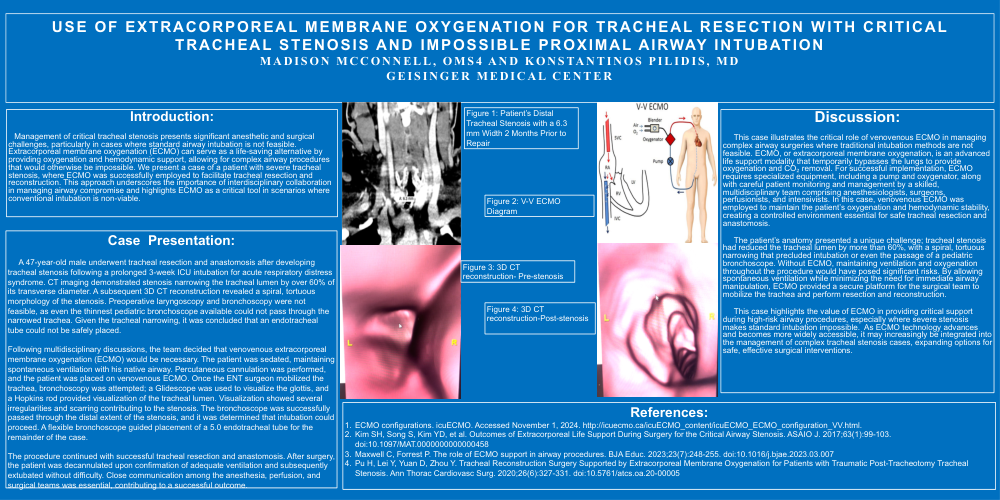
A 47-year-old male underwent tracheal resection and anastomosis after developing tracheal stenosis following a prolonged 3-week ICU intubation for acute respiratory distress syndrome. CT imaging demonstrated stenosis narrowing the tracheal lumen by over 60% of its transverse diameter. A subsequent 3D CT reconstruction revealed a spiral, tortuous morphology of the stenosis. Preoperative laryngoscopy and bronchoscopy were not feasible, as even the thinnest pediatric bronchoscope available could not pass through the narrowed trachea. Given the tracheal narrowing, it was concluded that an endotracheal tube could not be safely placed.
Following multidisciplinary discussions, the team decided that venovenous extracorporeal membrane oxygenation (ECMO) would be necessary. The patient was sedated, maintaining spontaneous ventilation with his native airway. Percutaneous cannulation was performed, and the patient was placed on venovenous ECMO. Once the ENT surgeon mobilized the trachea, bronchoscopy was attempted; a Glidescope was used to visualize the glottis, and a Hopkins rod provided visualization of the tracheal lumen. Visualization showed several irregularities and scarring contributing to the stenosis. The bronchoscope was successfully passed through the distal extent of the stenosis, and it was determined that intubation could proceed. A flexible bronchoscope guided placement of a 5.0 endotracheal tube for the remainder of the case.
The procedure continued with successful tracheal resection and anastomosis. After surgery, the patient was decannulated upon confirmation of adequate ventilation and subsequently extubated without difficulty. Close communication among the anesthesia, perfusion, and surgical teams was essential, contributing to a successful outcome.
Discussion:
This case illustrates the critical role of venovenous ECMO in managing complex airway surgeries where traditional intubation methods are not feasible. ECMO, or extracorporeal membrane oxygenation, is an advanced life support modality that temporarily bypasses the lungs to provide oxygenation and CO₂ removal. For successful implementation, ECMO requires specialized equipment, including a pump and oxygenator, along with careful patient monitoring and management by a skilled, multidisciplinary team comprising anesthesiologists, surgeons, perfusionists, and intensivists. In this case, venovenous ECMO was employed to maintain the patient’s oxygenation and hemodynamic stability, creating a controlled environment essential for safe tracheal resection and anastomosis.
The patient’s anatomy presented a unique challenge; tracheal stenosis had reduced the tracheal lumen by more than 60%, with a spiral, tortuous narrowing that precluded intubation or even the passage of a pediatric bronchoscope. Without ECMO, maintaining ventilation and oxygenation throughout the procedure would have posed significant risks. By allowing spontaneous ventilation while minimizing the need for immediate airway manipulation, ECMO provided a secure platform for the surgical team to mobilize the trachea and perform resection and reconstruction.
This case highlights the value of ECMO in providing critical support during high-risk airway procedures, especially where severe stenosis makes standard intubation impossible. As ECMO technology advances and becomes more widely accessible, it may increasingly be integrated into the management of complex tracheal stenosis cases, expanding options for safe, effective surgical interventions.
References: