334 posters, 125 sessions, 831 authors, 236 institutions
ePostersLive by SciGen Technologies S.A. All rights reserved.
78th Annual PostGraduate Assembly in Anesthesiology (PGA78) 2024
December 6 - 9, 2024 | New York City

3207
Unraveling the Heat: A Case Report of Malignant Hyperthermia
Poster Presenter
Authors
Affiliations
Part of Topic
Unraveling the Heat: A Case Report of Malignant Hyperthermia
Rachel Barkley, M.D. and Wendy Bernstein, M.D., M.B.A., FASA, FAMWA
Boston Medical Center
Learning Objectives:
● To recognize the signs and symptoms of malignant hyperthermia (MH)
● To review the appropriate therapies for MH
● To review a recent clinical case to understand the importance of promptly
treating a patient who shows subtle signs of MH
Case Presentation:
● 31 yo male with BMI 40 and no prior surgical history presented for tibial plateau fixation
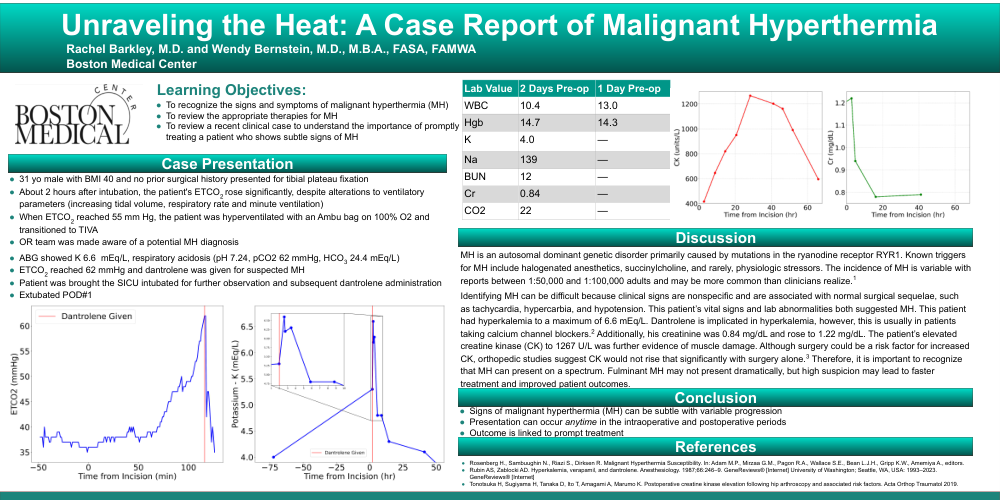
● About 2 hours after intubation, the patient's ETCO2 rose significantly, despite alterations to ventilatory
parameters (increasing tidal volume, respiratory rate and minute ventilation)
● When ETCO2 reached 55 mm Hg, the patient was hyperventilated with an Ambu bag on 100% O2 and
transitioned to TIVA
● OR team was made aware of a potential MH diagnosis
● ABG showed K 6.6 mEq/L, respiratory acidosis (pH 7.24, pCO2 62 mmHg, HCO3 24.4 mEq/L)
● ETCO2 reached 62 mmHg and dantrolene was given for suspected MH
● Patient was brought the SICU intubated for further observation and subsequent dantrolene administration
● Extubated POD#1
Discussion:
MH is an autosomal dominant genetic disorder primarily caused by mutations in the ryanodine receptor RYR1. Known triggers
for MH include halogenated anesthetics, succinylcholine, and rarely, physiologic stressors. The incidence of MH is variable with
reports between 1:50,000 and 1:100,000 adults and may be more common than clinicians realize.1
Identifying MH can be difficult because clinical signs are nonspecific and are associated with normal surgical sequelae, such
as tachycardia, hypercarbia, and hypotension. This patient’s vital signs and lab abnormalities both suggested MH. This patient
had hyperkalemia to a maximum of 6.6 mEq/L. Dantrolene is implicated in hyperkalemia, however, this is usually in patients
taking calcium channel blockers.2 Additionally, his creatinine was 0.84 mg/dL and rose to 1.22 mg/dL. The patient’s elevated
creatine kinase (CK) to 1267 U/L was further evidence of muscle damage. Although surgery could be a risk factor for increased
CK, orthopedic studies suggest CK would not rise that significantly with surgery alone.3 Therefore, it is important to recognize
that MH can present on a spectrum. Fulminant MH may not present dramatically, but high suspicion may lead to faster
treatment and improved patient outcomes.
Conclusions:
● Signs of malignant hyperthermia (MH) can be subtle with variable progression
● Presentation can occur anytime in the intraoperative and postoperative periods
● Outcome is linked to prompt treatment
References:
● Rosenberg H., Sambuughin N., Riazi S., Dirksen R. Malignant Hyperthermia Susceptibility. In: Adam M.P., Mirzaa G.M., Pagon R.A., Wallace S.E., Bean L.J.H., Gripp K.W., Amemiya A., editors.
● Rubin AS, Zablocki AD. Hyperkalemia, verapamil, and dantrolene. Anesthesiology. 1987;66:246–9. GeneReviews® [Internet] University of Washington; Seattle, WA, USA: 1993–2023. GeneReviews® [Internet]
● Tonotsuka H, Sugiyama H, Tanaka D, Ito T, Amagami A, Marumo K. Postoperative creatine kinase elevation following hip arthroscopy and associated risk factors. Acta Orthop Traumatol 2019.