334 posters, 125 sessions, 831 authors, 236 institutions
ePostersLive by SciGen Technologies S.A. All rights reserved.
78th Annual PostGraduate Assembly in Anesthesiology (PGA78) 2024
December 6 - 9, 2024 | New York City

3021
Balancing End-Of-Life Needs with an Anesthetic Plan: A Medically Challenging Case Involving The Full Stomach and the Anterior Mediastinal Mass
Poster Presenter
Authors
Kevin Hui, Shelley Kramer, Shireen Pais, Bernadette Pasamba-Rakhlin
Affiliations
Part of Topic
Balancing End-of-Life Needs with the Anesthetic Plan:
A Medically Challenging Case of the Full Stomach
and the Anterior Mediastinal Mass
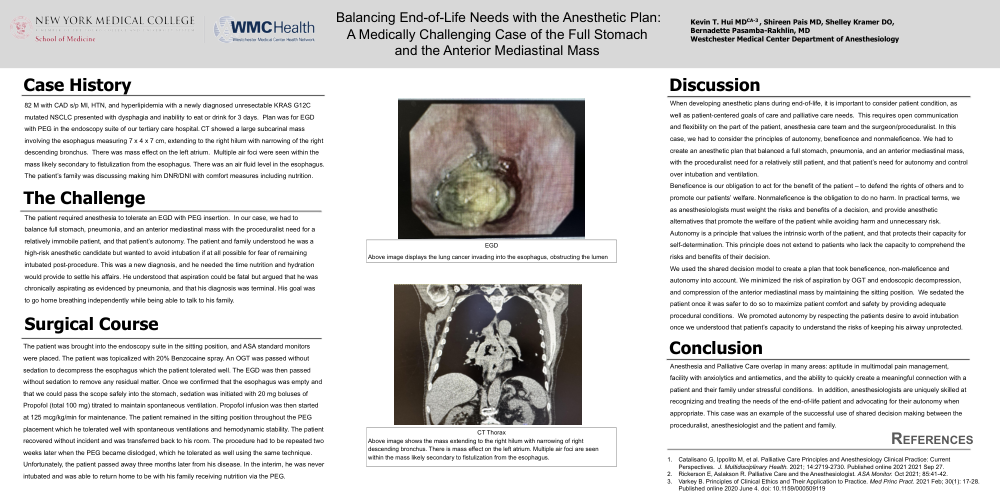
82 M with CAD s/p MI, HTN, and hyperlipidemia with a newly diagnosed unresectable KRAS G12C
mutated NSCLC presented with dysphagia and inability to eat or drink for 3 days. Plan was for EGD
with PEG in the endoscopy suite of our tertiary care hospital. CT showed a large subcarinal mass
involving the esophagus measuring 7 x 4 x 7 cm, extending to the right hilum with narrowing of the right
descending bronchus. There was mass effect on the left atrium. Multiple air foci were seen within the
mass likely secondary to fistulization from the esophagus. There was an air fluid level in the esophagus.
The patient’s family was discussing making him DNR/DNI with comfort measures including nutrition.
The patient required anesthesia to tolerate an EGD with PEG insertion. In our case, we had to
balance full stomach, pneumonia, and an anterior mediastinal mass with the proceduralist need for a
relatively immobile patient, and that patient’s autonomy. The patient and family understood he was a
high-risk anesthetic candidate but wanted to avoid intubation if at all possible for fear of remaining
intubated post-procedure. This was a new diagnosis, and he needed the time nutrition and hydration
would provide to settle his affairs. He understood that aspiration could be fatal but argued that he was
chronically aspirating as evidenced by pneumonia, and that his diagnosis was terminal. His goal was
to go home breathing independently while being able to talk to his family.
The patient was brought into the endoscopy suite in the sitting position, and ASA standard monitors
were placed. The patient was topicalized with 20% Benzocaine spray. An OGT was passed without
sedation to decompress the esophagus which the patient tolerated well. The EGD was then passed
without sedation to remove any residual matter. Once we confirmed that the esophagus was empty and
that we could pass the scope safely into the stomach, sedation was initiated with 20 mg boluses of
Propofol (total 100 mg) titrated to maintain spontaneous ventilation. Propofol infusion was then started
at 125 mcg/kg/min for maintenance. The patient remained in the sitting position throughout the PEG
placement which he tolerated well with spontaneous ventilations and hemodynamic stability. The patient
recovered without incident and was transferred back to his room. The procedure had to be repeated two
weeks later when the PEG became dislodged, which he tolerated as well using the same technique.
Unfortunately, the patient passed away three months later from his disease. In the interim, he was never
intubated and was able to return home to be with his family receiving nutrition via the PEG.
When developing anesthetic plans during end-of-life, it is important to consider patient condition, as
well as patient-centered goals of care and palliative care needs. This requires open communication
and flexibility on the part of the patient, anesthesia care team and the surgeon/proceduralist. In this
case, we had to consider the principles of autonomy, beneficence and nonmaleficence. We had to
create an anesthetic plan that balanced a full stomach, pneumonia, and an anterior mediastinal mass,
with the proceduralist need for a relatively still patient, and that patient’s need for autonomy and control
over intubation and ventilation.
Beneficence is our obligation to act for the benefit of the patient – to defend the rights of others and to
promote our patients’ welfare. Nonmaleficence is the obligation to do no harm. In practical terms, we
as anesthesiologists must weight the risks and benefits of a decision, and provide anesthetic
alternatives that promote the welfare of the patient while avoiding harm and unnecessary risk.
Autonomy is a principle that values the intrinsic worth of the patient, and that protects their capacity for
self-determination. This principle does not extend to patients who lack the capacity to comprehend the
risks and benefits of their decision.
We used the shared decision model to create a plan that took beneficence, non-maleficence and
autonomy into account. We minimized the risk of aspiration by OGT and endoscopic decompression,
and compression of the anterior mediastinal mass by maintaining the sitting position. We sedated the
patient once it was safer to do so to maximize patient comfort and safety by providing adequate
procedural conditions. We promoted autonomy by respecting the patients desire to avoid intubation
once we understood that patient’s capacity to understand the risks of keeping his airway unprotected.
Anesthesia and Palliative Care overlap in many areas: aptitude in multimodal pain management,
facility with anxiolytics and antiemetics, and the ability to quickly create a meaningful connection with a
patient and their family under stressful conditions. In addition, anesthesiologists are uniquely skilled at
recognizing and treating the needs of the end-of-life patient and advocating for their autonomy when
appropriate. This case was an example of the successful use of shared decision making between the
proceduralist, anesthesiologist and the patient and family.