334 posters, 125 sessions, 831 authors, 236 institutions
ePostersLive by SciGen Technologies S.A. All rights reserved.
78th Annual PostGraduate Assembly in Anesthesiology (PGA78) 2024
December 6 - 9, 2024 | New York City

3196
Anesthesia Considerations in the Management of the Patient with Achondroplasia
Poster Presenter
Authors
Affiliations
Part of Topic
Anesthesia Considerations in Management of the Patient with Achondroplasia
Introduction
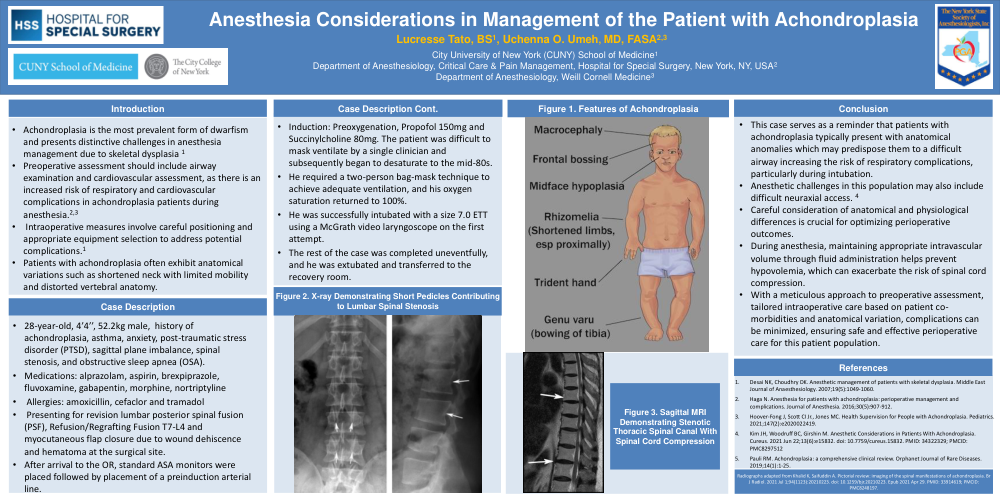
Achondroplasia is the most prevalent form of dwarfism and presents distinctive challenges in anesthesia management due to skeletal dysplasia
• Preoperative assessment should include airway examination and cardiovascular assessment, as there is an increased risk of respiratory and cardiovascular complications in achondroplasia patients during anesthesia.
• Intraoperative measures involve careful positioning and appropriate equipment selection to address potential complications.
• Patients with achondroplasia often exhibit anatomical variations such as shortened neck with limited mobility and distorted vertebral anatomy.
Case Description
28-year-old, 4'4'', 52.2kg male, history of achondroplasia, asthma, anxiety, post-traumatic stress disorder (PTSD), sagittal plane imbalance, spinal stenosis, and obstructive sleep apnea (OSA).
• Medications: alprazolam, aspirin, brexpiprazole, fluvoxamine, gabapentin, morphine, nortriptyline
• Allergies: amoxicillin, cefaclor and tramadol
• Presenting for revision lumbar posterior spinal fusion (PSF), Refusion/Regrafting Fusion T7-L4 and myocutaneous flap closure due to wound dehiscence and hematoma at the surgical site.
• After arrival to the OR, standard ASA monitors were placed followed by placement of a preinduction arterial line.
Induction: Preoxygenation, Propofol 150mg and Succinylcholine 80mg. The patient was difficult to mask ventilate by a single clinician and subsequently began to desaturate to the mid-80s.
• He required a two-person bag-mask technique to achieve adequate ventilation, and his oxygen saturation returned to 100%.
• He was successfully intubated with a size 7.0 ETT using a McGrath video laryngoscope on the first attempt.
• The rest of the case was completed uneventfully, and he was extubated and transferred to the recovery room.
Conclusion
• This case serves as a reminder that patients with achondroplasia typically present with anatomical anomalies which may predispose them to a difficult airway increasing the risk of respiratory complications, particularly during intubation.
• Anesthetic challenges in this population may also include difficult neuraxial access.
• Careful consideration of anatomical and physiological differences is crucial for optimizing perioperative outcomes.
• During anesthesia, maintaining appropriate intravascular volume through fluid administration helps prevent hypovolemia, which can exacerbate the risk of spinal cord compression.
• With a meticulous approach to preoperative assessment, tailored intraoperative care based on patient co-morbidities and anatomical variation, complications can be minimized, ensuring safe and effective perioperative care for this patient population.
References
Desai NK, Choudhry DK. Anesthetic management of patients with skeletal dysplasia. Middle East
Journal of Anaesthesiology. 2007;19(5):1049-1060.
Haga N. Anesthesia for patients with achondroplasia: perioperative management and
complications. Journal of Anesthesia. 2016;30(5):907-912.
Hoover-Fong J, Scott CI Jr., Jones MC. Health Supervision for People with Achondroplasia. Pediatrics.
2021;147(2):e2020022419.
Kim JH, Woodruff BC, Girshin M. Anesthetic Considerations in Patients With Achondroplasia.
Cureus. 2021 Jun 22;13(6):e15832. doi: 10.7759/cureus.15832. PMID: 34322329; PMCID:
PMC8297512
Pauli RM. Achondroplasia: a comprehensive clinical review. Orphanet Journal of Rare Diseases.
2019;14(1):1-25.