334 posters, 125 sessions, 831 authors, 236 institutions
ePostersLive by SciGen Technologies S.A. All rights reserved.
78th Annual PostGraduate Assembly in Anesthesiology (PGA78) 2024
December 6 - 9, 2024 | New York City

3195
Post-operative nausea and vomiting prophylaxis and management in Parkinson’s patients taking monoamine oxidase inhibitors
Poster Presenter
Authors
Affiliations
Part of Topic
PONV Prophylaxis and Management in Parkinson’s Patients Taking MAOi’s
Jennifer Chong, BA1; Ariel Engelman, MD2
1Albany Medical College; 2Albany Medical Center, Department of Anesthesiology
•Parkinson's disease (PD) is the second most common neurodegenerative disease worldwide, with the prevalence of disease increasing with age.1
•The management of Parkinson's patients during the perioperative period can be complicated by disruption of medication schedules, medication interactions and medication side effects.1
•
•Monoamine oxidase inhibitors (MAOI) are commonly used as adjuvant treatment for Parkinson’s disease (PD) to alleviate motor complications.2
•
•Myths and misunderstandings around MAOIs have led to the historical recommendation to discontinue these medications two weeks prior to surgery.2
•
•Patients with PD who experience PONV can have limited choices for prevention and treatment due to their age and medication interactions.
•
• This case report reviews the multi-factorial considerations of PONV prophylaxis and treatment in Parkinson’s patients on MAOIs.
•This case involved a 78-year-old male presenting for a laparoscopic cholecystectomy.
•
•The patient is a non-smoker and was noted to have a history of post-operative nausea and vomiting (PONV) and motion-sickness.
•
•This patient’s past medical history includes Parkinson’s disease diagnosed 9 years ago.
•
•He reports good functional status and that his Parkinson’s symptoms are well-controlled on carbidopa/levodopa (Sinemet) and selegiline (Eldepryl).
•Pre-operatively, the patient’s possible medication interactions were reviewed carefully in consideration this patient’s age group and home medications.
•
•The decision was made to utilize total intravenous anesthesia (TIVA) to reduce his risk of PONV, prophylactic dexamethasone after induction, and ondansetron to treat any symptoms postoperatively.
•
•The patient had an uneventful intraoperative and postoperative course and made a full recovery without interruption of his current medication regimen.
•The management of Parkinson's patients during the perioperative period can be challenging and result in medical complications, prolonged hospital stays, and delayed recovery.1
•
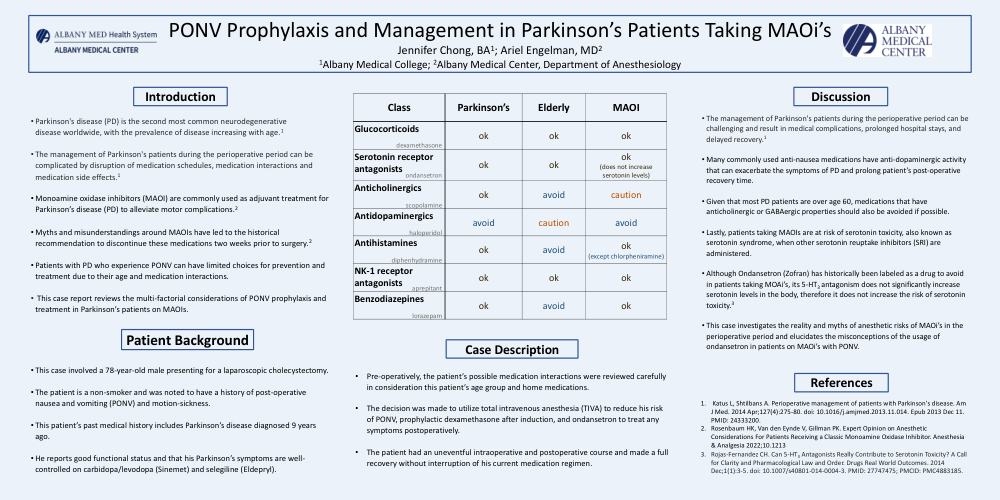
•Many commonly used anti-nausea medications have anti-dopaminergic activity that can exacerbate the symptoms of PD and prolong patient’s post-operative recovery time.
•
•Given that most PD patients are over age 60, medications that have anticholinergic or GABAergic properties should also be avoided if possible.
•
•Lastly, patients taking MAOIs are at risk of serotonin toxicity, also known as serotonin syndrome, when other serotonin reuptake inhibitors (SRI) are administered.
•
•Although Ondansetron (Zofran) has historically been labeled as a drug to avoid in patients taking MOAi’s, its 5-HT3 antagonism does not significantly increase serotonin levels in the body, therefore it does not increase the risk of serotonin toxicity.3
•
•This case investigates the reality and myths of anesthetic risks of MAOi’s in the perioperative period and elucidates the misconceptions of the usage of ondansetron in patients on MAOi’s with PONV.
1. Katus L, Shtilbans A. Perioperative management of patients with Parkinson's disease. Am J Med. 2014 Apr;127(4):275-80. doi: 10.1016/j.amjmed.2013.11.014. Epub 2013 Dec 11. PMID: 24333200.
2.Rosenbaum HK, Van den Eynde V, Gillman PK. Expert Opinion on Anesthetic Considerations For Patients Receiving a Classic Monoamine Oxidase Inhibitor. Anesthesia & Analgesia 2022;10.1213
Rojas-Fernandez CH. Can 5-HT3 Antagonists Really Contribute to Serotonin Toxicity? A Call for Clarity and Pharmacological Law and Order. Drugs Real World Outcomes. 2014 Dec;1(1):3-5. doi: 10.1007/s40801-014-0004-3. PMID: 27747475; PMCID: PMC4883185