334 posters, 125 sessions, 831 authors, 236 institutions
ePostersLive by SciGen Technologies S.A. All rights reserved.
78th Annual PostGraduate Assembly in Anesthesiology (PGA78) 2024
December 6 - 9, 2024 | New York City

3194
Urgent laparotomy and salpingectomy secondary to ectopic pregnancy in a patient requiring VA ECMO after ventricular fibrillation cardiac arrest at home
Poster Presenter
Authors
Alexandra Tsivitis, Derek Atkinson, Andrew Feit, Naomi Nguyen
Affiliations
Part of Topic
Urgent laparotomy and salpingectomy secondary to ectopic pregnancy in a patient requiring VA ECMO after ventricular fibrillation cardiac arrest at home
Alexandra Tsivitis DO1, Derek Atkinson, MD1, Naomi Nguyen BS2,Andrew Feit, MD FASA 1
1. Department of Anesthesiology, 2. Renaissance School of Medicine, Stony Brook University, Stony Brook, NY, 11794
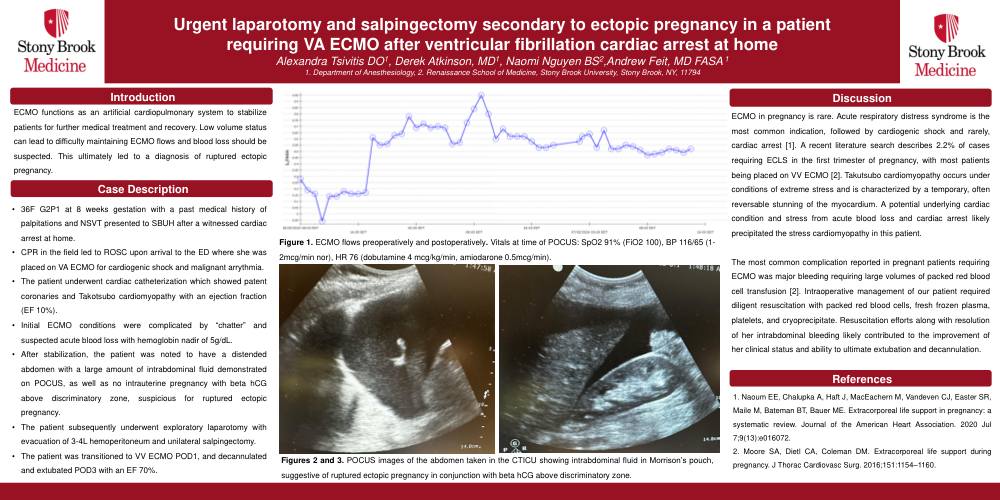
Introduction: ECMO functions as an artificial cardiopulmonary system to stabilize patients for further medical treatment and recovery. Low volume status can lead to difficulty maintaining ECMO flows and blood loss should be suspected. This ultimately led to a diagnosis of ruptured ectopic pregnancy
Case Description:
Discussion:
ECMO in pregnancy is rare. Acute respiratory distress syndrome is the most common indication, followed by cardiogenic shock and rarely, cardiac arrest [1]. A recent literature search describes 2.2% of cases requiring ECLS in the first trimester of pregnancy, with most patients being placed on VV ECMO [2]. Takutsubo cardiomyopathy occurs under conditions of extreme stress and is characterized by a temporary, often reversable stunning of the myocardium. A potential underlying cardiac condition and stress from acute blood loss and cardiac arrest likely precipitated the stress cardiomyopathy in this patient.
1. Naoum EE, Chalupka A, Haft J, MacEachern M, Vandeven CJ, Easter SR, Maile M, Bateman BT, Bauer ME. Extracorporeal life support in pregnancy: a systematic review. Journal of the American Heart Association. 2020 Jul 7;9(13):e016072.
2. Moore SA, Dietl CA, Coleman DM. Extracorporeal life support during pregnancy. J Thorac Cardiovasc Surg. 2016;151:1154–1160.