Loading...

334 posters, 125 sessions, 831 authors, 236 institutions

ePostersLive by SciGen Technologies S.A. All rights reserved.

3191

Remote management of bupropion toxicity: a tale of telemedicine, seizures, and QT prolongation
Part of Topic

Remote management of bupropion toxicity: a tale of telemedicine, seizures, and QT prolongation

Rebecca Bulmer, M.B., B.Ch., B.A.O.1, Mark T. Keegan, MB, MRCPI, D.ABA, FCCM2.
1Resident, Mayo Clinic School of Graduate Medical Education, Anesthesiology and Perioperative Medicine, 2 Consultant, Division of Intensive Care and Respiratory Therapy, Department of Anesthesiology and Perioperative Medicine, Mayo Clinic and Mayo Clinic College of Medicine and Science, Rochester, MN, USA

ABSTRACT

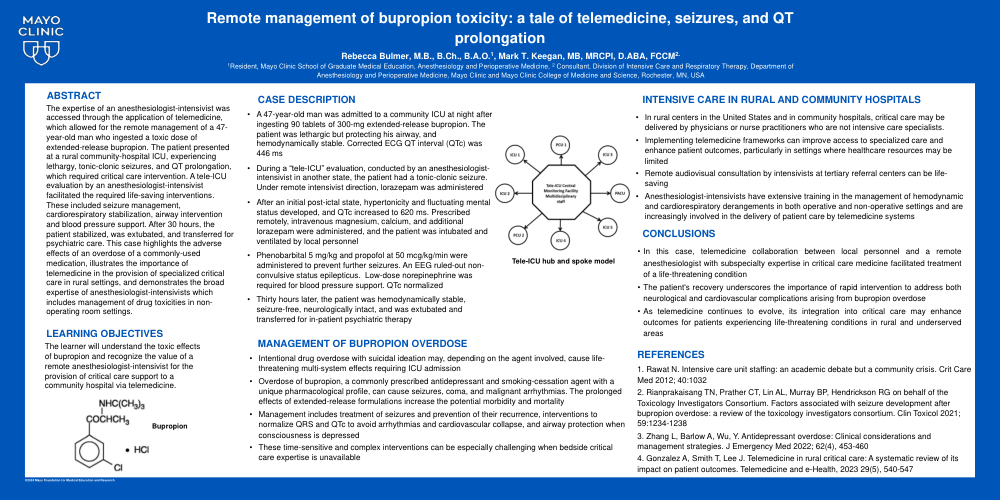
The expertise of an anesthesiologist-intensivist was accessed through the application of telemedicine, which allowed for the remote management of a 47-year-old man who ingested a toxic dose of extended-release bupropion. The patient presented at a rural community-hospital ICU, experiencing lethargy, tonic-clonic seizures, and QT prolongation, which required critical care intervention. A tele-ICU evaluation by an anesthesiologist-intensivist facilitated the required life-saving interventions. These included seizure management, cardiorespiratory stabilization, airway intervention and blood pressure support. After 30 hours, the patient stabilized, was extubated, and transferred for psychiatric care. This case highlights the adverse effects of an overdose of a commonly-used medication, illustrates the importance of telemedicine in the provision of specialized critical care in rural settings, and demonstrates the broad expertise of anesthesiologist-intensivists which includes management of drug toxicities in non-operating room settings.

LEARNING OBJECTIVES

The learner will understand the toxic effects of bupropion and recognize the value of a remote anesthesiologist-intensivist for the provision of critical care support to a community hospital via telemedicine.

CASE DESCRIPTION

•A 47-year-old man was admitted to a community ICU at night after ingesting 90 tablets of 300-mg extended-release bupropion. The patient was lethargic but protecting his airway, and hemodynamically stable. Corrected ECG QT interval (QTc) was 446 ms
•During a “tele-ICU” evaluation, conducted by an anesthesiologist-intensivist in another state, the patient had a tonic-clonic seizure. Under remote intensivist direction, lorazepam was administered
•After an initial post-ictal state, hypertonicity and fluctuating mental status developed, and QTc increased to 620 ms. Prescribed remotely, intravenous magnesium, calcium, and additional lorazepam were administered, and the patient was intubated and ventilated by local personnel
•Phenobarbital 5 mg/kg and propofol at 50 mcg/kg/min were administered to prevent further seizures. An EEG ruled-out non-convulsive status epilepticus.  Low-dose norepinephrine was required for blood pressure support. QTc normalized
•Thirty hours later, the patient was hemodynamically stable, seizure-free, neurologically intact, and was extubated and transferred for in-patient psychiatric therapy

MANAGEMENT OF BUPROPION OVERDOSE

•Intentional drug overdose with suicidal ideation may, depending on the agent involved, cause life-threatening multi-system effects requiring ICU admission
•Overdose of bupropion, a commonly prescribed antidepressant and smoking-cessation agent with a unique pharmacological profile, can cause seizures, coma, and malignant arrhythmias. The prolonged effects of extended-release formulations increase the potential morbidity and mortality
•Management includes treatment of seizures and prevention of their recurrence, interventions to normalize QRS and QTc to avoid arrhythmias and cardiovascular collapse, and airway protection when consciousness is depressed
•These time-sensitive and complex interventions can be especially challenging when bedside critical care expertise is unavailable
 

INTENSIVE CARE IN RURAL AND COMMUNITY HOSPITALS

•In rural centers in the United States and in community hospitals, critical care may be delivered by physicians or nurse practitioners who are not intensive care specialists.
•Implementing telemedicine frameworks can improve access to specialized care and enhance patient outcomes, particularly in settings where healthcare resources may be limited
•Remote audiovisual consultation by intensivists at tertiary referral centers can be life-saving
•Anesthesiologist-intensivists have extensive training in the management of hemodynamic and cardiorespiratory derangements in both operative and non-operative settings and are increasingly involved in the delivery of patient care by telemedicine systems
 

CONCLUSIONS

•In this case, telemedicine collaboration between local personnel and a remote anesthesiologist with subspecialty expertise in critical care medicine facilitated treatment of a life-threatening condition
•The patient's recovery underscores the importance of rapid intervention to address both neurological and cardiovascular complications arising from bupropion overdose
•As telemedicine continues to evolve, its integration into critical care may enhance outcomes for patients experiencing life-threatening conditions in rural and underserved areas
 
REFERENCES

1. Rawat N. Intensive care unit staffing: an academic debate but a community crisis. Crit Care Med 2012; 40:1032

2. Rianprakaisang TN, Prather CT, Lin AL, Murray BP, Hendrickson RG on behalf of the Toxicology Investigators Consortium. Factors associated with seizure development after bupropion overdose: a review of the toxicology investigators consortium. Clin Toxicol 2021; 59:1234-1238

3. Zhang L, Barlow A, Wu, Y. Antidepressant overdose: Clinical considerations and management strategies. J Emergency Med 2023; 62(4), 453-460

4. Gonzalez A, Smith T, Lee J. Telemedicine in rural critical care: A systematic review of its impact on patient outcomes. Telemedicine and e-Health, 2023 29(5), 540-547


78th Annual PostGraduate Assembly in Anesthesiology (PGA78) 2024 » banner
Copyright © 2015-2026, ePostersLive® SciGen is a registered trademark of SciGen Technologies S.A. Patent pending.

This website and third-party tools we use rely on cookies for the best user experience. By selecting "I agree", you agree to cookie usage as described in our Privacy Policy.
