334 posters, 125 sessions, 831 authors, 236 institutions
ePostersLive by SciGen Technologies S.A. All rights reserved.
78th Annual PostGraduate Assembly in Anesthesiology (PGA78) 2024
December 6 - 9, 2024 | New York City

3184
Vanishing Phantom Limb Pain Following Adductor Canal and Sciatic Nerve Block with Peripheral Nerve Catheter Infusion
Poster Presenter
Authors
Samuel Greenberg, Wesam Andraous M.D., Vincent Bargnes, Katrina Kerolus, Eman Nada
Affiliations
Part of Topic
We present the case of 67-year-old male with a complex history including end-stage renal disease, heart failure, cerebrovascular disease, and significant peripheral arterial disease status-post bilateral below-the-knee amputations more than a year previously, who presented for elective surgical debridement of a chronic wound on the left lower limb stump. The patient suffered from chronic residual neuropathic and phantom limb pain following failed pharmacologic, surgical, and functional therapy.
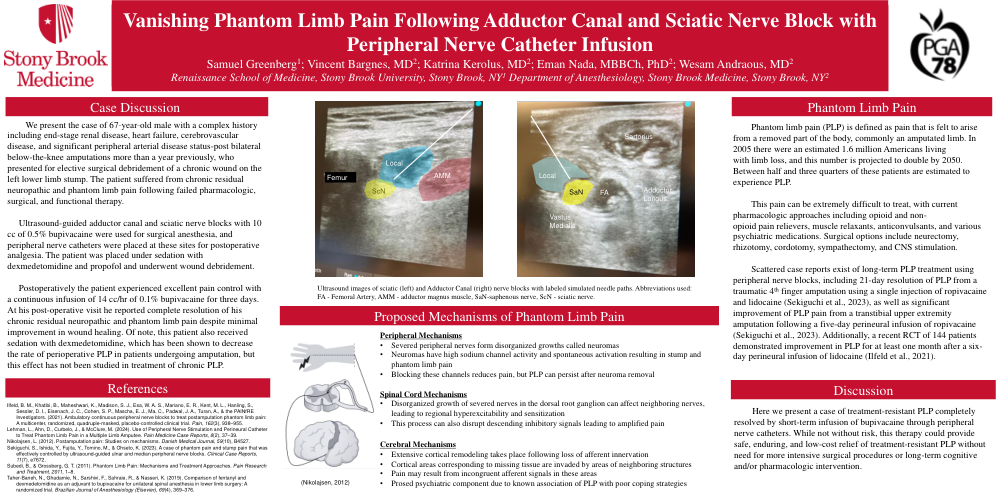
Ultrasound-guided adductor canal and sciatic nerve blocks with 10 cc of 0.5% bupivacaine were used for surgical anesthesia, and peripheral nerve catheters were placed at these sites for postoperative analgesia. The patient was placed under sedation with dexmedetomidine and propofol and underwent wound debridement.
Postoperatively the patient experienced excellent pain control with a continuous infusion of 14 cc/hr of 0.1% bupivacaine for three days. At his post-operative visit he reported complete resolution of his chronic residual neuropathic and phantom limb pain despite minimal improvement in wound healing. Of note, this patient also received sedation with dexmedetomidine, which has been shown to decrease the rate of perioperative PLP in patients undergoing amputation, but this effect has not been studied in treatment of chronic PLP.
Phantom limb pain (PLP) is defined as pain that is felt to arise from a removed part of the body, commonly an amputated limb. In 2005 there were an estimated 1.6 million Americans living with limb loss, and this number is projected to double by 2050. Between half and three quarters of these patients are estimated to experience PLP.
This pain can be extremely difficult to treat, with current pharmacologic approaches including opioid and non-opioid pain relievers, muscle relaxants, anticonvulsants, and various psychiatric medications. Surgical options include neurectomy, rhizotomy, cordotomy, sympathectomy, and CNS stimulation.
Scattered case reports exist of long-term PLP treatment using peripheral nerve blocks, including 21-day resolution of PLP from a traumatic 4th finger amputation using a single injection of ropivacaine and lidocaine (Sekiguchi et al., 2023), as well as significant improvement of PLP pain from a transtibial upper extremity amputation following a five-day perineural infusion of ropivacaine (Sekiguchi et al., 2023). Additionally, a recent RCT of 144 patients demonstrated improvement in PLP for at least one month after a six-day perineural infusion of lidocaine (Ilfeld et al., 2021).
Here we present acase of treatment-resistant PLP completely resolved by short-term infusion of bupivacaine through peripheral nerve catheters. While not without risk, this therapy could provide safe, enduring, and low-cost relief of treatment-resistant PLP without need for more intensive surgical procedures or long-term cognitive and/or pharmacologic intervention.