334 posters, 125 sessions, 831 authors, 236 institutions
ePostersLive by SciGen Technologies S.A. All rights reserved.
78th Annual PostGraduate Assembly in Anesthesiology (PGA78) 2024
December 6 - 9, 2024 | New York City

3180
Peripheral Nerve Stimulator for Treatment of Intractable Complex Regional Pain Syndrome, Type 2
Poster Presenter
Part of Topic
Learning Objective
To explore the potential role of 60-day peripheral nerve stimulators (PNS) in the treatment of Complex Regional Pain Syndrome (CRPS) refractory to other established treatment modalities.
Case Description
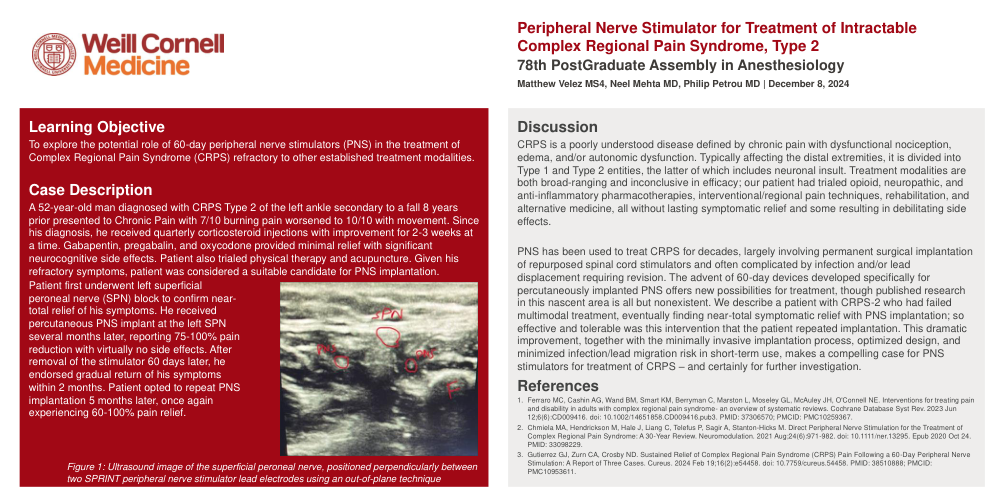
A 52-year-old man diagnosed with CRPS Type 2 of the left ankle secondary to a fall 8 years prior presented to Chronic Pain with 7/10 burning pain worsened to 10/10 with movement. Since his diagnosis, he received quarterly corticosteroid injections with improvement for 2-3 weeks at a time. Gabapentin, pregabalin, and oxycodone provided minimal relief with significant neurocognitive side effects. Patient also trialed physical therapy and acupuncture. Given his refractory symptoms, patient was considered a suitable candidate for PNS implantation. Patient first underwent left superficial peroneal nerve (SPN) block to confirm near-total relief of his symptoms. He received percutaneous PNS implant at the left SPN several months later, reporting 75-100% pain reduction with virtually no side effects. After removal of the stimulator 60 days later, he endorsed gradual return of his symptoms within 2 months. Patient opted to repeat PNS implantation 5 months later, once again experiencing 60-100% pain relief.
Discussion
CRPS is a poorly understood disease defined by chronic pain with dysfunctional nociception, edema, and/or autonomic dysfunction. Typically affecting the distal extremities, it is divided into Type 1 and Type 2 entities, the latter of which includes neuronal insult. Treatment modalities are both broad-ranging and inconclusive in efficacy; our patient had trialed opioid, neuropathic, and anti-inflammatory pharmacotherapies, interventional/regional pain techniques, rehabilitation, and alternative medicine, all without lasting symptomatic relief and some resulting in debilitating side effects.
PNS has been used to treat CRPS for decades, largely involving permanent surgical implantation of repurposed spinal cord stimulators and often complicated by infection and/or lead displacement requiring revision. The advent of 60-day devices developed specifically for percutaneously implanted PNS offers new possibilities for treatment, though published research in this nascent area is all but nonexistent. We describe a patient with CRPS-2 who had failed multimodal treatment, eventually finding near-total symptomatic relief with PNS implantation; so effective and tolerable was this intervention that the patient repeated implantation. This dramatic improvement, together with the minimally invasive implantation process, optimized design, and minimized infection/lead migration risk in short-term use, makes a compelling case for PNS stimulators for treatment of CRPS – and certainly for further investigation.
Sources
- Ferraro MC, Cashin AG, Wand BM, Smart KM, Berryman C, Marston L, Moseley GL, McAuley JH, O'Connell NE. Interventions for treating pain and disability in adults with complex regional pain syndrome- an overview of systematic reviews. Cochrane Database Syst Rev. 2023 Jun 12;6(6):CD009416. doi: 10.1002/14651858.CD009416.pub3. PMID: 37306570; PMCID: PMC10259367.
- Chmiela MA, Hendrickson M, Hale J, Liang C, Telefus P, Sagir A, Stanton-Hicks M. Direct Peripheral Nerve Stimulation for the Treatment of Complex Regional Pain Syndrome: A 30-Year Review. Neuromodulation. 2021 Aug;24(6):971-982. doi: 10.1111/ner.13295. Epub 2020 Oct 24. PMID: 33098229.
- Gutierrez GJ, Zurn CA, Crosby ND. Sustained Relief of Complex Regional Pain Syndrome (CRPS) Pain Following a 60-Day Peripheral Nerve Stimulation: A Report of Three Cases. Cureus. 2024 Feb 19;16(2):e54458. doi: 10.7759/cureus.54458. PMID: 38510888; PMCID: PMC10953611.